








Nigeria’s states generated a remarkable ₦3.78 trillion in Value Added Tax (VAT) during the first half of 2026, underscoring the country’s growing tax base despite persistent economic challenges. Lagos alone accounted for ₦1.81 trillion, representing nearly half of the total VAT generated nationwide, followed by Rivers (₦560.04 billion), Oyo (₦253.67 billion) and the Federal Capital Territory (₦182.93 billion).
At first glance, these figures suggest an economy gathering momentum. Rising VAT collections are often interpreted as evidence of stronger business activity, higher consumer spending and improved tax administration. Governments frequently point to such revenue growth as proof that economic reforms are beginning to yield results.
Yet for millions of Nigerians, these impressive numbers tell only part of the story. The most pressing question is not how much VAT the government is collecting, but whether ordinary citizens are becoming better off.
Rising Tax Revenue Does Not Always Mean Rising Prosperity
VAT is fundamentally a consumption tax. As economic activity expands, governments naturally expect VAT receipts to increase. Improved tax compliance, digital payment systems and stronger tax administration can also contribute to higher collections. However, higher VAT revenue does not necessarily indicate that households are experiencing greater prosperity.
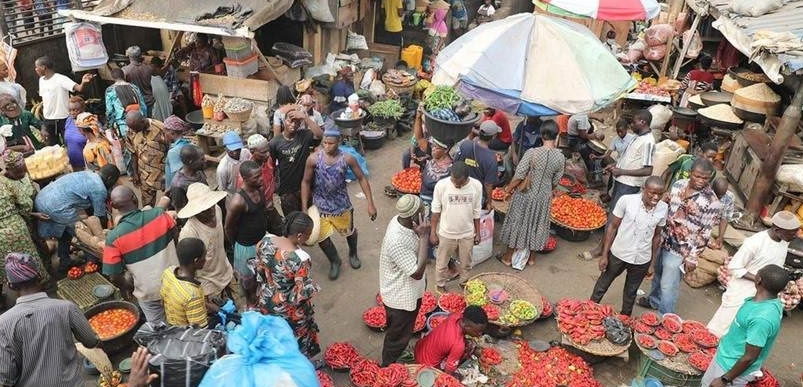
Nigeria’s recent tax gains have coincided with one of the country’s most difficult cost-of-living crises in decades. Following the removal of petrol subsidies, exchange-rate reforms and persistent inflation, Nigerians have faced significantly higher prices for food, transportation, electricity and essential goods.
Consequently, higher VAT collections may partly reflect higher prices rather than substantially higher consumption or improved living standards.
World Bank’s Warning Should Temper Celebration
Celebrating rising government revenues without considering household welfare risks overlooking a much deeper economic challenge.
In its most recent assessment of Nigeria, the World Bank warned that approximately 79 percent of Nigerians are either living in poverty or remain vulnerable to falling into poverty. While recent macroeconomic reforms have begun improving fiscal stability, the Bank notes that millions of households continue to struggle with high inflation, weak purchasing power and declining real incomes.
The implication is profound – An economy can generate record tax revenues while the majority of its citizens continue to face economic hardship. Indeed, rising VAT collections may partly reflect inflation itself. When prices increase sharply, consumers pay more VAT even if they are buying fewer goods. Governments therefore collect more revenue without households becoming more prosperous.
Revenue Growth Must Translate into Better Public Services

Taxation is not an end in itself. Citizens generally accept paying taxes because they expect governments to provide quality public services in return. This includes better roads, reliable electricity, functional schools, accessible healthcare and stronger security.
The International Monetary Fund (IMF) has consistently argued that domestic revenue mobilisation is essential for sustainable development. However, it also stresses that higher tax revenues should create fiscal space for productive public investment and stronger social protection, particularly for vulnerable households.
Without visible improvements in public services and living standards, higher tax collections risk being perceived merely as increasing the financial burden on citizens.
The surge in VAT revenue demonstrates that Nigeria’s tax system is generating more resources for government. That is an important achievement. But tax statistics should never become substitutes for measures of human well-being.
The World Bank has repeatedly emphasised that inclusive economic growth is ultimately measured by improvements in people’s welfare, reductions in poverty and expanded economic opportunities—not simply by stronger fiscal indicators. Until rising government revenues translate into more affordable food, reliable electricity, quality healthcare, better schools, stronger job creation and higher real incomes, record VAT collections will remain a fiscal success that many Nigerians struggle to celebrate.
The true measure of Nigeria’s economic progress is not how much tax government collects, but whether the people paying those taxes experience a better quality of life.
Conclusion
Nigeria’s record ₦3.78 trillion VAT collection is undoubtedly a positive fiscal milestone, but it should not be mistaken for evidence of broad-based prosperity. As long as the World Bank estimates that nearly 79% of Nigerians are poor or vulnerable to poverty, the true measure of economic success remains whether government revenues translate into better jobs, lower living costs and improved quality of life. Ultimately, strong public finances are meaningful only when ordinary Nigerians share in the benefits of economic growth.