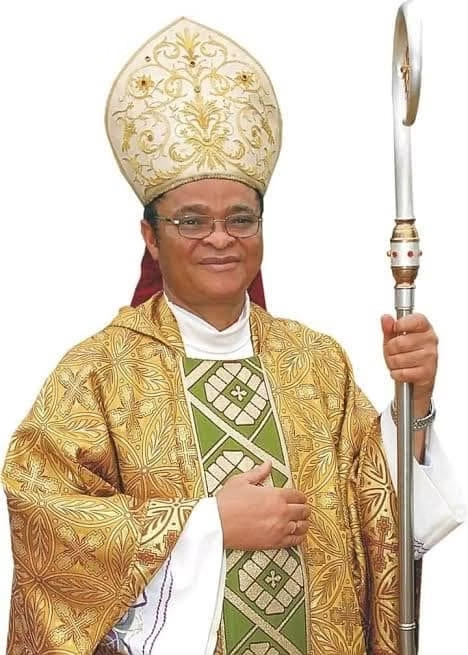





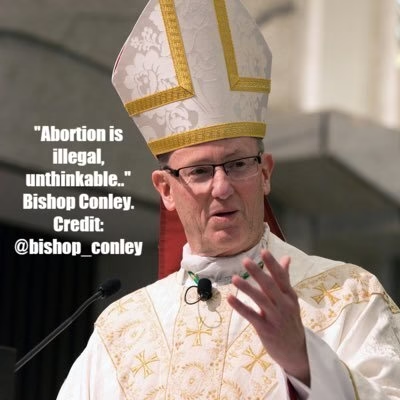
A courageous and determined Catholic Bishop in the US has reaffirmed the importance of safeguarding life from inception to natural death in a recent compelling message directed at young people.
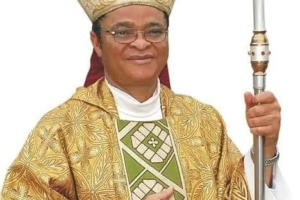
In his homily at the Opening Mass of the 2026 National Prayer Vigil for Life, held at the Basilica of the National Shrine of the Immaculate Conception in Washington, D.C., Bishop James D. Conley of Lincoln, Nebraska, encouraged the youth to take the lead in the pro-life movement.
Abortion is “illegal, unthinkable.”
The Bishop who championed the cause of building a culture of life said, “Our goal is not only to make abortion illegal…unthinkable.”
Based on the teaching of the Catholic Church, abortion is outlawed based on the foundational belief that human life is sacred and must be respected absolutely from the moment of conception.
The three core theological and moral teachings are based on the sanctity of life, the fact that life begins at conception, abortion is a grave moral evil and its universal application.
The Church teaches that every human being is made in the image of God and possesses an inherent right to life.
Additionally,human life, as a distinct individual with its own genetic code, begins at fertilization. From this first moment, an embryo must be recognized as having the rights of a person.
Procured abortion is considered a “mortal sin” and an “intrinsic evil”; that is why the Church characterises it as the deliberate killing of an innocent human being, violating the Fifth Commandment (“Thou shalt not kill”).
Based on universal application, thesanctity of life is regarded as unchangeable and applies regardless of circumstances, including cases of rape, incest, or fetal deformity.
Meanwhile,addressing the youth like Jesus, the good shepherd, Bishop Conley said, “My dear young people, you are the pro-life generation.”
According to the 70-year-old prelate, I have said to young people in my own diocese, young people of your generation, that I strongly believe that 50 years from now, when my generation will have gone to God, your grandchildren will ask you, ‘Is it true that when you were my age, they our children to death from the womb?’”
Canonical and Social Implications Vs Forgiveness and Mercy
In the Catholic Church, procuring an abortion can result in excommunication due to its canonical and social implications under Canon Law.
It states that any Catholic who successfully procures a completed abortion or formally cooperates in one incurs automatic (latae sententiae) excommunication (Canon 1397 §2).
However, the Church allows certain medical procedures under specific circumstances, such as the “Principle of Double Effect.”
This principle applies to cases like ectopic pregnancies or uterine cancer, where the primary intent is to save the mother’s life, even if the death of the fetus is a foreseen but unintended consequence.
To emphasise the importance of mercy, forgiveness, and the salvation of souls as paramount, the Church affirms that the sin of abortion is forgivable.
For example, in 2016, Pope Francis granted all priests the authority to absolve the sin of abortion and lift the associated excommunication for those who genuinely seek forgiveness with a repentant heart.
Conclusion
Organisations such as Prolife, Project Rachel and Rachel’s Vineyard provide spiritual and psychological healing for individuals impacted by abortion.
The Church urges voters to oppose legislation that permits abortion, emphasising that the right to life serves as the foundation for all other human rights.
Counsel from leaders like Bishop Conley calls for political responsibility, urging the government to protect life from conception until natural death.