
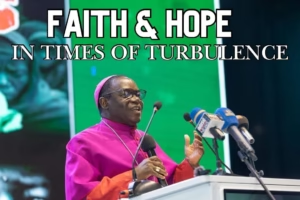

Nigeria’s outspoken cleric and the Catholic Bishop of Sokoto Diocese, Most Rev. Matthew Hassan Kukah, has criticised the government for its failure to ensure the safety of lives and property.
During a recent interview on the current affairs program Frontline, aired on Eagle 102.5 FM in Ilese Ijebu, Kukah lamented the pervasive hypocrisy in the country, linking it to the current deficit of trust among the populace.
“Theatre of lies” fuels systemic hypocrisy.
The impassioned cleric, who referred to the current situation as a “theatre of lies,” indicated that religion must take precedence over politics.
The pulpit should hold greater significance than the political podium, he noted, clarifying that the issue lies not in religion interfering with politics, but rather in “politicians disobeying what they hear in Churches and Mosques.”
The 73-year-old prelate emphasised that violence stems from the “conflict between obedience and disobedience.”
He explained that a failure to uphold moral values ultimately leads to the collapse of governance, eroding the trust between the government and its citizens.
Using the metaphor of “filling stations,” the public intellectual argued that churches and mosques should serve to equip individuals with the moral and ethical values essential for fostering a just society.
The convener of The Kukah Centre and the National Peace Committee in Abuja remarked that the purported combination of “kinetic and non-kinetic strategies” to address the persistent security challenges in the country remains largely rhetorical and ambiguous.
The Bishop expressed concern over the peace initiative introduced by the Katsina State government, which emphasises the release of suspected bandits, warning that this fosters a perilous culture that rewards criminal behaviour.
The pioneer Pro-Chancellor and Chairman of the Governing Council of the Federal University of Applied Sciences in Kachia, Kaduna State, who has held the position since March 2025, lamented the situation in a country that has become accustomed to rewarding misconduct.
He emphasised that this is evident in appointments, elections, and now within the realm of security.
In response to the recent initial denial by security agencies regarding the abduction of over 170 worshippers in Kaduna State, Kukah characterised the situation as indicative of a profound credibility deficit, underscoring that it reveals the nation’s fractured crisis management system.
Christian genocide controversy
Following the Bishop’s remarks at the launch of the 2025 World Report on Religious Freedom in Vatican City on 21 October 2025 and during the 46th Supreme Convention of the Knights of St. Mulumba in Kaduna on 28 November 2025, social media erupted with insinuations suggesting that the esteemed prelate, known for his unwavering voice of conscience amid the turbulent landscape of Nigerian politics, has altered his position on the persecution of Christians in the West African nation.
In a statement issued by Fr. Dr. Atta Barkindo, the director of the Kukah Centre in Abuja, it was clarified that “at no point has His Lordship diminished the gravity of the crisis of faith-based persecution in various regions of Nigeria, nor has he failed to resonate with the very real suffering it inflicts.”
Referencing paragraph 5 of the 13-paragraph speech delivered at the Vatican on 21 October, Barkindo emphasised that Bishop Kukah stated, “The inability of the federal government and its security agencies to halt these killings has fostered the conditions for the genocide that has engulfed many communities today.”
“The inability of the federal government and its security agencies to halt these killings has fostered the conditions for the genocide that has engulfed many communities today.” – Kukah
He underscored that His Lordship conveyed to the world, “By whatever names we choose, the fact remains that Nigerians are dying unacceptable deaths across the nation. In numerous instances, they are targeted due to their beliefs and, in many cases, their ethnicity.”
He further clarified the matter by explaining that, based on international criminal law, it is always difficult for prosecutors to establish genocide claims on the basis of physical harm alone, as the intent of the perpetrators must be established beyond a reasonable doubt.
Article I of the Genocide Convention defines genocide as requiring both “a mental element”—the intent to destroy, in whole or in part, a national, ethnic, racial, or religious group—and “a physical element,” which includes killing members of the group, causing serious harm, inflicting conditions to cause physical destruction, preventing births, and forcibly transferring children.
Charismatic persona, advocacy, social critique
The political scientist and social commentator who has served as the Bishop of Sokoto Diocese since September 8, 2011, is widely recognised for his advocacy of justice, democracy, and interreligious dialogue in Nigeria and throughout Africa.
Born on August 31, 1952, in Anchuna, Zangon Kataf, Kaduna State, Kukah pursued his studies in Theology and Philosophy at St. Augustine Major Seminary in Jos, Plateau State.

Bishop Kukah with Pope Leo during a visit to the Vatican
He was ordained as a priest for the Kaduna diocese on December 19, 1976, and he earned a PhD in Political Science from the School of Oriental and African Studies (SOAS) at the University of London in 1990.
In addition, he obtained a Master’s degree in Public Policy from Harvard University’s Kennedy School of Government, where he was an Edward Mason Fellow, as well as another Master’s in Peace Studies from the University of Bradford, UK, in 1980. Kukah graduated with a Bachelor of Divinity from the Pontifical Urban University in Rome in 1976 and has held various ecclesiastical and public service roles.
His notable positions include Senior Rhodes Fellow at St. Anthony’s College, Oxford (2001–2003), Secretary of the National Political Conference (2005), a member of the Electoral Reform Committee (2007–2009), and Pro-Chancellor and Chairman of the Council at Nasarawa State University, Keffi.
He also served as the Secretary General of the Catholic Bishops’ Conference of Nigeria from 1994 to 2000 and was a member of the Human Rights Violation Investigation Commission (Oputa Panel) from 1999 to 2001.
He acted as Chairman of the Ogoni-Shell Reconciliation Committee and served as Secretary of the National Political Reform Conference in 2005.
As a prominent advocate for Christian-Muslim relations, he is a member of the Pontifical Council for Interreligious Dialogue at the Vatican.
“The fact remains that Nigerians are dying unacceptable deaths across the nation. In numerous instances, they are targeted due to their beliefs and, in many cases, their ethnicity.” – Kukah
An accomplished author, he is known for his blockbuster titles such as “Religion, Politics and Power in Northern Nigeria,” “Witness to Justice: An Insider’s Account of Nigeria’s Truth Commission,” “Democracy and Civil Society in Nigeria,” and “Broken Truths: Nigeria’s Elusive Quest for National Cohesion.”
Renowned for his commitment to “truth-telling” and his critiques of the Nigerian political elite across various administrations, Kukah’s advocacy led to the establishment of The Kukah Centre (TKC) in 2012.
This non-profit policy research institute focuses on governance, active citizenship, and national development.
Conclusion
During the launch of the ACN 2025 World Report on Religious Freedom at the Augustinianum Hall, the Bishop expressed concerns about the potential redesignation of Nigeria as a “Country of Concern.”
In his address, titled “A Plea and Testimony from Nigeria,” he argued that such a designation could undermine ongoing dialogue and reconciliation efforts.
For the second time in five years, Nigeria was designated a CPC by the US government, in both cases by President Donald Trump. The first time was in 2020, but the designation was removed in 2021.
The designation is more than a mere label, as it represents an official classification under the U.S. International Religious Freedom Act (IRFA) of 1998 with huge foreign policy implications.
Countries found to encourage or tolerate severe violations of religious freedom face economic sanctions, international isolation, strained bilateral relations and targeting of terrorists and their sympathisers, including the freezing of their assets.
Kukah called on international partners to support local initiatives that promote inclusion and foster peace.
Cardinal Pietro Parolin, who presented ACN’s findings, revealed that over 5.4 billion people reside in countries where religious freedom is routinely violated.
At the event, which marked 25 years of ACN’s commitment to advocating for religious freedom, Kukah emphasised that despite these challenges, “Nigeria still has a window of opportunity to rebuild trust, strengthen unity, and demonstrate to the world that faith can heal rather than divide.”
This is the way to go: Africans narrating their own stories.
Soar high and higher Advocatus Africa!
Thank you for your positive comment @James. We keep working towards a better continent!
Bishop Matthew Kukah has been a man of conscience and has never misfired with his thoughts and reflection in private or public audiences. Christian persecution in Nigeria is not recent. It has been the birth of Nigeria in all sectors of life such as appointments, recruitment into the Nigerian military, promotions, admissions into tertiary institutions and teaching of Christian religious education.
Thank you, Fr. Dr. Tim Barga for your positive comments. We pray for more voices of conscience like Bishop Kukah towards a better country!
My Lord is a prophet of truth and a man of letters. Very articulate, and logical in his coherent submissions. We thank God for blessing us with his personality.
Thank you Philemon for reading our story and for your commendation of Bishop’s advocacy for a better Nigeria!