
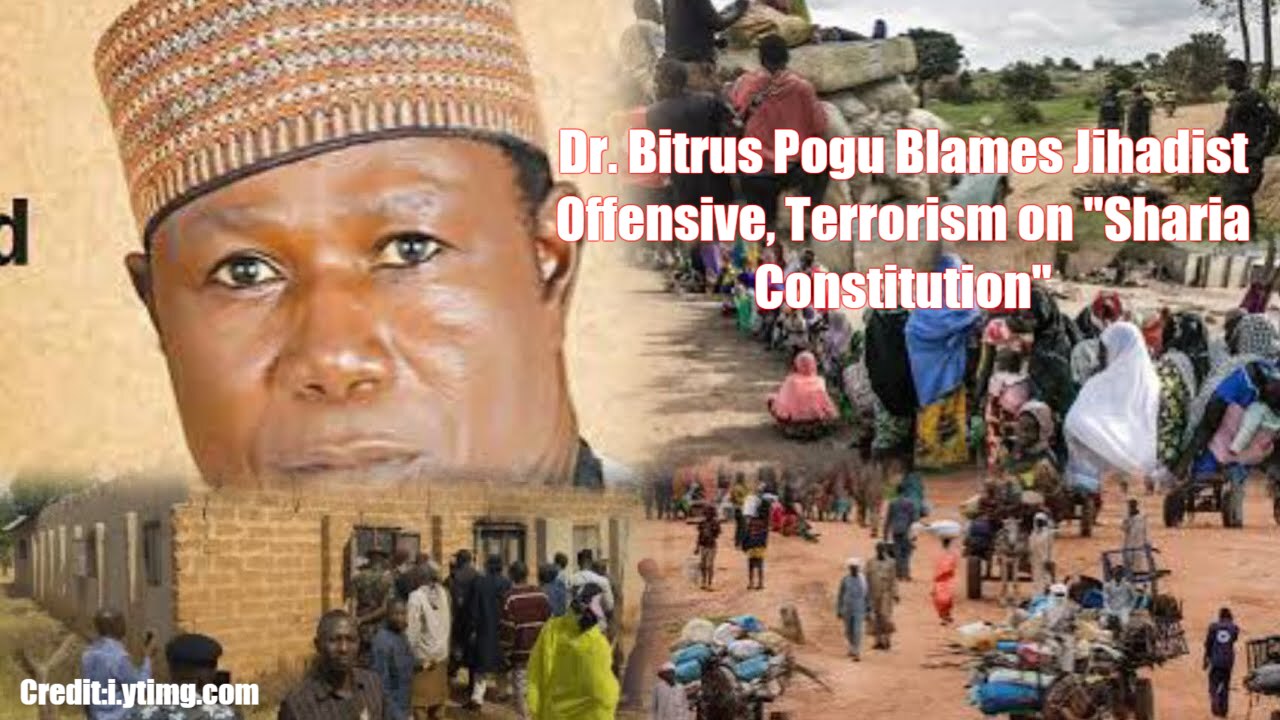
Amid increasing levels of the destruction of lives and property across Nigeria’s Middle Belt by suspected Islamists, which led to the deployment of about 200 American troops into the West African nation, a prominent leader in the region has blamed the situation on what he called “a Sharia constitution.”
Dr. Bitrus Pogu, President of the Middle Belt Forum (MBF), who spoke in the light of the prevailing circumstances of terrorism, banditry, abductions, and relentless killings in Nigeria, coupled with a plethora of national social unrest, blamed the problem on the complexity of the 1999 Constitution.
The Dual Constitution Conundrum
Speaking recently on SYMFONI during an interview, Dr. Pogu stated that, “The truth about the matter is our constitution has become a Sharia constitution whether we like it or not. That is the truth.”
He emphasised that “The 1999 Constitution is a Sharia constitution because as I mentioned in one interview, there are up to 73 mentions of sharia in that constitution, about 28 mentions of Islam in that constitution, about 10 mentions of Muslims in that Constitution.
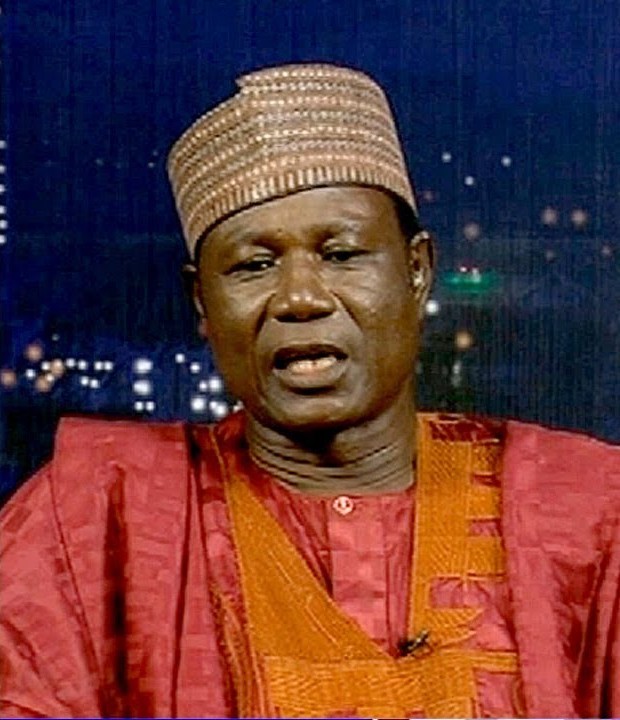
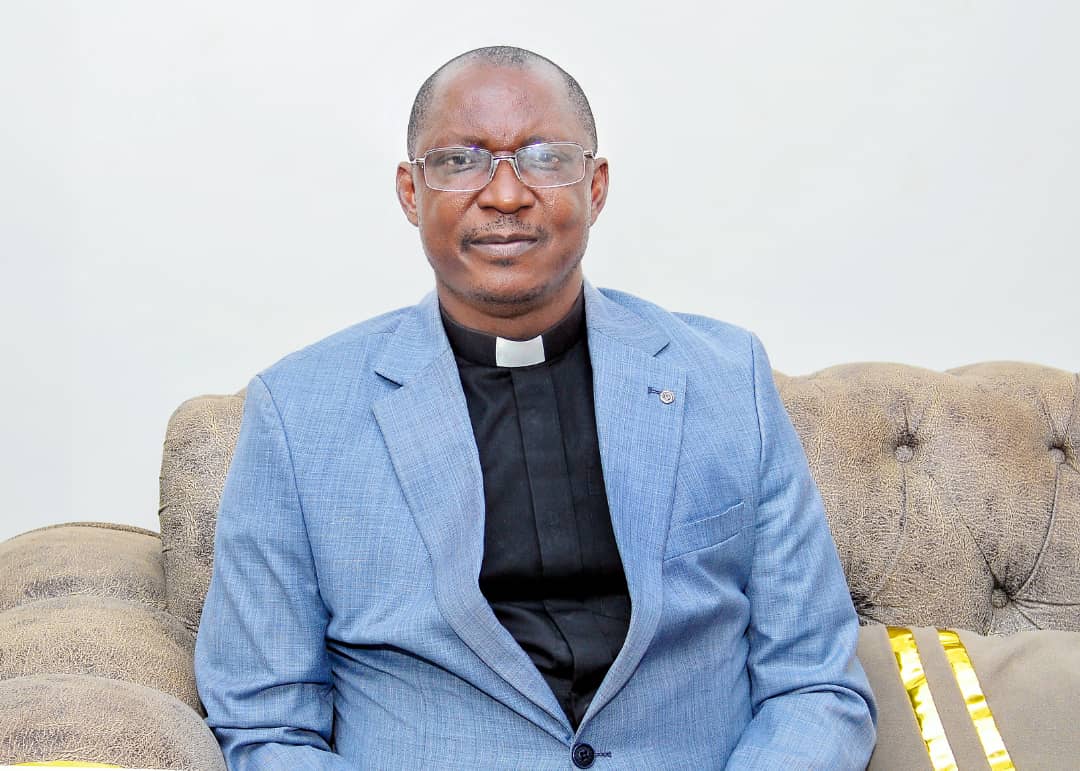
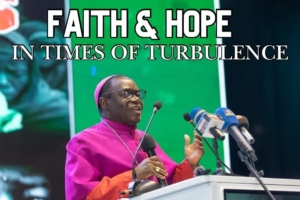
Dr. Bitrus Pogu, President of the Middle Belt Forum (MBF). Credit: i.ytimg.com
“There is no mention of Christian or Christianity in that Constitution. That means at least Christians don’t exist in this country. That is the truth. We cannot shy away from it.”
He lamented that, “And the National Assembly members know this, but the problem with this country is that we have cowards in positions of power who even when they know the truth are unable to speak up and say gentlemen, this doesn’t suit the so called secularity of the Constitution.”
The MBF President insisted that “Our Constitution is not secular. Our Constitution is a Sharia Constitution and that is where we have problems today, including the insurgency in the name of Sharia. So with Sharia, whether you like it or not, that is what will continue to happen, unless it is crushed.”
Jihadists’ Eldorado World: Non-Kinetic Approach Untenable
Regarding the non-kinetic approach and negotiations with insurgents, the indigene of Borno State noted that “Negotiations will not work. Anybody who says non-kinetic, that is the funniest terminology I have heard. Somebody who thinks that if he kills and if he dies trying to kill for his faith, he is going above to meet some beautiful facilities beyond what he gets here, is in the mind. You can’t change him through some non-kinetic something. He is out there to kill or be killed.”
Dr. Pogu queried, “If somebody will voluntarily go and blow himself up, just because he feels he’s going to be rewarded, how do you solve the problem through some non-kinetic approach?” but surmised, “So the issue is, it will not stop, this thing will not stop, unless it is crushed.”
On the claim that not only Christians are attacked or killed, the advocate for political restructuring claimed that Muslims’ attack is a ploy to change the narrative, but Christians are the main target.
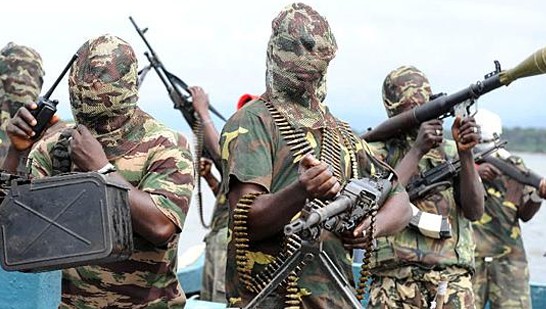
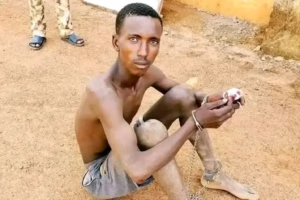
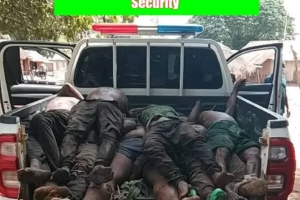
Suspected Terrorists. Credit: Osun Defender
According to him, “Whether you like it or not, it is not only Christians that are attacked in this process. They (the insurgents) can sacrifice people just to change the narrative. So the agenda continues and it will not abate unless it is crushed. Anybody who tells you that the agenda will subside through some negotiations is just deceiving you. Unless it is crushed, it will continue.”
He described a video by the late Boko Haram leader, Abubakar Shekau, saying, “The first video production by late Shekau, if he is late. Shekau said after the bombing of Gada Biyu in Jos. I got the video, I still have it. He said in Hausa, ‘we are the ones who conducted this thing in the Sultaniya, the place called Plateau or Jos. We did it because what you hear is not just as what you have seen, because our people have been killed.’
“He (Shekau) mentioned Zangon Kataf and so many other places, and he said, they are not fighting a political war, they are not fighting for money, but they are fighting a religious war. He said, ‘It is a war between Muslims and Christians.’ And then he warned Muslims that any Muslim who assists any unbeliever in the war should consider himself dead.”
Jihadism “will not end till Islam is the determinant of governance in Nigeria.”
Mr. Pogu further affirmed that some Muslims are used as “sacrificial lambs,” stressing that “So if Muslims are being attacked in the war, that is one reason. Two, he (Shekau, Boko Haram leader) continued, and said, ‘it will not end’, as a summary, because he said other things before that, ‘till Islam is the determinant of governance in Nigeria.’ It will not end till Islam is the determinant of governance in Nigeria. So will it stop? We have not gotten there yet.”
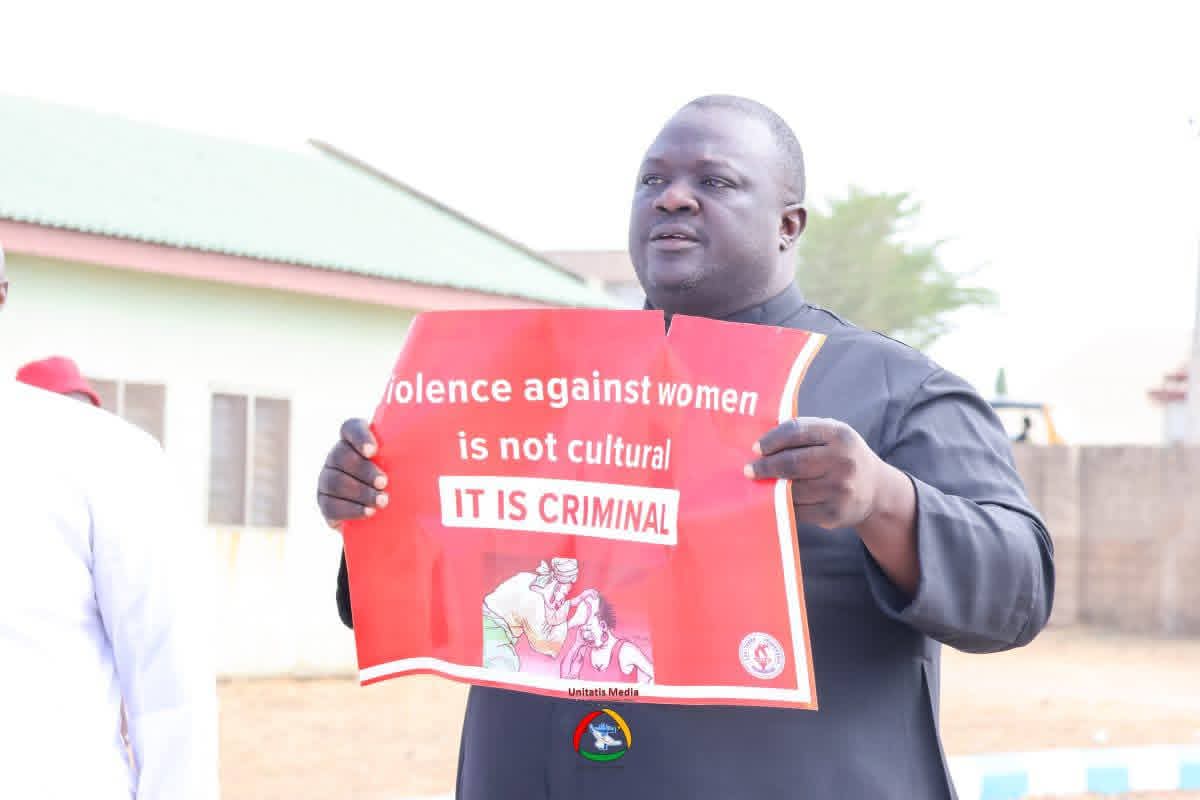
Very Rev. Fr. Peter Tari, Administrator of Our Lady Queen of Peace Cathedral Jalingo, during a recent peaceful protest against incessant killings in Southern Taraba.
For context, Nigeria is a heterogeneous country with diverse cultures and religions, but the Sharia criminal penal code, which aligns with Islamic legal principles, has been domesticated in about 12 states of Northern Nigeria where Christians and non-Muslims are domiciled.
Christians in Northern Nigeria have persistently expressed fears with regard to the Sharia penal code, indicating fears of systematic persecution, marginalisation, and violation of constitutional rights, citing examples of blasphemy laws, restrictions on religious freedom, and increased violence by extremist groups.
The Middle Belt Region
Although not recognised in the Constitution, Middle Belters fought against Usman dan Fodio’s jihad (1804-1809).
The region is diverse in cultural, ethnic, and religious composition, with major tribes such as Idoma, Tiv, Ngas, Berom, Gbagyi/Gbari, Jukun, Tangale, Igala, Ebira, Nupe, Igede.
It would be recalled that in the 1950s, through the United Middle Belt Congress (UMBC), a veteran Tiv Icon, Joseph Tarka, fought against northern domination and southern neglect, advocating for what experts call “regional self-determination within Nigeria’s federal structure.”

The Middle Belt Region. Credit: pbs.twimg.com
Although contentious, the region which comprises states such as Plateau, Benue, Kogi, Kwara, Niger, Taraba, Nasarawa, and the Federal Capital Territory (Abuja) serves as a bridge between a largely Muslim North and a predominantly Christian South.
Because of the fertile arable land, lush green grass, and valleys from Southern Kaduna through Plateau to Benue, the region often attracts herders who clash with farmers because their crops are destroyed by cattle.
Beyond the farmer-herder rhetoric widely reported by some sections of the media, Mr. Pogu’s position points to religious motives for the constant attacks in the region by suspected Fulani Militia, who often chant Allahu Akbar (God is the greatest), giving the killings a religious signature.