




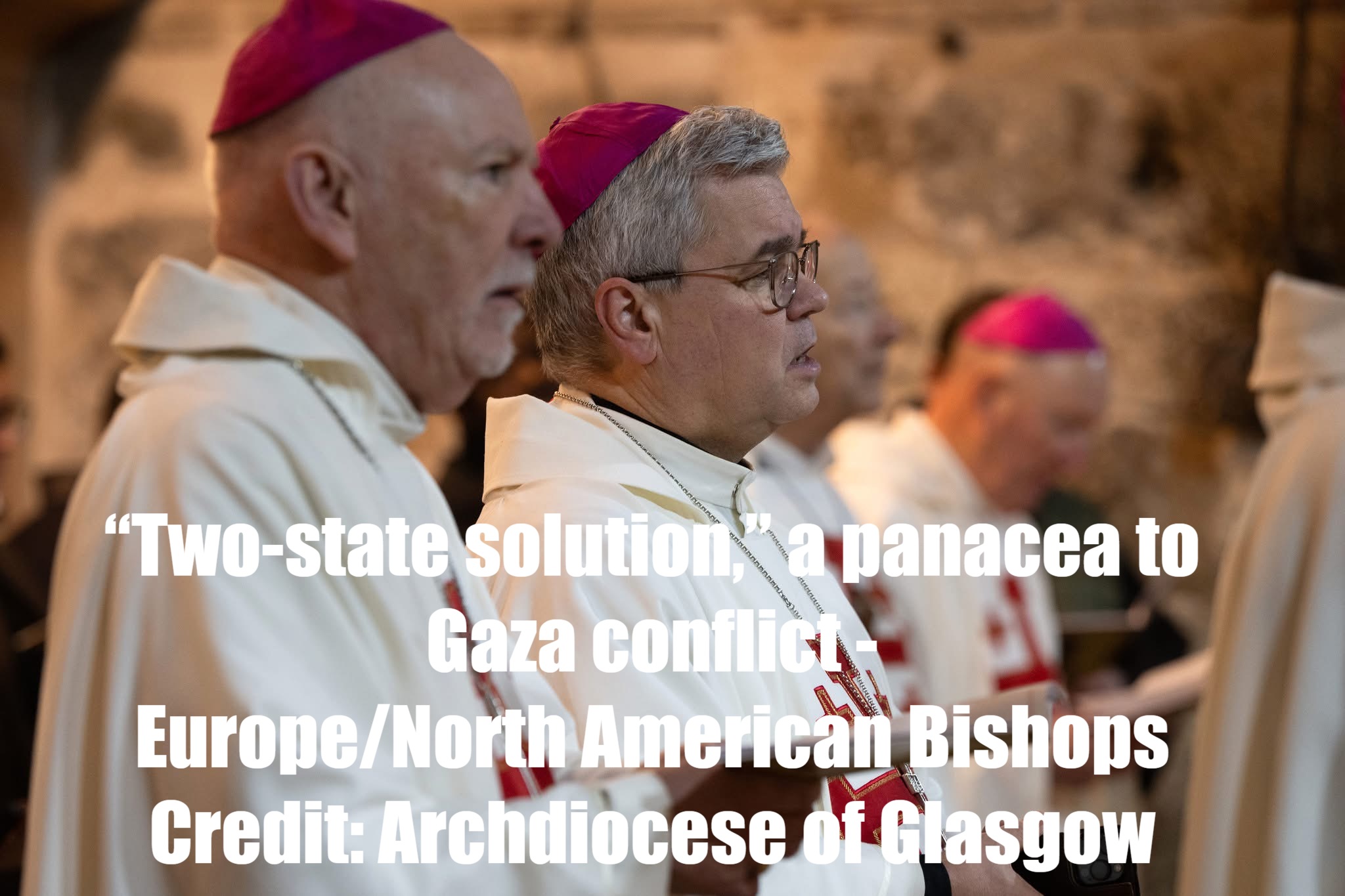
Catholic Bishops from Europe and North America have made a strong case for upholding human rights within Israeli and Palestinian society, urging all parties in the region to embrace dialogue and reconciliation.
This disclosure, contained in a final communique made available by the Archdiocese of Glasgow, indicated that the Church leaders who went under the aegis of the international “Holy Land Coordination” called for an immediate end to the Israeli military occupation of the West Bank.
The Bishops urged global governments and experts to put pressure on Israel to uphold the “rules-based international order” while demanding meaningful negotiations towards “a two-state solution.”
The prelates urged the international community to address the catastrophic humanitarian crisis in Gaza occasioned by a system of occupation in the West Bank, which threatens human dignity.
Like the apostles, the Church fathers visited the Bedouin communities in the West Bank, where they saw evidence of the destructive impact of “extremist settler violence.”
A group of Israeli and Palestinian parents who have all lost children to the conflict but found the strength to work together, called The Parents Circle – Families Forum, advocated for justice, reconciliation and peace for everyone.
Another group, Rabbis for Human Rights, which represented the voice of Jewish tradition in human rights, urged policymakers to safeguard human rights for all.
The non-partisan organization, which draws over 170 rabbis and students from all denominations, disclosed that they work with the conviction that every person is created in the image of God.
During the visit, the Bishops echoed the call of Cardinal Pierbattista Pizzaballa, the Latin Patriarch of Jerusalem, for the international community to support a return to the Holy Land on pilgrimage as a tangible sign of support and solidarity.
At The Rossing Center for Education and Dialogue, a Jerusalem-based interreligious organisation, the Bishops underscored the need for interreligious and political dialogue among Jews, Christians and Muslims.
The body met with leading Palestinian and Israeli peace activists while experiencing first-hand the inhuman conditions of the Bedouin communities and Christian villages under pressure.
For the bishops, it was a five-day working experience of the devastating effect of war, advocacy and “listening” to those “at the margins.”