








The latest agreement between the United Kingdom (UK) and Nigeria – something that should bother any concerned and patriotic Nigerians. Many critics have continued to question both its fairness and long-term implications. While the Nigerian Presidency describes it as a practical step toward managing migration and strengthening bilateral ties, others see deeper structural concerns.
At the centre of the controversy are issues of power imbalance, sovereignty, and economic pressure. The deal links migration enforcement with financial cooperation, raising questions about intent. For many observers, it reflects a broader pattern in global relations between developed and developing nations. And increasingly, it is being viewed not as a partnership, but as pressure. Is this really an agreement or modern slavery?
A One-Way Street: Power and Reciprocity
One of the most striking criticisms of the deal is the imbalance in benefits between the two countries.
The UK gains a faster and more efficient system to deport Nigerians, including those without valid passports. However, there is no corresponding easing of visa restrictions for ordinary Nigerians seeking to travel legally. This lack of reciprocity has led many to describe the agreement as a one-sided arrangement. Critics argue it reflects a familiar global dynamic where stronger nations dictate terms. In this context, cooperation begins to resemble compliance rather than mutual agreement.
“At the centre of the controversy are issues of power imbalance, sovereignty, and economic pressure.” – Dr. Ijuptil
This asymmetry also raises broader questions about diplomatic leverage. Nigeria, facing economic challenges, may have limited bargaining power in such negotiations. The UK, on the other hand, secures outcomes aligned with its domestic immigration priorities. When one side consistently gains more tangible benefits, the balance of power becomes clear. Such dynamics often shape not just policy, but long-term international relationships. And they rarely favour the weaker economy.
Sovereignty at Stake: The “UK Letters” Controversy
A major point of contention is Nigeria’s agreement to accept “UK Letters” as valid identification for deportation. Traditionally, a country verifies its citizens through its own passport system. Allowing another nation to determine identity using its own documents raises sovereignty concerns. Critics argue that this undermines Nigeria’s authority over its own citizenship verification process. It shifts control of identification from Abuja to London. And that shift is seen by many as deeply problematic.
“Without proper Nigerian-issued identification, the possibility of errors increases significantly. Individuals who merely “appear” Nigerian could be wrongly deported. Victims of trafficking or undocumented migrants may be misclassified.” – Dr. Ijuptil
There are also practical risks associated with this approach. Without proper Nigerian-issued identification, the possibility of errors increases significantly. Individuals who merely “appear” Nigerian could be wrongly deported. Victims of trafficking or undocumented migrants may be misclassified. Such mistakes could have serious human and legal consequences. And once deported, correcting those errors becomes far more difficult.
Cash for Compliance? The Economics Behind the Deal
The timing of the migration agreement alongside a £746 million port development deal has raised eyebrows, owing to the fact that Nigeria public debt has exceeded ₦153 trillion, with external debt amounted to about $47–48 billion. More critically, a significant share of government revenue is spent on debt servicing. This reduces funding available for essential sectors like healthcare and education. Taking on additional tied loans under these conditions increases financial vulnerability.
I see this as a form of transactional diplomacy, which links financial support to migration enforcement. The funding, backed by UK Export Finance, is not a grant but a loan with conditions. Part of the money must be spent on British companies and exports. This ensures economic returns for the UK while Nigeria takes on debt. Such arrangements blur the line between cooperation and coercion.
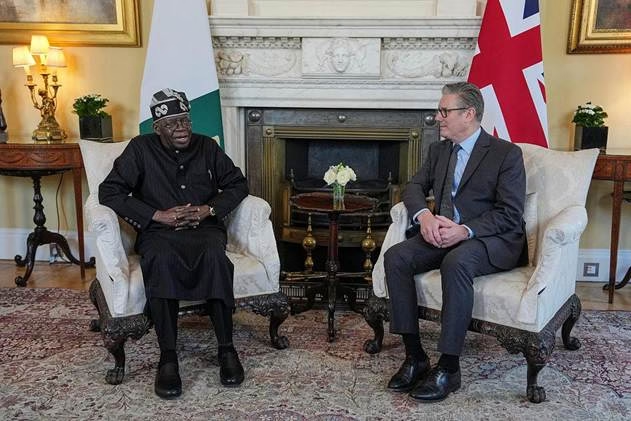
Bola Tinubu, Nigeria’s president and Keir Starmer, UK prime minister, during a meeting at 10 Downing Street in London, UK. Credit: Bloomberg
“More critically, a significant share of government revenue is spent on debt servicing. This reduces funding available for essential sectors like healthcare and education. Taking on additional tied loans under these conditions increases financial vulnerability.” – Dr. Ijuptil
For me, this creates the impression of a “cash-for-migrants” deal. Nigeria receives infrastructure financing while agreeing to accept deportees more easily. Given Nigeria’s rising debt and economic challenges, this linkage feels exploitative to some. It suggests that financial vulnerability may be influencing policy decisions. This dynamic is often associated with neo-colonial patterns in global finance. Where economic need shapes political concessions.
Brains Out, Burdens Back: A Contradictory Migration System
Another major criticism lies in the contradiction within migration policies. The UK continues to benefit from Nigeria’s skilled workforce, including doctors and engineers. This ongoing “Japa” wave has seen thousands of professionals relocate abroad. At the same time, the UK is accelerating the return of those it considers undesirable. This creates a system where talent is welcomed, but vulnerability is rejected. Critics insist that this reflects selective migration rather than fairness.

Travellers at a Nigerian Airport.
The result is a double loss for Nigeria. It loses skilled professionals who contribute to foreign economies. And it receives back individuals who may require reintegration support. This imbalance places additional strain on Nigeria’s social and economic systems. It also raises ethical questions about how migration is managed globally. Because opportunity appears selective, not universal.
Human Rights and the Risk of Forced Returns
Human rights organisations have also raised concerns about the speed and scale of deportations.
The agreement reportedly targets hundreds of failed asylum seekers for return. However, Nigeria continues to face security challenges, including insurgency in the northeast. Groups like Boko Haram remain active in parts of the country. Returning individuals to such conditions raises serious ethical questions. Particularly regarding their safety and well-being.
“Nigeria continues to face security challenges, including insurgency in the northeast. Groups like Boko Haram remain active in parts of the country.” – Dr. Ijuptil
There is also concern about the principle of non-refoulement. This principle prohibits returning individuals to places where they may face harm. Fast-tracking deportations could risk violating this international standard. If due process is not carefully followed, vulnerable individuals may be exposed to danger. Nigeria’s acceptance of these returns adds another layer of responsibility. And potentially, complicity in any resulting harm.
Strain at Home: Social and Security Implications
Finally, the domestic impact of mass returns cannot be ignored. Nigeria is expected to receive over a thousand individuals, including foreign offenders. Many of these returnees may have spent years or decades abroad. Reintegrating them into society will require significant resources and planning.
Without proper support systems, they may struggle to adapt. And this could increase social instability.
Nigeria already faces high unemployment and economic pressure. Adding a large number of returnees could strain existing systems further. This is also a big concern looking at the insecurities in Nigeria, especially if reintegration fails. Communities may face additional challenges absorbing these individuals. This places the burden of adjustment almost entirely on Nigeria. While the benefits of the deal remain largely external.