


- Deteriorating political, security and humanitarian situation demands immediate, coordinated action
- Government must guard against “a direct call to genocide.”
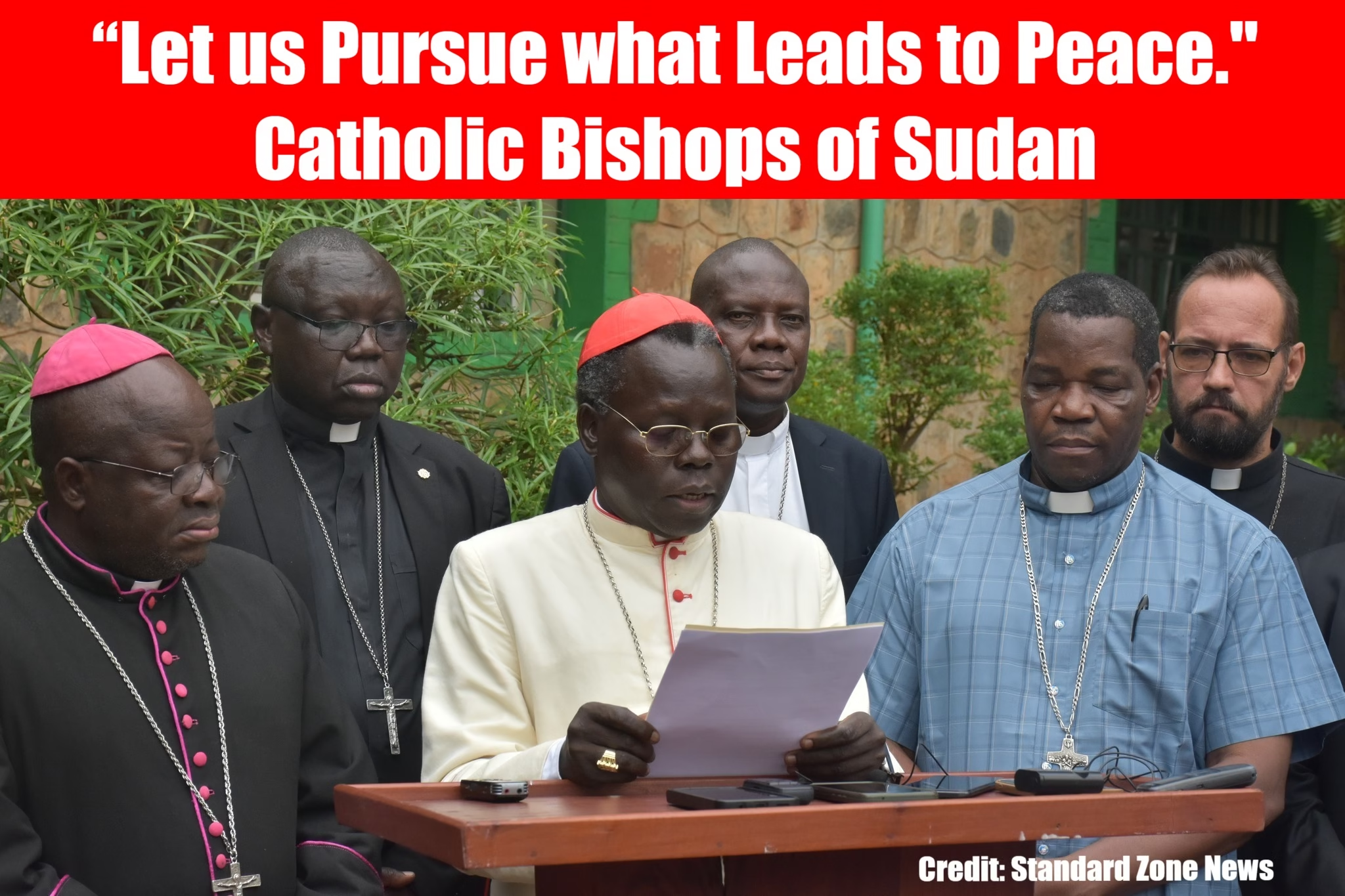
Amid the face of increasing political, security, and humanitarian crises in South Sudan, Catholic Bishops in the conflict-ridden nation have issued a call for peace and dialogue, urging the government to safeguard lives and livelihoods.
This appeal is articulated in a communiqué from the Catholic Bishops of the South Sudan Ecclesiastical Province, dated Tuesday, 27 January 2026, which addresses the escalating political and humanitarian challenges in both Sudan and South Sudan.
“Let us pursue what leads to peace”
Directed “to the government of national unity and opposition groups in our beloved country,” the statement titled, “Let us pursue what leads to peace and building one another up,” condemned the intractable security situation in the region.
In part, it read, “In response to the deteriorating political, security and humanitarian situation in our country, we, the Catholic bishops of South Sudan ecclesiastical province, condemn in the strongest terms the renewed fighting between the government forces, SPLM-IO and other armed opposition groups, particularly in the Jonglei and Eastern Equatoria.”
The Sudan People’s Liberation Movement-in-Opposition (SPLM-IO), also known as the Anti-Government Forces (AGF), is the primary opposition political party in the country.
It emerged from a split within the Sudan People’s Liberation Movement in 2013, driven by political tension between current President Salva Kiir and Vice President Riek Machar regarding leadership of the Sudan People’s Liberation Army (SPLA).
The Bishops underlined that in 2025, they “raised concerns on behalf of the sovereign people of South Sudan to the political leaders,” reiterating, “We are coming again with the urgency to reiterate our appeal for dialogue, unity, peace and reconciliation in the Republic of South Sudan.”
According to them, in July of the same year, “we called on all the political leaders not to ignore dialogue.”
The Church Fathers blamed the ongoing conflict on a lack of embracing “genuine dialogue,” which “is being sidelined intentionally, while military action is wrongly embraced as a solution to addressing political and social differences.
“As shepherds and leaders in this country, we are alarmed and surprised by the total disregard [for] the full implementation of the revitalised peace agreement. The growing discourse within the unity government attacks and counterattacks between the warring parties in many parts of the country is spreading rapidly, causing displacement, anger and many other inhuman conditions.”
The Revitalised Agreement on the Resolution of Conflict in South Sudan (R-ARCSS), initiated in 2018 after an earlier peace deal failed, aimed to stabilise the country and put an end to the devastating civil war that plagued the country.
The statement, which focused on the “deterioration to an intolerable level” of safety and dignity for civilians, highlighted the need for embracing political accountability, daily prayer and fasting for peace.
Responsibility on the part of social media users, gov’t officials
The Bishops cautioned users on the responsible utilisation of social media, warning against misinformation.
“We are equally concerned by the issuing of wild messages in the social media which amplify hate speech [and] misinformation. The part of this kind of communication [on] social media is the promotion of tribal sentiments and incitement,” they noted.
The statement also condemned “the alleged speech” by General Johnson Olony, the Deputy Chief of the South Sudan People’s Defence Forces (SSPDF) for Mobilisation and Disarmament, which called “for indiscriminate violence against civilians in Jonglei state, directing forces to spare no life.”
The Church leaders who described such a speech as “a direct call to genocide,” urged “all the fighting forces not to heed… any directive that risks victimising innocent civilians and pitching communities against each other.”
The prelates also decried the “alarming increase in armed robbery of motorists and the common people, even in the city of Juba and other parts of the country.”
Since South Sudan became an independent nation from Sudan on 9 July 2021, conflict in the youngest country in the world has become the largest humanitarian crisis of the 21st century, with over 30 million people in need of assistance.
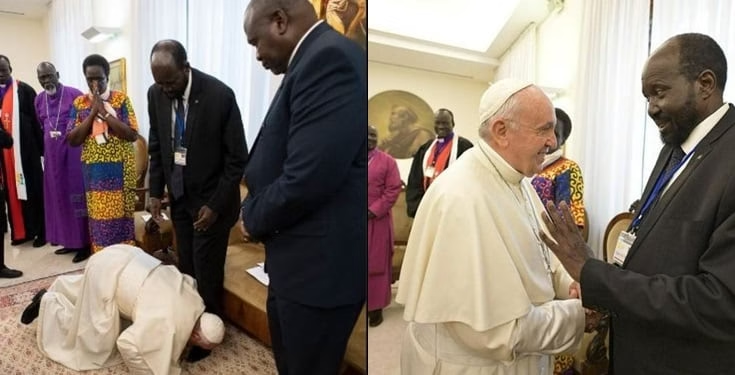
Pope Francis kisses the feet of South Sudanese leaders. Credit: Tori.ng
Conclusion
In light of the severe security challenges facing the East-central African nation, Pope Francis made a powerful, dramatic gesture on Thursday, 11 April 2019, at Casa Santa Marta in the Vatican, when he knelt to kiss the feet of South Sudan’s formerly warring leaders, imploring them to embrace peace and reconciliation.
Due to the persistent violence in South Sudan, various official Church platforms, including the Africa Section of Vatican News, South Sudan’s Catholic Radio Network, and the Association of Member Episcopal Conferences in Eastern Africa (AMECEA), are providing regular updates on the situation in the landlocked country.
They often emphasise the urgent need for humanitarian aid, as well as peace and reconciliation efforts.