



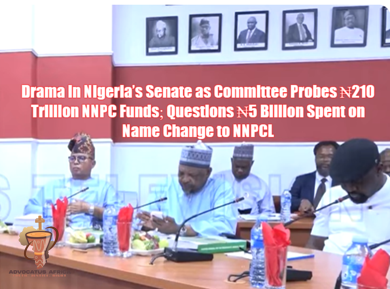
A dramatic investigation has erupted in Nigeria’s National Assembly after members of a Senate committee raised serious questions about unexplained funds amounting to ₦210 trillion linked to the country’s state-owned oil company.
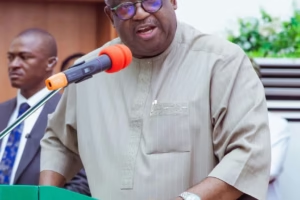
During a trending community meeting video, Mohammed Tahir Monguno, Chairman of the Senate Committee on the Nigerian National Petroleum Company Limited (NNPCL), expressed shock at several financial figures associated with the company.
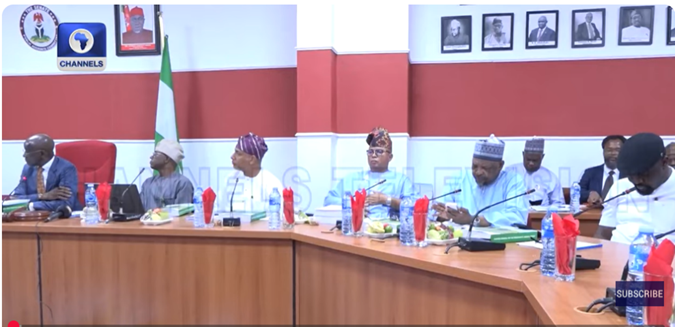
Screenshot of Senate Committee Meeting Video. Source: Channel TV
The Nigerian National Petroleum Company Limited (NNPCL), formerly known as the Nigerian National Petroleum Corporation (NNPC), is Nigeria’s national oil company responsible for managing the country’s petroleum resources.
Ongoing Senate probe
Addressing constituents, Senator Ahmed Wadada Aliyu stated, “₦5 billion is also lingering on NNPC. In this day and age, who will comprehend such a figure to be expended on just changing the name from NNPC to NNPCL incorporation? Five billion naira.”
Senator Aliyu stated that the committee was particularly concerned about a combined ₦210 trillion, which he claimed had not been adequately explained during legislative scrutiny.
According to him, the amount is made up of two separate figures — ₦103 trillion and ₦107 trillion, which the committee says could not be reconciled using standard accounting procedures.
“NNPC should return the sum of ₦210 trillion, being the combined amount of ₦103 trillion and ₦107 trillion, which were not properly explained to the committee, as the aggregate cannot be netted off using acceptable accounting principles,” Aliyu stated.
The committee has demanded the appearance of several former senior officials connected with the period under investigation.
Those expected to appear include Mele Kyari, former Group Chief Executive Officer (GCEO) of NNPCL, Umar Ajiya, former Chief Financial Officer (CFO) of NNPC, Bala Wunti, former Group General Manager and later head of the National Petroleum Investment Management Services (NAPIMS).
NAPIMS (National Petroleum Investment Management Services) is a subsidiary of NNPC responsible for managing the federal government’s investments in Nigeria’s oil and gas joint ventures.
Senator Aliyu added that the officials must appear alongside external auditors who served during the period under review, as well as representatives of the current management of NNPCL.
“They must appear before the committee together with the entire body of external auditors that served within the period under review and put together these financial reports,” he insisted.
Political Context: Anti-Corruption Promises
The investigation has sparked intense political debate, particularly because fighting corruption was a central campaign promise of Nigeria’s ruling party, the All Progressives Congress (APC).
The APC came to power in 2015 under former President Muhammadu Buhari, whose administration pledged to combat corruption and improve transparency in public institutions.
The current administration, led by Bola Ahmed Tinubu, also campaigned on strengthening accountability in governance and economic management.
However, critics argue that the latest revelations raise serious questions about whether those promises have been fulfilled.
Some observers claim that rather than declining, corruption may have become institutionalised across several sectors of Nigeria’s public administration since the emergence of the APC government.
Public Trust and National Accountability
The unfolding probe has also triggered broader concerns about governance and public trust.
Analysts say that if allegations of unexplained trillions of naira are not convincingly addressed, it could further erode confidence in public institutions responsible for managing Nigeria’s oil wealth.
Many citizens and civil society groups are now calling for full transparency, independent audits, and public disclosure of financial records related to the national oil company.
For many Nigerians, the issue goes beyond a name change costing ₦5 billion or an unexplained ₦210 trillion.
It raises a deeper question: How can citizens trust leaders whose actions appear disconnected from the common good of the Nigerian people?
As the Senate investigation unfolds, civic groups are urging Nigerians to remain vigilant and demand accountability.
Their message is simple: Nigerians must wise up, ask questions, and insist that public resources are managed in the interest of the nation rather than a privileged few.