







Following widespread insecurity in Nigeria, the Trump administration has ordered the departure of non-emergency embassy staff from Abuja due to the “deteriorating security situation.”
The statement issued by the Department of State cited potential terror threats against diplomatic facilities, also urged Americans to “reconsider” travelling to the West African nation.
“The overall Travel Advisory for Nigeria is Level 3.”
The advisory dated 8 April 2026 underscored that “The overall Travel Advisory for Nigeria is Level 3.”
The measure is coming at a time when the West African nation is ranked as the fourth in the global terrorism index.
The data released by the Institute for Economics and Peace on 19 March 2026 recorded a 46 percent increase in deaths from terrorism in 2025.
Meanwhile, the US government has begun evacuating its staff and their family members from Nigeria due to the precarious nature of security across the oil-rich nation.
Clarifying the move, the U.S. Department of State explained that Washington ordered non-emergency workers and their families in its embassy in the nation’s capital, Abuja to pull out.
Citing current risk indicators at Level 3, the state department warned its citizens to “Reconsider travel to Nigeria due to crime, terrorism, unrest, kidnapping, and inconsistent availability of health care services.”
“Some areas have increased risk.”
Stressing that “Some areas have increased risk – the Department of State authorised non-emergency U.S. government employees and U.S. government employee family members to leave U.S. Embassy Abuja due to the deteriorating security situation.”
The Travel Advisory also warned U.S. citizens to avoid visiting most Northern states in Nigeria, as well as Southern states such as Abia, Anambra, Bayelsa, Delta, Enugu, Imo, and certain areas of Rivers, if they still wish to travel to the country.
The statement suggested that US nationals should avoid travelling to the North because of the activities of Boko Haram and armed bandits and the South of the country because of the high risk of terrorism and kidnapping.
Infractions of security in the last two weeks
In the last two weeks, especially from late March to 9 April 2026, Nigeria has experienced a significant surge in violent attacks across multiple regions, resulting in dozens of deaths and hundreds of abductions.
From 26 March to 9 April 2026, there have been major attacks during the Easter Weekend Attacks (4–5 April) involving suspected Fulani militants and bandits, who launched coordinated assaults across several states, killing scores in Plateau State.

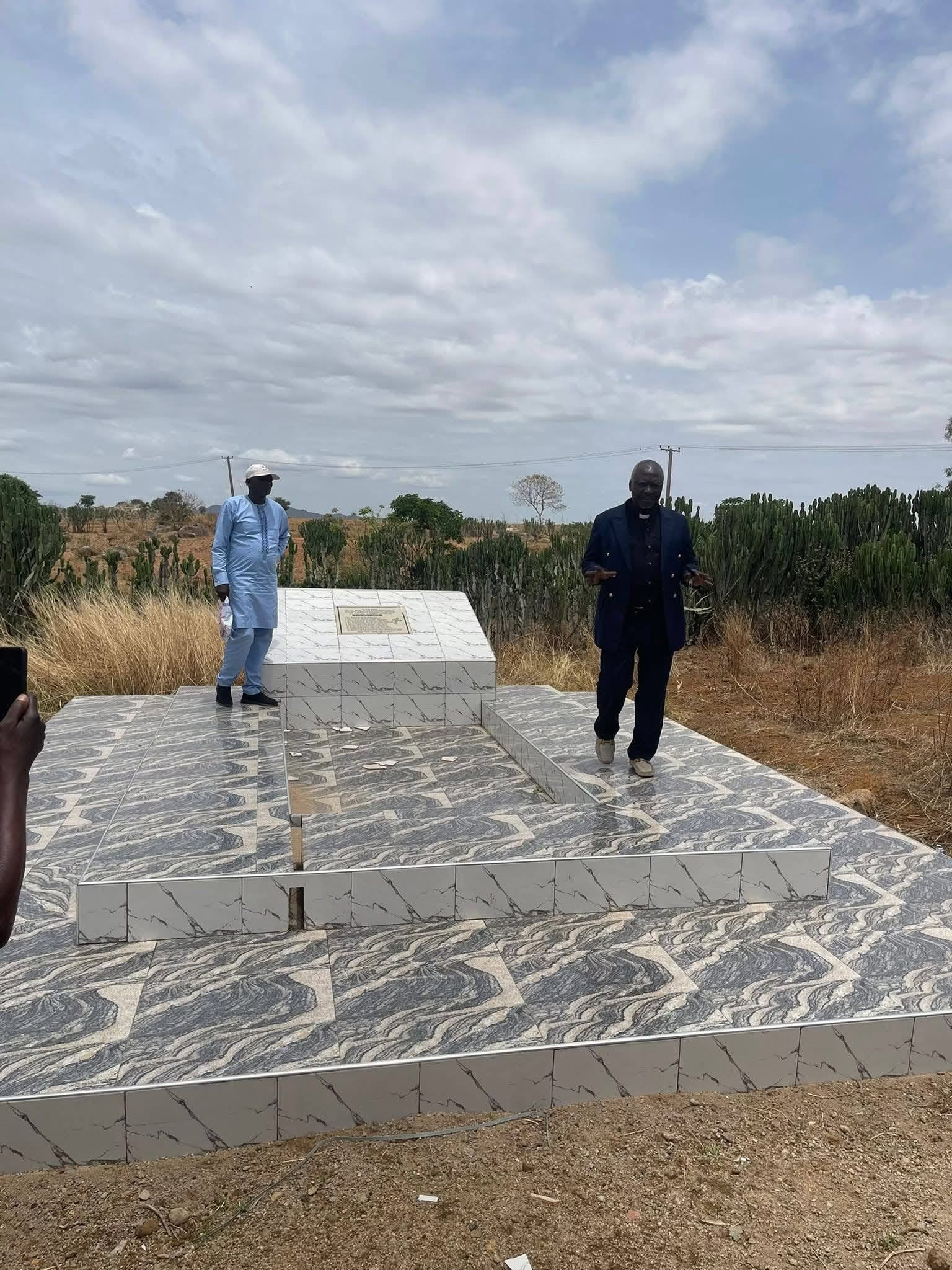
Funeral Memorial Notice of 22-year-old Promise, Gideon A. Yuba, one of the victims of the Palm Sunday killings in Angwan Rukuba, Jos, Plateau State.
While suspected Fulani and Boko Haram militants killed at least 40 to 53 people on Palm Sunday, 29 March in Angwa Rubuka and Eto Baba near Jos, two people were killed in Pwomol village of Plateau State on Easter Monday.
In Benue state, similar attacks occurred in Mbalom and Mbasombo communities on Easter Sunday, where suspected Fulani militia killed at least 26 people.
Summary of Targeted Areas & Security Status
| State | Primary Incident Type | Recent Impact |
|---|---|---|
| Borno | Insurgent attacks on military | Senior officers killed; bases targeted |
| Plateau | Ethnic/Religious violence | Over 40 killed in late March |
| Kaduna | Church attacks/Kidnapping | Worshippers killed and abducted |
| Benue | Community raids | 26 killed during Easter celebrations |
| Niger | Banditry and Raids | Dozens killed in Shiroro district @Advocatus Africa. |
Gunmen also attacked two churches in Ariko village, a suburb of Kaduna State, killing at least 5 people and abducting 14 others.
During an overnight assault between 8 and 9 April, Boko Haram/ISWAP reportedly overran a military base in Benisheikh, in Borno State, killing a Brigadier-General and several other soldiers.
Recall that in Chibok community of the same state, at least 21 people were killed in the Kautikari Christian community by Boko Haram on 30 March.
In Niger State, gunmen raided villages in the Shiroro district on 8 April, killing at least 20 people after an earlier attack on Baga community in the same district, where about 160 armed men allegedly stormed the community, and killed about 5 people.
Early in April, suspected bandits carried out mass abductions in several villages of Zamfara State, but were repelled by the military, who reportedly killed 65 of the criminal gang during an offensive.
Although major attacks have been predominant in the North-Central regions of the country, also known as the Middle Belt, other incidents covered by Advocatus Africa occurred in the North-East and North-West.