


In the face of recent deadly attacks in Niger and Kwara States, a viral, 2-minute-18-second social media snippet of a Nigerian investigative journalist, Steven Kefas, who took a swipe at the Nigerian judiciary and media for their failure to amplify the voices of the marginalised who are facing existential threats by terrorists, has resurfaced online.
Kefas, who spoke at a high-profile Middle Belt Town Hall Meeting in Jos, Plateau State, titled “Conversations around security: News Central drives dialogue from conflict to action and justice,” disclosed that if “you must speak the truth as a journalist in this country, then you must be ready to face the consequences.”
The publisher of Middle Belt Times shared his incarceration for speaking truth to power, decrying that minority groups are not protected.
A seemingly compromised Judiciary
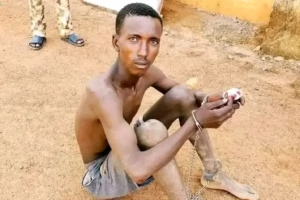
He narrated that “In 2019, I spent 162 days in prison for my uncompromised reportage. And when I was stepping into Kaduna prison, the first thing I wanted to see were the terrorists that have been terrorising our people. I didn’t find any. The few I found, including the ones who killed the Agwom Adara in 2018, they were looking better than me, who was coming from outside.”
In May 2019, under Governor Nasir El-Rufai, the investigative reporter was arrested in Port Harcourt and detained for 162 days for reporting on insecurity in Southern Kaduna.
Meanwhile, the Agwom Adara, Dr. Maiwada Galadima was abducted and killed in October 2018 and the principal suspect in his murder, one Adikwu, was said to have died in police custody under suspicious state-organised moves.
Continuing on the killers of Adara, the journalist decried, “As of today, I don’t know their whereabouts. They may have been released because I remember meeting a certain Adamu in Kaduna prison who told me something. He said, ‘Look, in no distant time, we would go back to Mali.’ He was arrested for illegal possession of firearms. That’s a capital offence.”
Connecting security with effective judicial processes, Kefas, known for documenting religious persecution and human rights issues in the Middle Belt region for over a decade, said, “The security agents are no longer here. I heard somebody talking about the judiciary. It’s a compromised judiciary. It is.”
Alleged complicity of the press amid perceived injustices against the Middle Belt
Kefas spoke about the perceived marginalisation of the people of Southern Kaduna, whom he met in prison.
“When I got to prison, I saw a lot of young men from Southern Kaduna who were standing trial for simply trying to defend their communities. I wept bitterly,” he stated.
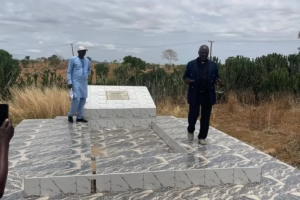
He claimed that “In 2027, for instance, there was an attack at Bakin Kogi, Kaninkon….and Channels TV said 7 houses were burnt and 4 people were killed. I left Port Harcourt for Southern Kaduna. I counted 150 houses, and I saw a mass grave containing 21 persons.”
The Senior Research Analyst at the Observatory for Religious Freedom in Africa insisted that “the media is also complicit in what is happening in the Middle Belt.”
Lauding the efforts of emerging media organisations in the region, Kefas said, “Thank God for News Central for what you are doing. Unfortunately, you are very young. You started in 2017 or thereabouts.”
According to News Central TV, the host, the event was aimed to provide a direct platform for residents and experts to engage in discussions about the ongoing security crisis in the region.
As violence continues to afflict Nigeria’s Middle Belt, News Central TV has brought the national conversation to Jos, Plateau State, where political leaders, security forces, and community stakeholders gathered for a tense and emotional town hall meeting.
Voices from across the region called for an end to the crisis, demanding accountability, justice, and lasting peace.
Through powerful testimonies, rare cross-sector dialogue, and on-the-ground reporting, the forum underscores the growing urgency for unity in a divided region.
The journalist’s statement, “these atrocities have been occurring for many years,” apparently resonates with what security analysts describe as the enduring impact of Usman dan Fodio’s jihad (1804-1808).
Conclusion
Experts view the jihad as a reference point for the ongoing crisis in Nigeria’s middle belt region, which was not conquered by the jihadists, who are now on a vengeful mission, determined to reclaim the territory.
On why he decided to establish his own media, at the August 2025 event, the conflict reporter for Truth Nigeria revealed that “Before I founded Middle Belt Times…I was writing for various platforms and sometimes when I write my stories, they will tell me that these guys are not terrorists, they are unknown gunmen or they are bandits. And one day I spoke to an editor and said, ‘Look, Sir, don’t publish my story.’”
Counterterrorism experts think that labels or frames, such as Boko Haram and herder-farmer clashes, are a creation of the Nigerian media.
They hold that media representations of the main actors in any conflict have huge implications for enduring peace and security in Nigeria.