






The latest data by the World Food Programme (WFP) has raised alarm over the humanitarian crisis across Nigeria’s northern states.
The brief titled “Saving Lives, Changing Lives” observes that although Nigeria is Africa’s most populous and the sixth most populous country globally, “Over half of the people in Nigeria are multi-dimensionally poor, and 65 percent of them live in the North.”

Description: This figure compares internally displaced populations across northern
Nigeria, showing that the North-East remains the epicentre of displacement, with
over two million displaced people, followed by significant displacement across the
North-West and North-Central regions.
Interpretation: Conflict-driven displacement remains geographically concentrated and the North-East still the humanitarian hotspot
Nigeria’s country brief, November – December 2025, discloses that Nigeria’s northern states, once known for “surplus food production areas, now grapple with poverty and recurring conflicts.”

Almajiri kids are a sign of multi-dimensional poverty in northern Nigeria. Credit: Nationaleconomy.com/
The report decried the “widescale humanitarian crisis in the north resulting from the internal displacement of over 2.3 million people in the north-east in addition to 1.3 million people in the north-west and north-central states.”
As of December 2024, it was also observed that the average cost of a healthy diet had surged by 90 percent compared to the previous year.
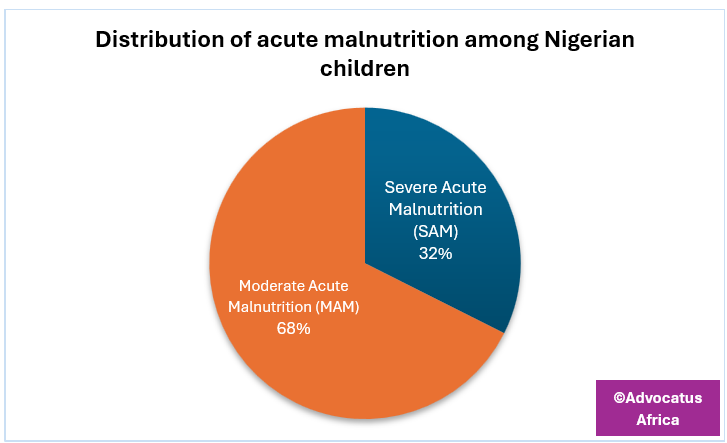
Description: The chart shows the breakdown of acute malnutrition among children
aged 0–59 months, highlighting the relative shares of severe and moderate acute
malnutrition cases.
Interpretation: Moderate malnutrition forms the majority burden but severe cases remain life-threatening.
WFP maintains that the “October 2025 Cadre Harmonisé projects that 34.7 million people across Nigeria will likely face crisis or worse levels of food insecurity during the 2026 lean season (June to August).”
In terms of interventions,the UN body emphasised thatitoffered 1,182,740 people in November 2025, 3,834 mt of food assistance distributed, US$ 10.9 million distributed through cash-based transfers and US$ 128 million six-month net funding requirement (January 2025 – June 2026).

Description: This figure presents the scale of WFP’s funding needs relative to
available resources, illustrating the gap between total strategic plan requirements,
funding received, and near-term operational needs.
Interpretation: Significant funding shortfall and risk of aid disruption if unmet.
WFP revealed that it urgently needs USD 128 million to sustain its operations from January 2025 to June 2026.
Nigeria’s Human Development Index (HDI) ranking of 161 out of 193 countries places it among nations with low human development, reflecting persistent challenges in healthcare, education, and income levels.

Description: This figure summarises the scale of humanitarian support delivered
through different modalities, including the number of people assisted, food aid
distributed, and cash transfers provided.
The report acknowledged the generous support of the African Development Bank, Canada, Cyprus, European Commission, France, Germany, Luxembourg, Republic of Korea, Saudi Arabia, Sweden, CERF, United Kingdom, United States, and private donors in the 2025 fiscal year.
Looking headed unveiled it 5-year Strategic Plan (2023-2027) aimed at delivering emergency food assistance and supporting recovery and resilience-strengthening efforts for vulnerable people and communities.