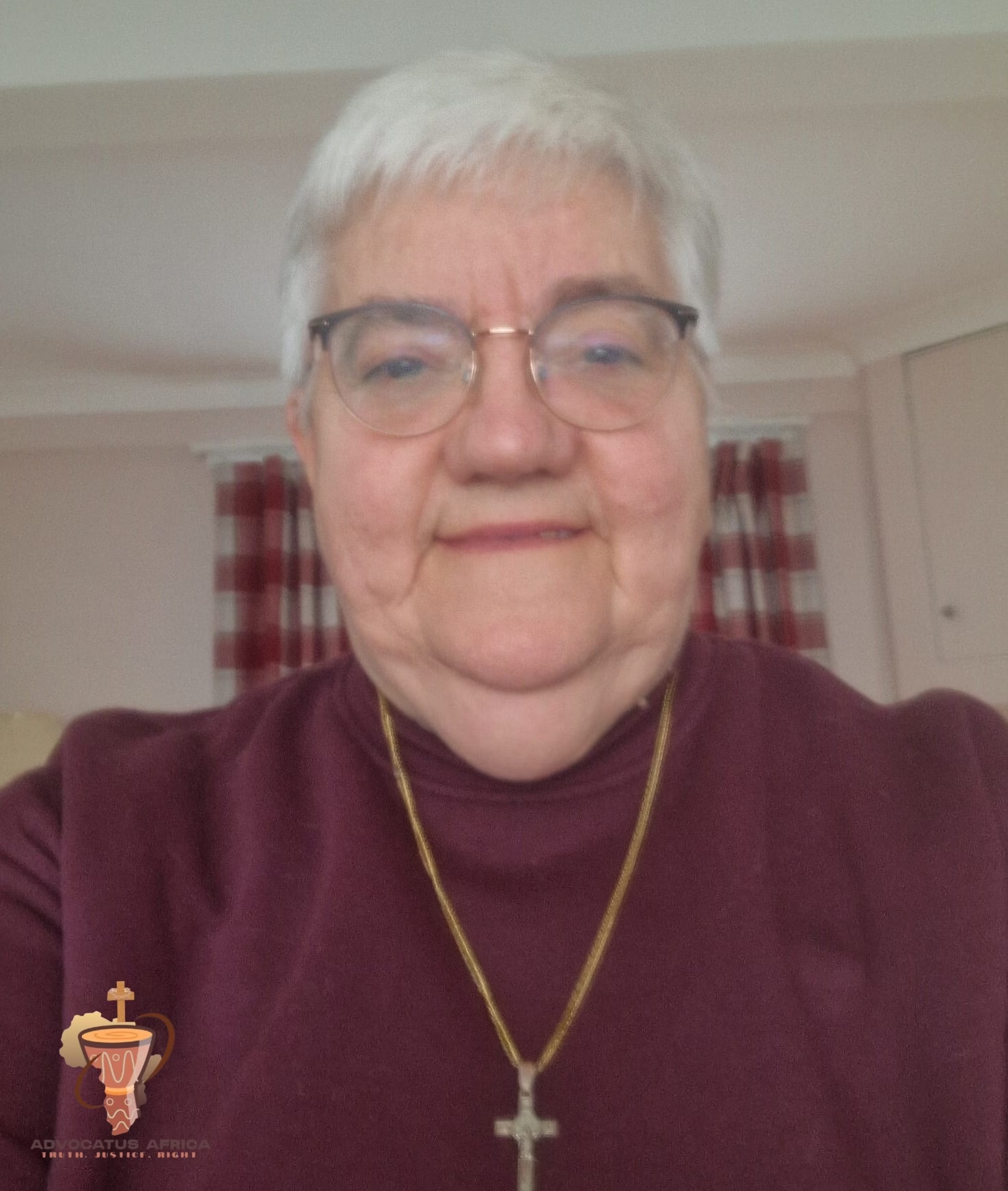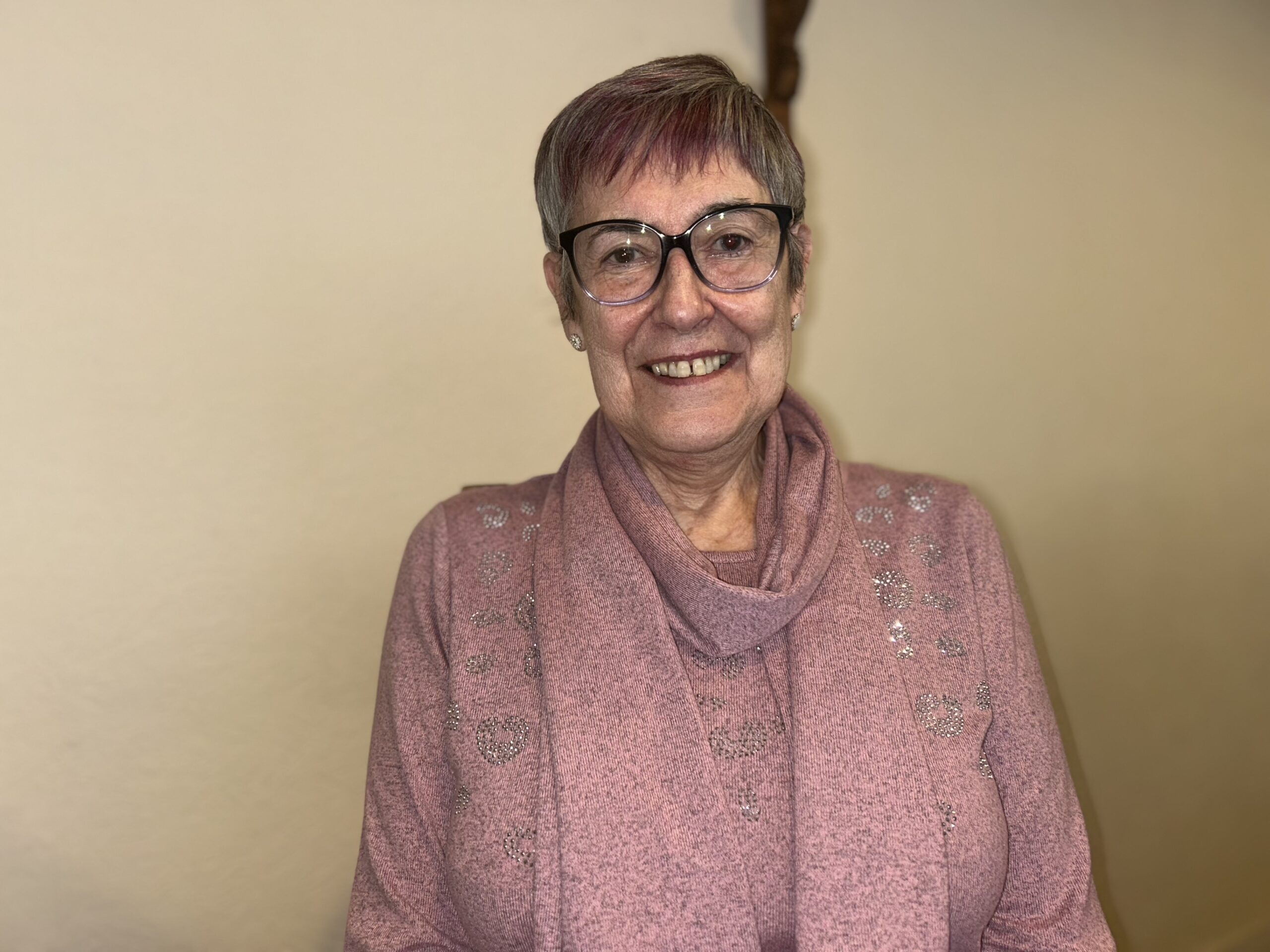
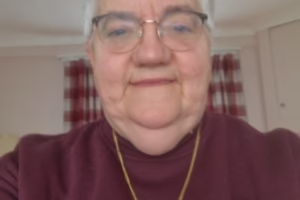

Easily recognised for her gentle, shy smiles, bright eyes, insightful ideas, spiritual presence, and humility, Ellen McBride is a notable figure within the Catholic Church in Scotland. Her journey from the Clydebank community to the University of Glasgow and onward to the Archdiocese of Glasgow has established her as a dedicated religious representative and educator within West Dunbartonshire Council.
The Irish-born advocate passionately champions the needs of Catholic schools and families and has a rich history of involvement in various municipal groups, including her role as Chair of St. Eunan’s Parish Pastoral Council.
In an interview with our Editor-In-Chief, Justine John Dyikuk, McBride shared insights about her Irish heritage, discussing her journey in balancing her commitment to serving both God and humanity as a Lecturer, Catechist and community mobiliser.
This interview is edited for length and clarity:
Can you please briefly tell us about yourself and your background?
I was born in Ireland, out in the county. I was baptised on the same day. That was the tradition at the time. Therefore, I have no problem remembering the date of my baptism. My parents moved to Scotland in search of a job for my father. There was not much work in Ireland at that time. We settled in Clydebank because my mother had a sister there. So, we were brought up in Clydebank. My second brother was born in Glasgow. When we arrived, my mother was pregnant. Then, there was another sister born.

Ellen McBride, Catechist, Educationalist and author
I always wanted to be a teacher since I was a little girl. I don’t know if it had something to do with religion. My mother was always at home. Her religion was so important to her. The first memory I have of my mother is standing behind me, taking my right hand to make the sign of the cross, and we always had prayers, the family rosary. Religion was a central force, shaping every facet of our lives. I don’t know if that really had something to do with the fact that I wanted to be a teacher to pass on something.
“The first memory I have of my mother is standing behind me, taking my right hand to make the sign of the cross, and we always had prayers, the family rosary.” – McBride
When I was in school, I kept worrying whether I would pass exams or get into training. While waiting to go into higher education, I did some voluntary work in a hospice. I thought I would become a nurse. That service was always there. God had things in mind. I passed the exams.
Then what happened? What motivated you to become a teacher?
My mother was very talented. She knitted all our jumpers and clothes. I was virtually brought up in a sewing machine. I had the talent for that. I wanted to become a teacher who taught sewing. I think God intervened and changed my course. Eventually, I was accepted into Notre Dame College, Glasgow. It was run by the Notre Dame Sisters. I owe them a great deal for my education. I had a very good time because I met a lot of great people there. I got a good degree at the end.
“I was accepted into Notre Dame College, Glasgow. It was run by the Notre Dame Sisters. I owe them a great deal for my education.” – McBride
I was a primary school teacher at St. Stephen’s in Dalmuir for 15 years. I became an assistant head just after 3 years. That caused a bit of a problem among the staff. I loved teaching. It was just the best job in the world. After 15 years, I became a Head Teacher at Peter’s Primary School, Dumbarton. Instead of having a class or a department, I had the whole school. That was great. I enjoyed being a head teacher. It was hard work. Sometimes I felt more like a social worker. I was dealing with the problems of the parents, teachers and children. I used to keep thinking to myself: I am supposed to be developing the curriculum and here I was dealing with administrative and social issues. But anyway, I thoroughly enjoyed it.
I had no intention of doing anything else, but then Strathclyde, the biggest region in Europe at that time, drew up an inspectorate team. The director gave the head teachers a talk and said: “Don’t think you’re not able. Apply and see.” I don’t know what made me do it. I applied and I got it. I had to leave St. Peter’s school. I had achieved my aim of becoming a teacher. That was the first time I came out of the Catholic sector. I met all sorts of people – religious and non-religious. We had a big team of inspectors. Challenges started coming: Why were you in catholic school? Why do catholic schools exist?”
As a leading figure in the Archdiocese of Glasgow, can you tell us how you responded to these challenges in your role of training Catechists?
Because of the questions I faced, I felt I had to do something. So, I enrolled for a Master’s in Theology from Loyola University, New Orleans, Edinburgh campus. It ran for three years. It was great. I really enjoyed it. That gave me a basis. It was very interesting. Because I had enjoyed the course, and the University wanted to spread it to Glasgow, one of the priests who was a tutor there asked me to come with him to see the Archbishop, Cardinal Winning. He was a lovely man. We told him about the course and brought stuff. He said, “Oh, it is a good course. I will let it happen in the diocese if you do it, Ellen.” So, that was the first time I facilitated that course in Glasgow. That was the teaching thing that was coming in that I didn’t realise at the time.
That finished and we could not get anybody to do the next course. It was expensive. People didn’t have money. Still, under Cardinal Winning, I was asked to be part of a small group that would develop a course for catechists. That was how the course was born. We wrote it. We got about 20 people for the first course. It’s been going on for nearly 20 years. The course runs for two years. It is modular. It runs in conjunction with Glasgow University.
It was an award course from the University. Anyone who came to be trained as a Parish catechist had to be nominated by the parish priest. At the beginning, we said they could take the academic part of the course alone without doing the catechesis element. That happened once and I think nobody was interested in that. They really wanted to be a parish catechist. I do the catechesis element of the course, which enabled me to build up relationship with priests. At first, when the course started, we gave them essays to write at the end of each module. That ran for two years and we stopped it, because no one in a parish asks you to write an essay. They might ask you to take a group such as (Rite of Christian Initiation of Adults) RCIA, children’s liturgy or sacramental preparation.
The first course is the New Testament (NT). I gave them a subject related to the module to pick a text from the NT, make a 10-minute presentation to the class and tell us why you like it. In the first year, I give the whole class feedback. I don’t give feedback individually. It gets longer in the second year and I give individual feedback.
“In about 20 years, we have trained over 100 catechists, some of whom have died.” McBride
The big presentation takes place at St. Eunan’s Clydebank, where they take a scripture group during Lent and work in pairs. They study the first reading and the gospel and present it for an hour and a half. They work with the parish to open up that scripture. I sit at the back. I don’t interrupt because it is their night, unless I have to. The priest does not interfere either otherwise; people end up asking him questions instead of the presenters. In about 20 years, we have trained over 100 catechists, some of whom have died. We usually want 10 to start the course. That hasn’t happened every year, but we just go with it anyway. Presently, we have 10 in the first year and 12 in the second year.
Have you incorporated new media in your Catechetical programme on new evangelisation?
We have people of different ages. For example, some students do not have an email. So, we take the students where they are. We encourage them to set up a WhatsApp account to communicate with one another. At the end of the summer break, I will take them on the use of PowerPoint to prepare them to use it in parishes. We have a video on the Archdiocesan website that invites people to come to the course. I admit that this is an area of development for us.
Can you take us into how you assist in interviewing seminarians to begin their formative years?
For the past 6 years, I have been involved in interviewing seminarians. Fr. Tom Kilbride was a Director in the Glasgow Archdiocesan Education Department. Then he was appointed to Salamanca as a rector. His job was to look after the seminarians. They were interviewed before they came in. When he asked me if I would be on the panel. I was delighted to oblige. Every year, in October, I go along. The team was made up of Fr. Tom, a priest or another lay person and me. Fr. Tom didn’t give us questions, but he suggested that I should ask about being in a parish.
“When you are in the seminary, you have a lot of head knowledge. How would you translate what is in your head to your heart and work in a parish with many people who have lots of challenges?”– McBride
I would ask the seminarians questions like: Hopefully, this is the start of your training. Just think forward. You might be trained as a priest. How are you going to work in a participative way with the laity? Because you are on parallel roads, but you’re both going to God, you may meet people who are holier or know more than you. How would you deal with that? When you are in the seminary, you have a lot of head knowledge. How would you translate what is in your head to your heart and work in a parish with many people who have lots of challenges? This year, we had 14 candidates at the interview, which took two days. We prepare them for Salamanca and eventually Rome by recommending them. However, the Bishop makes the final decision.