



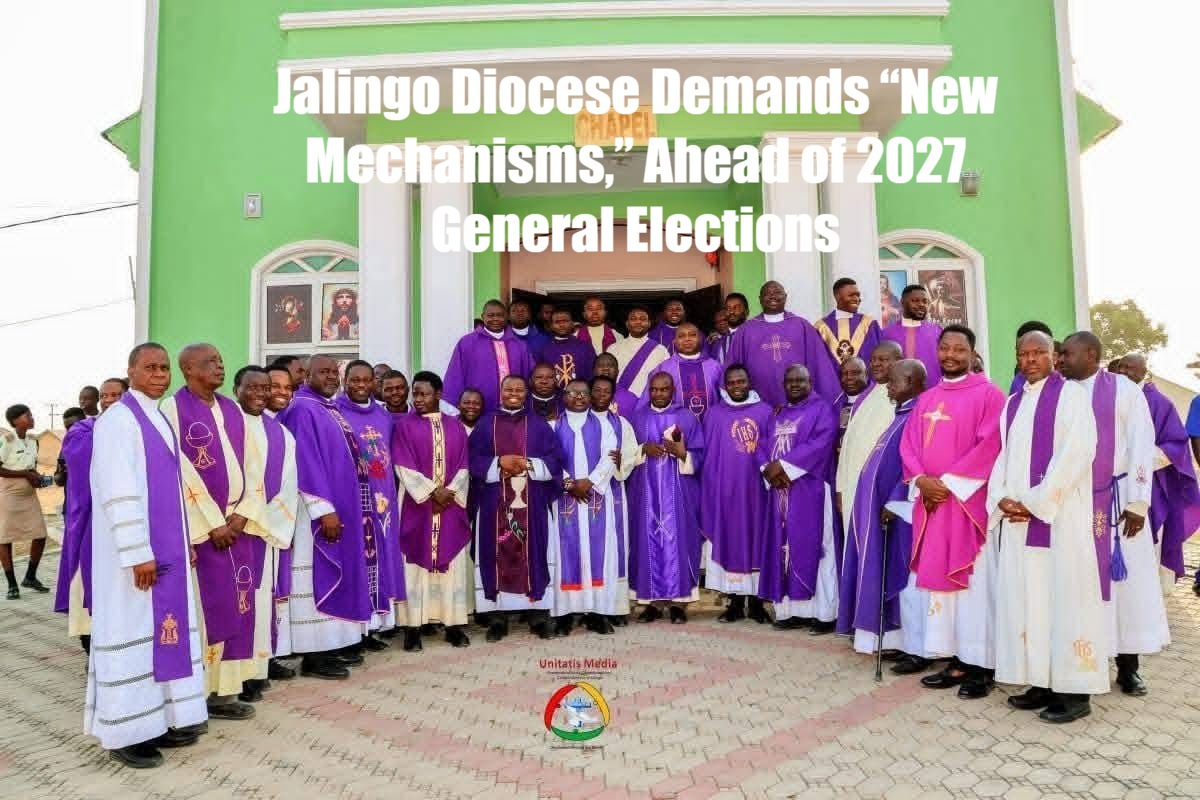
The Catholic Diocese of Jalingo, Taraba State, North-Eastern Nigeria, has called for the Church and State to develop what it described as “new mechanisms” ahead of the 2027 general elections.
This call is contained in a communique issued at the end of the 22nd Biennial General Assembly of the Catholic Diocese of Jalingo, which was held at St. Charles Borromeo Pastoral Centre, Shavou Mile Six, Taraba State, Nigeria, from 1st – 4 March 2026.
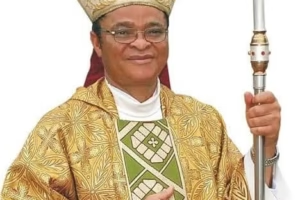
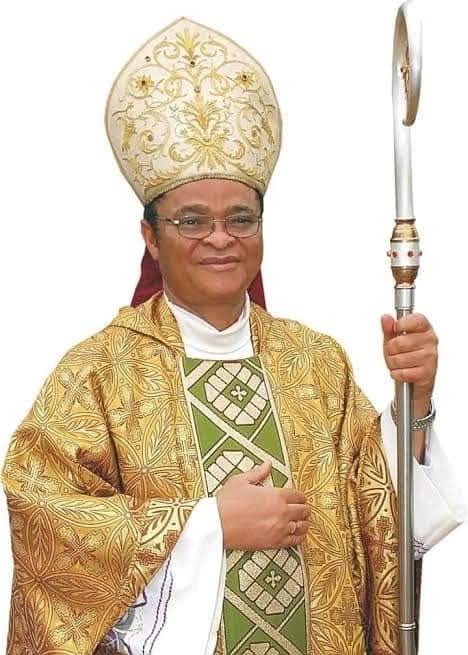
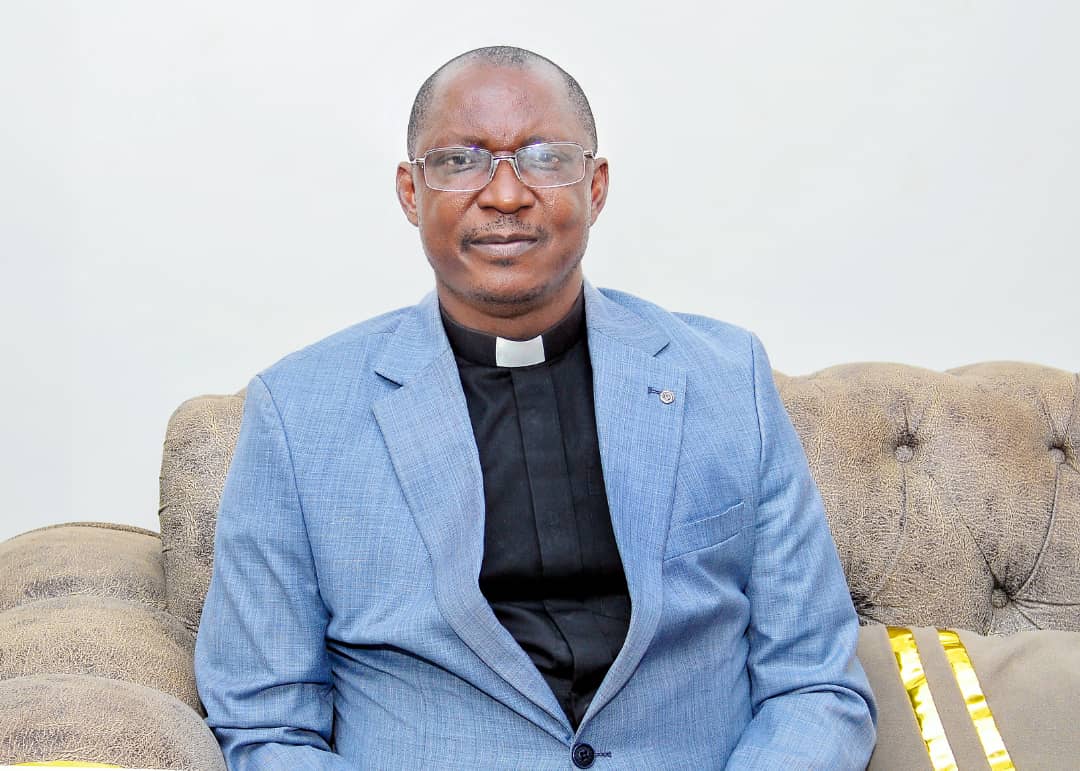
In the communique signed by the Catholic Bishop of Jalingo, Most Rev. Dr. Charles M. Hammawa, and Diocesan Chancellor/Notary, Very Rev. Fr. Eugene Batare, the diocese rolled out a blueprint for electioneering and elections in Nigeria.
“The Church calls on the State, especially now that we are at the threshold of 2027 elections, to, where need be, put in place new mechanisms while stepping up existing ones to ensure free and credible elections,” the statement suggested.
It warned against the dangers of widespread violence, polarisation and vote-buying in the nation’s electoral process.
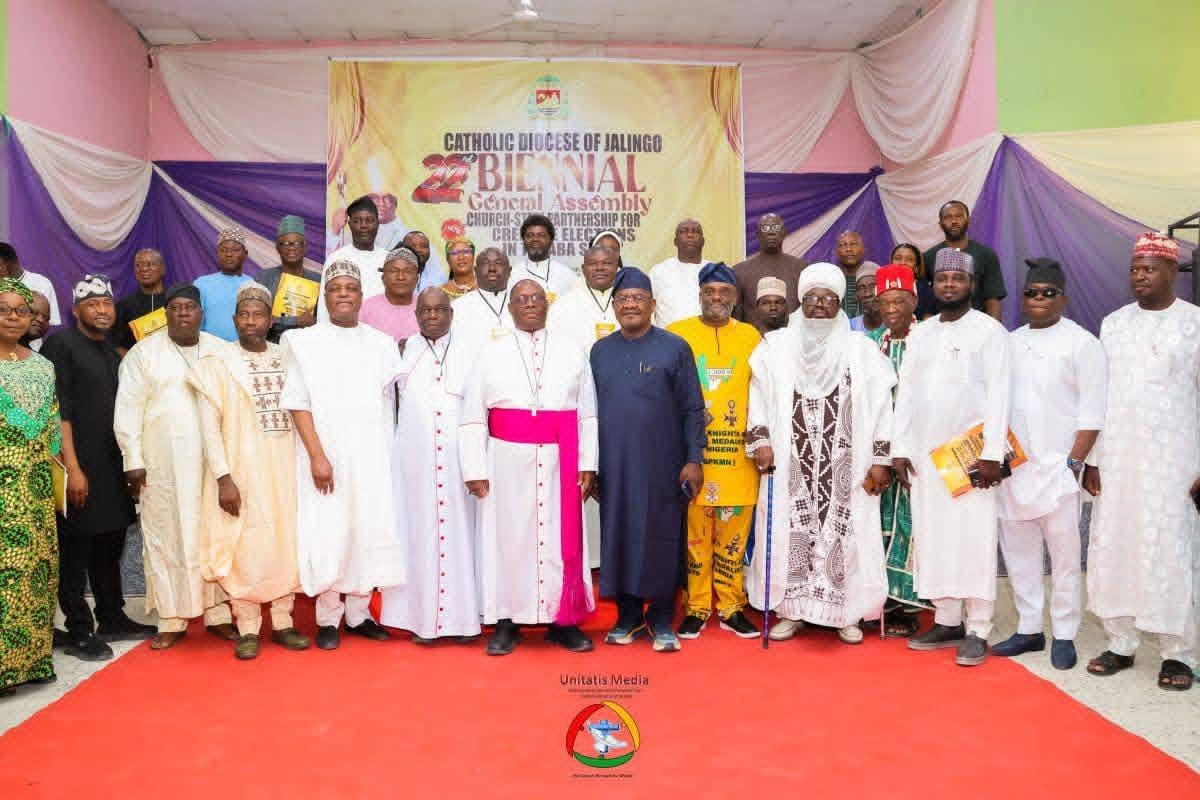
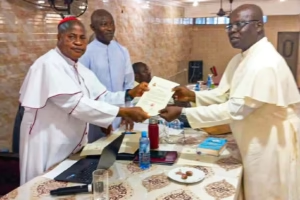
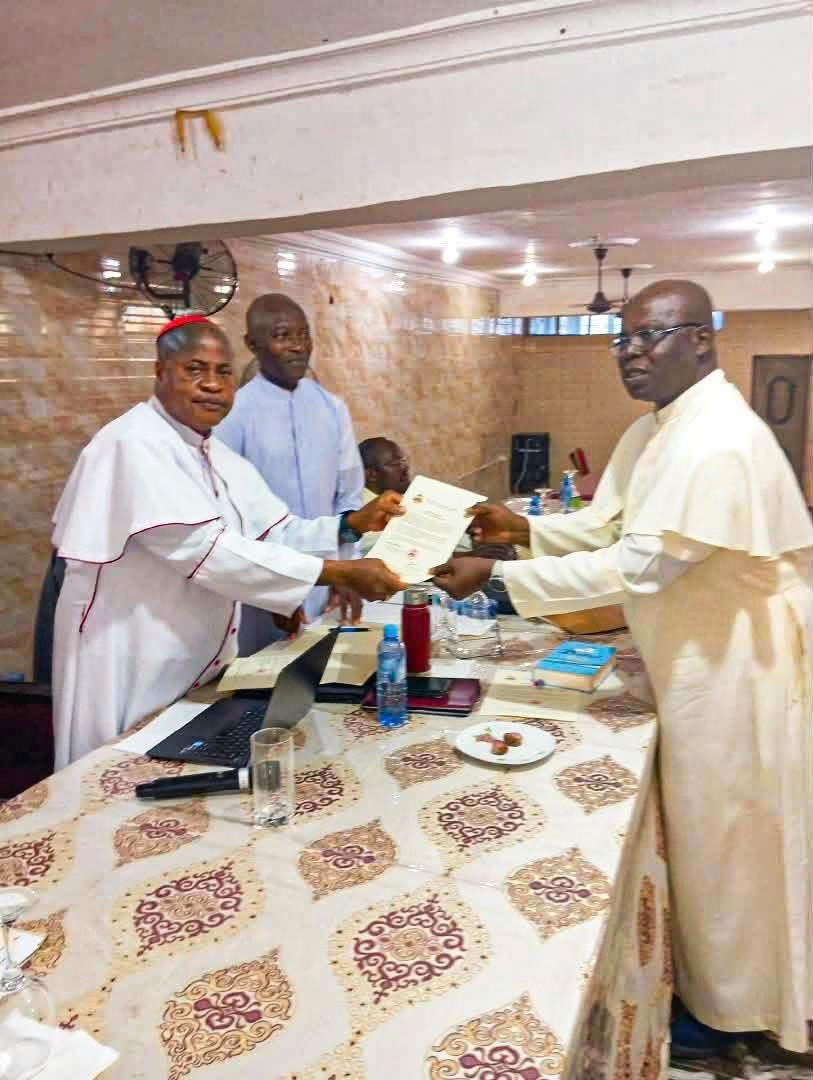
Catholic Bishop of Jalingo Diocese, Most Rev. Dr. Charles M. Hammawa, with dignitaries at the event
No to “Violence, vandalism, threats, hate speech, ‘ethno-religious politicisation.’”
In part, the statement cautioned against, “Violence, vandalism, threats, hate speech, ‘ethno-religious politicisation’, vote buying and selling, results manipulation and, the consequent voter apathy still trail our electioneering and voting processes,” while insisting that “The Church intensifies her efforts in denouncing these ills, even as She, through various means, continues to form and reform consciences, guiding them towards free and credible elections.
Having prayerfully deliberated on the theme “Church- State partnership for Credible Elections in Taraba State,” the diocese urged for reforms and collaboration in “Major areas such as education of the masses on the need to vote, on campaign and voting procedures, monitoring of elections, etc are some areas the State may wish to partner with the Church through her veritable organ of Justice, Peace and Development Commission/Caritas.”
In the same vein, the occasion that had the Bishop, the clergy, the consecrated persons, dignitaries and the lay faithful of the Diocese in attendance, there were also deliberations on Church-State partnership.
“The Church and the State as institutions of the Sacred and the Secular are distinct and autonomous. The Church lives in cognisance of this reality and appreciates the same from the State, as the Holy Scripture teaches: give to Caesar what belongs to Caesar and to God what belongs to God (Matthew 22:21).
“This does not mean that the Church is in parallel with the State as the Late Pontiff Benedict XVI asserted: while the church does not have a political mission, she nonetheless has a political responsibility in the world,” it noted.
“Christianity cannot remain on the sidelines in the fight for justice.”
The statement maintained that “Christianity cannot take upon herself the political battle to bring about the most just society possible and neither does she remain on the sidelines in the fight for justice.
“Yet the promotion of justice through efforts to bring about openness of mind and will to the demands of the common good constitutes the element that concerns deeply the mission of the church (Deus caritas est 28).”
It underscored that “This mission, namely, respect for the human person, justice, peace and development, are avenues of collaboration between Her and the State (Cf. Genesis 1:28; Exodus 20:13; Vat.II, Gaudium et Spes, Constitution of the Church in the Modern World nos. 4, 42, 76).
“It is with this understanding that the Church as a moral voice, speaks and acts in partnership with the State and seeks more of it.”
On good governance, the top diocesan officials acknowledged that “the responsibility of leadership is brought about by the collective mandate of a people vested in trust, on a selected few to steer the society to greater heights,” warning that “This trust should not be betrayed.”
They appreciated “the complex nature of leadership,” while calling “on our political leaders to deliver on their mandate and do more to better our State.”
As regards security, health, roads and welfare of workers,’ employment and education, the message emphasised:
“The areas of security, health, good roads and workers’ welfare demand urgent attention. Commerce and industry are other ventures that should be considered, given the volume of raw materials available in the State.
“The teeming number of the unemployed and the need to generate more income for infrastructural development are other areas to be considered. The Church will continue to assist the State in the areas of health, education, empowerment, employment and certain infrastructural needs.
“More so, it is in the character of the Church, taking after Christ her Founder and Head, to remain committed to her prophetic role of observing and voicing the needs of our State, offering guidance for better achievements.”
Taraba is “nature’s gift to the nation.”
Narrowing the message to the motto of Taraba State, “nature’s gift to the nation,” Jalingo Diocese maintained that “Our State is blessed with abundant resources. The Mambila Plateau, with its beautiful weather and physical features, its meandering routes, tea, timber, precious stones and fruits, is a tourist attraction, a haven of comfort and wealth.
“The Gashaka-Gumti Forest and its wild-life is another holiday home and research centre; the arable plains of the Northern zone providing cereals, tubular crops and animal husbandry, the vast Benue Basin and its aquatic life, the thick forest of the Southern region and its timber, cocoa, palm trees and other farm produce; the copious ethnic groups and, many more are obtainable in Taraba State. These explain its fitting description as Nature’s Gift to the Nation.”
The Church noted that “These resources, when properly harnessed, are enough to enhance a better life for Taraba and for our Country,” arguing that “Good leadership makes it possible.”
Regrettably, they stated that “Despite these blessings, we still wallow in poverty and lack of basic infrastructural developments. Credible elections result in good governance, this in turn guarantees the much desired common good and so, every link of the chain is necessary and deserves attention.”
Conclusion
The assembly reckoned that “The minds of the kings and leaders are in the hand of God (Prov. 21:1),” while drawing lessons from “the season of Lent and Ramadan,” as opportunities for intense prayer, fasting, and almsgiving.
While praying that leaders express “goodwill” towards the people, the statement urged the government to “offer listening ears” to the cries of the people while enjoining “all believers in God to use this opportunity to pray for our leaders, our state and our country at large, to have a credible and successful election.”


Impressive
, communique was read by Very Rev. Fr. Innocent Daloba not Eugene
Thank you for your feedback. We reported that the communique was “signed by the Catholic Bishop of Jalingo, Most Rev. Dr. Charles M. Hammawa, and Diocesan Chancellor/Notary, Very Rev. Fr. Eugene Batare,” not read.