





A growing debate has emerged over Nigeria’s expanding reliance on multilateral loans as the country becomes one of the largest borrowers from the World Bank. While the federal government insists the debt remains manageable and necessary for economic reforms, critics argue that rising borrowing has yet to produce visible improvements in infrastructure, productivity, or living standards for ordinary Nigerians. Recent discussions among economists, civic groups, and financial analysts have increasingly focused not just on how much Nigeria borrows, but whether those loans are genuinely transforming the economy.
Borrowing More, But Producing Less?

Nigeria recently emerged as the third-largest borrower from the World Bank’s International Development Association (IDA), with exposure estimated at over $18 billion. Reports by Reuters, TheCable and Nairametrics show Nigeria ranking behind only Bangladesh and Pakistan in IDA exposure.
During a television discussion on Nigeria’s debt profile, economic analyst Wale Gundare argued that government officials often rely on debt-to-GDP ratios to defend borrowing while ignoring more troubling indicators such as debt-service-to-revenue ratio and weak national productivity.
According to Gundare, Nigeria’s debt-to-GDP ratio may still appear moderate compared to countries like Egypt or South Africa, but the country’s productivity crisis tells a different story. He noted that Nigeria reportedly generates only about $7 in output per worker per hour, compared to roughly $23 in South Africa and $26 in Egypt.
However, figure reflects a deeper structural problem: loans are not translating into productive infrastructure capable of generating exports, industrial growth, or mass employment. Questions continue to grow over how billions of dollars in borrowing have failed to deliver stable electricity, efficient rail systems, stronger manufacturing output, or large-scale industrial expansion.
Online conversations reflect similar frustrations. Discussions on Reddit’s Nigeria forums increasingly question why continuous borrowing has not produced visible improvements in public services or economic opportunity.
Inflation Slows, But Hardship Persists

Government supporters often point to moderating inflation and improved macroeconomic indicators as evidence that reforms under President Bola Ahmed Tinubu are beginning to work. Data published by Nigeria’s National Bureau of Statistics and reported by Vanguard showed headline inflation declining from 34.80 percent in December 2024 to 15.15 percent by December 2025. Food inflation also reportedly dropped from 39.84 percent to 10.84 percent during the same period.
However, many Nigerians argue that lower inflation does not necessarily mean prices are falling. Instead, it simply means prices are rising more slowly than before. This distinction has become a major source of public frustration as transportation costs, electricity bills, food prices, and living expenses remain significantly higher than they were before the 2023 reforms.
At the same time, the World Bank continues warning that poverty remains severe despite signs of macroeconomic stabilization. Reports highlighted by News Central TV indicated that Nigeria’s poverty rate has climbed to roughly 63 percent, with weak income growth continuing to erode household purchasing power. This growing gap between improving economic indicators and worsening living conditions has become central to Nigeria’s current economic debate.
The Bigger Problem May Be Strategy, Not Borrowing
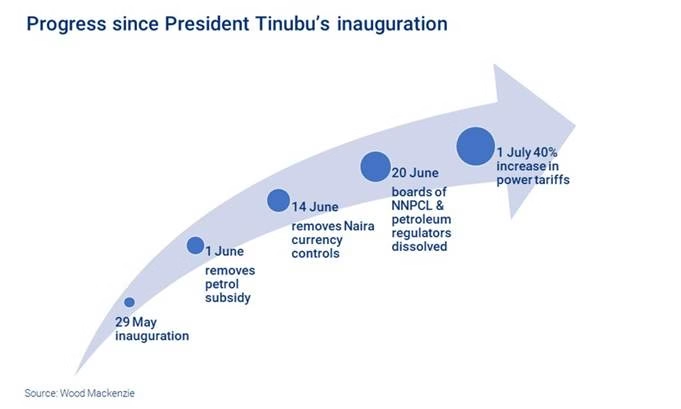
I can argue that Nigeria’s real challenge is not necessarily the volume of borrowing, but the absence of a coherent national development strategy guiding those loans. During the same interview, Gundare referenced the Nigerian Integrated Infrastructure Master Plan, which estimates that the country requires over $2.3 trillion in infrastructure investment over a 30-year period. According to him, borrowing itself is not inherently dangerous if tied to measurable productivity gains and long-term industrial goals.
That argument aligns partly with comments by civic organizations, such as BudgIT Nigeria, whose representatives have repeatedly stressed that transparency, accountability, and implementation remain bigger concerns than borrowing alone. However, it is argued that Nigeria often borrows without a clearly coordinated framework explaining how loans collectively improve exports, power generation, transportation systems, manufacturing capacity, or employment growth. As a result, many projects appear fragmented, politically driven, or disconnected from a broader national economic vision.
Reuters recently reported that Nigeria still projects massive fiscal deficits and high debt-servicing obligations despite ongoing reforms. For many Nigerians, this raises a difficult question: if borrowing continues to rise while poverty, unemployment, and economic hardship remain widespread, how will Nigerians eventually measure whether Tinubu’s reforms succeeded? That debate is likely to intensify as the Tinubu administration continues pursuing fresh external financing while simultaneously asking citizens to endure the social costs of economic restructuring.
Editor’s Note: Featured photo is courtesy of naijanews.com.