


The Roman Catholic Diocese of Argyll and the Isles has responded to the Scottish Bishops, who have begun a consultation for the possible merger of Dioceses, indicating that it would remain an independent Diocese.
The Diocese took this position after sessions of consultation among the Diocesan Pastoral Council (DPC) and the members of the clergy, each lasting at least four hours.
The report published on the official Facebook page of the Diocesan website noted that the position was taken in response to the ongoing consultations by the Scottish Bishops regarding the present structures of the Catholic Church in Scotland and its mission support.
The Diocese, which has Bishop Brian McGee, who also doubles as the President of the Scottish Catholic International Aid Fund (SCIAF) as chief shepherd, expressed appreciation “to the clergy and Diocesan Pastoral Council for their insights,” urging everyone to read the final submission to the Bishops’ Conference.
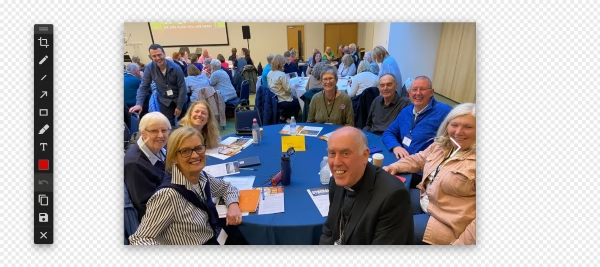
The Diocese underscored that “This report is the fruit of Conversations in the Spirit by both the Diocesan Pastoral Council and by the Clergy of our Diocese. Each discernment session lasted more than four hours, not including the writing and scrutiny of the initial reports and then the collated submission for the Bishops’ Conference of Scotland.
It explained that the Bishops of Scotland wanted to know if the mission of the Church is best supported by the present Diocesan structures or whether an alternative arrangement would be better.
“The unanimous position is that Argyll and the Isles should remain an independent diocese.”
On the question of a possible amalgamation of Dioceses, the members of the DPC and the clergy took a unanimous position: “The unanimous position is that Argyll and the Isles should remain an independent diocese as this best suited our unique reality and so enable missionary growth.”
The statement, which carries the bishop’s insignia, further disclosed that during the sessions of consultations by DPC and the Clergy of the Diocese, which each lasted four not less than four hours, “There was both enthusiasm and honesty during both sessions”, where “People see much that is good in their parishes and diocese but recognise their struggles too.”
Meanwhile, the Diocese appraised the “Need to better share resources with other dioceses”, acknowledging that “Such resources could be financial or expertise in areas such as property management, Health and Safety etc.”
Expressing willingness to share its resources with other Dioceses in Conference, the Diocese revealed that “Argyll and the Isles also has much to offer others and we envisage an ‘exchange of gifts’ as proposed in the Synod of Bishops.”
Advancing the reasons against the merger with other Diocese the located located in the Western Scottish Highlands, the Inner and Outer Hebrides argued that “For Western Europe, we are also extremely rural, consisting principally of small and scattered communities. We have no town with even 10,000 people.
“How would our needs be understood so that we receive adequate pastoral care if we merged with an urban diocese? Merging with another rural area with a low population would increase our existing challenges.
“Our diocese has multiple geographical challenges which are especially exacerbated during the long winter months. The weather, transport costs and travel infrastructure has deteriorated bringing new challenges for mission. Becoming part of an even larger diocese would be unhelpful.”
“The mission is Christ’s mission – we must have the same priorities as Jesus’ were.”
The Diocese expressed a strong belief and optimism in the mission of Christ, stating that “Mission is the most important value. Diocesan structures are secondary to and must be supportive of mission. However, we do believe that preserving our unique identity is best for promoting mission within our diocese.”
Providing another viable reason, the Diocese stressed that “If we are to merge, we would like to see the evidence for why this would improve our ability for mission. Merging alone solves nothing. We feel that Christ is with us; a personal experience of Christ with me and my community.”
Describing signs of positive areas of mission, it indicated that “Within the diocese there are many signs of mission – it is not restricted to preaching and the Sacraments but service of the kingdom of God.
“Therefore mission is present: through love, visiting the sick and bereaved, Foodbanks, pilgrimages, silence and beauty, catechesis, seeking justice, witness to family and friends, COVID outreach outreach beyond Church, Liturgy.”
Other positive signs of mission include, “Ecumenism, working with a Local Authority to adopt the SCES Sex Education Programme in non-denominational schools, Gaelic culture, evangelising through Gaelic media, writing and publishing as a form of mission. Our diocese enjoys a vibrant Gaelic and Celtic heritage which enriches our spirituality and religious life.”
Noting the peculiarities and uniqueness of their environment, the Church leaders of Argyll and the Isles further emphasised that “Unique in secular Europe is that many of our parishes are a natural part of their society.
“We have a presence, basic to our nature as a Diocese. We engage with our surrounding societies, which often support us too. However, more intentional evangelisation beyond presence and celebrating sacraments is needed.”
“Our bishop is accessible to us, regularly visiting even the most remote areas.”
The representatives of the people and the clergy of the Diocese expressed confidence in the pastoral care and approach of the diocesan Bishop, who is accessible, regularly visiting even the remote areas.
Therefore, they indicated that “Merging our diocese would reduce pastoral interaction between the bishop and his clergy and parishioners. Parishes being swallowed up (we are different from elsewhere in Scotland) would increase isolation for the clergy and for our small communities. This would be impact negatively both on mission and at the human level.”
“Formation of laity that will improve the acceptance of lay ministries.”
Consequently, the Diocese raised fundamental areas to further strengthen and support mission in the Catholic Church in Scotland.
“Many parishes spoke of a strong outreach to the poor through societies such as SVDP and food banks while others spoke of a ‘quiet’ visiting of the sick and dying. The Diocesan Holyland Accompaniment Initiative was mentioned. However, others thought that their parish could improve their outreach to the poo,” the report stated.
On the sharing of resources within the ecclesiastical structures, they stated their concerns thus, “How can we better share good practice and improve cooperation across parishes and the diocese? This should also include financial support for poorer parishes by the richer parishes.
“How can we better support clergy? Increasing lay involvement, especially among men. Formation of laity that will improve the acceptance of lay ministries. How can we deepen spiritual and catechetical growth of the laity, including our youth? Can parishes be better prepared for not having a resident priest?”
The Catholic Church in Scotland faces challenges, including declining mass attendance, resource deficits, and a decline in vocation to the priesthood and the religious life.
Conclusion
The Scottish bishops recently began a consultation among members of the faithful concerning the structure of the 8 dioceses in Scotland to discern if the existing structures of the Dioceses and parishes promote missionary work.
In each Diocese, the same three questions were issued by the Bishops of Scotland to foster discernment, beginning with mission before questions examining structures.
Some of the crucial questions were to examine whether the present structure of eight dioceses in Scotland supports mission, whether the particular diocese already has all that it needs, whether it would help if dioceses were to share resources with another diocese or dioceses and whether it would help if our diocese merged with another Diocese.
Editor’s Note: Featured photo is courtesy of the Diocese of Argyll & the Isles.