



Following a recent controversial statement by Minister of Power, Adebayo Adelabu, who stated that the situation of electricity in the oil-rich West African nation is partly “beyond our control,” Dr. Ijuptil K. Joseph’s op-ed critically interrogates Nigeria’s energy crisis, which often results in persistent blackouts amid rising energy costs.
Nigeria’s electricity crisis has once again taken center stage following a controversial statement by Minister of Power, Adebayo Adelabu, who described the situation as partly “beyond our control.” The remark, captured in a widely circulated video, has triggered strong reactions from Nigerians who continue to endure persistent blackouts and rising energy costs.
While the minister acknowledged the hardship faced by citizens, his reference to factors outside government control has been interpreted by many as an attempt to deflect responsibility. The timing of the statement is particularly sensitive, coming amid ongoing grid instability and public frustration. For a government that has repeatedly promised improvements in electricity supply, the reaction has been swift and critical. The controversy highlights the widening gap between official assurances and lived realities.
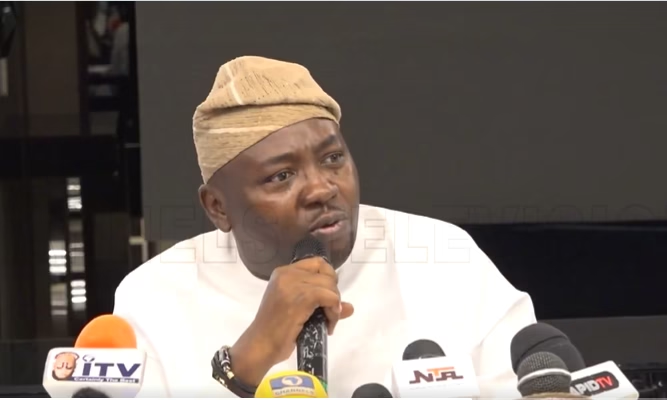
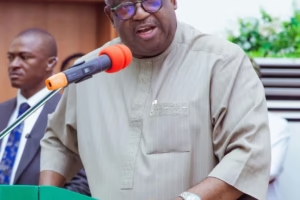
Minister of Power, Adebayo Adelabu speaks on Nigeria’s electricity crisis in a viral video. Credit: Channels TV.
In his remark during a press brief, the minister stated that “We want the generality of Nigerians, officially now, coming from me as a minister of power that for this temporary issue that is leading to hardship experience especially during this dry season where there is so much heat everywhere, where businesses are also being affected, where schools are being affected…”
According to him, “It is not our wish to find ourselves in this situation, but there are some factors beyond our control, but we are not relenting, we are working 24/7 to make sure that we go back to the trajectory of 2025, whereby you praised us, whereby you recommended us for a good job well done. You can… if we can provide such service in 2025. This is 2026, where we will be willing to even do more better as we are close to the election year.”
Adelabu further disclosed that “Except that we cannot help it, that’s why we find ourselves here. But I can assure you that in the next few weeks, all these will be over. Power generation will be improved, transmission will be improved, and 6,000 megawatts will be achieved before the end of 2026.”
Claims vs Reality: The 2025 “Trajectory” Question
The minister’s claim of returning to a positive “trajectory of 2025” has been strongly disputed by many Nigerians, who point to repeated national grid collapses during that same period. Reports indicate that Nigeria experienced multiple system failures between 2023 and 2025, with blackouts affecting large parts of the country. Notably, in 2025 alone, several grid disturbances were recorded, raising concerns about the stability of the power infrastructure. These incidents challenge the narrative of consistent progress and raise questions about the accuracy of the minister’s assertion.
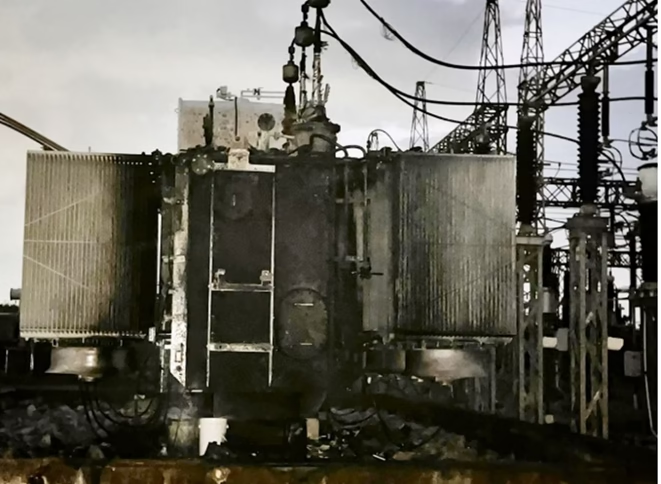
Collapsed Power Grids. Credit: Advocatus Africa.
Citizens have taken to social media to express frustration, with many highlighting that there was no sustained period of reliable electricity to justify such claims. Comments from Nigerians include: “Which 2025 are they talking about?” “We have been in darkness for years,” and “This is not new, it’s getting worse.” Such reactions reflect a broader skepticism toward official statements that appear disconnected from everyday experiences.
Examples of reported grid issues include the 2023 multiple nationwide grid collapses reported by transmission authorities, the 2024 continued instability with recurring outages across regions and the 2025 repeated system disturbances despite reform promises. Additionally, in February 2026 alone, the national grid reportedly collapsed twice in four days, leaving large parts of the country without electricity for hours. These patterns suggest that the challenges are long-standing rather than temporary, contradicting the idea of a stable benchmark year.
“Reliance on self-generated power increases costs, reduces productivity, and worsens environmental pollution.” – Dr. Ijuptil
Economically, the impact on businesses is severe, with small and medium enterprises spending about 3.5 trillion Naira annually on generators. This reliance on self-generated power increases costs, reduces productivity, and worsens environmental pollution. Overall, the crisis continues to hinder economic growth and quality of life across the country.
Power, Promises, and Politics
The minister’s reference to being “close to election year” has also drawn attention, with analysts interpreting it as a political signal rather than a purely technical statement. Electricity supply has long been a central campaign issue in Nigeria, often used as a benchmark for government performance. During the 2022 campaign, Bola Ahmed Tinubu famously stated that voters should not support him if he failed to deliver stable electricity. This context has led critics to argue that the renewed emphasis on power improvements may be tied to electoral considerations. The concern is that electricity promises risk becoming cyclical, which intensifies during campaign periods but fading afterward without lasting impact.
For many Nigerians, the issue is no longer about promises but about delivery. The repeated pattern of commitments followed by limited progress has eroded public trust in the sector. The mention of elections in the minister’s statement reinforces fears that infrastructure development may be driven by political timelines rather than long-term planning. As the country approaches another electoral cycle, the demand for accountability is likely to grow stronger. Ultimately, the credibility of any new assurances will depend on visible, measurable improvements in electricity supply.
Practical Solutions to Nigeria’s Power Crisis
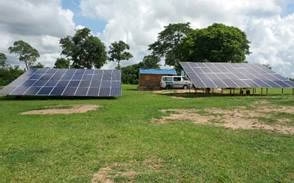

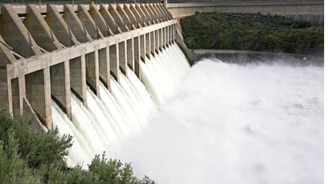
Solar energy, transmission grid infrastructure, and hydropower sources are key solutions to Nigeria’s electricity challenges.
Despite the scale of the crisis, energy experts agree that Nigeria’s electricity challenges are solvable with the right mix of policy, investment, and execution. One of the most immediate solutions lies in expanding decentralised solar power, including mini-grids and solar home systems, which can deliver electricity directly to communities without relying on the fragile national grid.
Nigeria’s strong solar potential, estimated at 5–7 kWh/m² of daily radiation, makes this a highly viable option for rapid deployment. In parallel, the country must urgently upgrade its transmission infrastructure, as weak grid capacity remains a major cause of system collapses. Without strengthening transmission and distribution networks, increased power generation alone will not translate into stable electricity supply.
Another critical step is diversifying energy sources beyond gas and centralised generation, incorporating hydropower, wind, and biomass to create a more resilient energy mix. Research indicates that Nigeria has significant untapped hydropower potential, alongside growing opportunities in renewable energy. In addition, battery storage systems are essential to stabilise renewable energy and ensure consistent supply, particularly during peak demand periods.
“Solving Nigeria’s electricity crisis will require moving beyond rhetoric to sustained implementation, accountability, and a clear commitment to delivering reliable power for all citizens.” – Dr. Ijuptil
In conclusion, policy reforms should also focus on attracting private sector investment, supported by transparent regulations and incentives that encourage long-term participation. Ultimately, solving Nigeria’s electricity crisis will require moving beyond rhetoric to sustained implementation, accountability, and a clear commitment to delivering reliable power for all citizens. Will the government of the day develop enough willpower to deliver on its energy promise?