






In this blockbuster piece, Advocatus Africa’s in-house data and annotation analyst, Dr. Ijuptil K Joseph, critically examines the £746 million agreement between Nigeria and the UK tied to infrastructure development and migration control within the wider context of Nigeria’s fiscal struggles and long-term economic independence.
The recent agreement between Nigeria and the United Kingdom has sparked intense debate about its true implications. While government officials describe it as a milestone in economic cooperation, many observers see deeper concerns beneath the surface. At the heart of the discussion is a £746 million loan tied to infrastructure development and migration control.
In a country already burdened by rising debt, such commitments cannot be viewed in isolation. They must be examined within the broader context of Nigeria’s fiscal struggles and long-term economic independence. The real question is whether this deal represents progress or a continuation of a troubling cycle.
A “Historic” Deal with Unequal Foundations
The agreement between the United Kingdom and Nigeria has been widely described as historic, signalling a renewed era of cooperation. During the visit of Bola Ahmed Tinubu, both nations emphasised shared goals in trade, infrastructure, and security. Public messaging focused heavily on partnership, opportunity, and mutual benefit. The optics—state banquets, high-level meetings, and royal receptions, reinforcing this narrative.
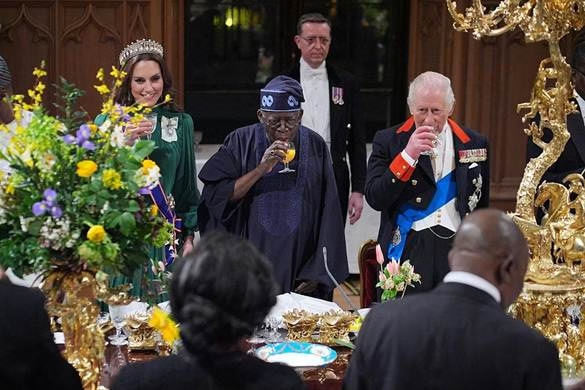
President Bola Tinubu with the Royal Family. Credit: Christ Jackson
However, diplomatic presentation does not always reflect economic reality. True partnerships must be judged not by ceremony, but by structure. Beyond the symbolism, the agreement introduces binding commitments that shape Nigeria’s policy space. It links financial assistance with migration cooperation and security alignment. Nigeria agreed to recognise UK-issued travel documents to speed up deportations. This effectively strengthens the UK’s control over migration processes. While framed as administrative efficiency, it shifts responsibility onto Nigeria. Such provisions reveal a deeper imbalance beneath the language of cooperation.
Historically, agreements between developed and developing nations often carry unequal weight. Stronger economies tend to shape terms that align with their domestic priorities. In this case, the UK secures migration enforcement, trade access, and economic return. Nigeria, on the other hand, assumes financial and social responsibilities. This asymmetry raises important questions about fairness and long-term impact. Because when obligations are uneven, the partnership begins to resemble leverage.
Debt, Loans, and the Cost of Conditional Financing
At the centre of the agreement is a £746 million loan backed by UK Export Finance. This funding is intended to refurbish key ports in Lagos and improve trade infrastructure. On the surface, this appears to be a strategic investment in economic growth. But unlike grants or open financing, this loan comes with strict conditions. It is tied to procurement rules that favour the lender’s domestic industries. This is where the real economic implications begin to emerge.
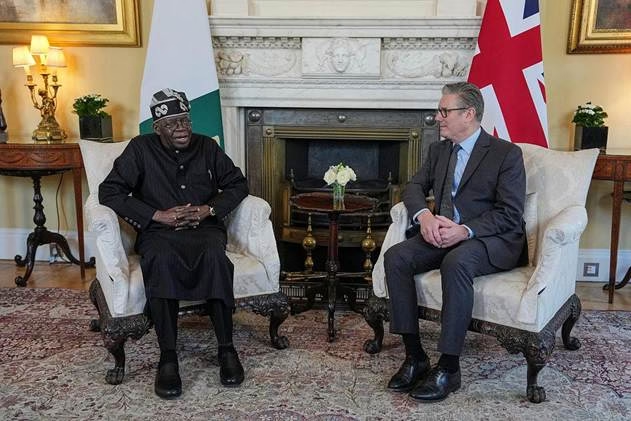
Bola Tinubu, Nigeria’s President, and Keir Starmer, UK Prime Minister, during a meeting at 10 Downing Street in London, UK. Credit: Bloomberg
At least 20% of the total contract value, which amounted to £236 million, must go to British firms. Additionally, £70 million has already been earmarked for British steel exports. This ensures that a portion of the borrowed funds flows directly back into the UK economy. In effect, Nigeria is financing foreign industry through its own debt obligations. Local companies are left with fewer opportunities to participate in large-scale projects. This limits domestic capacity building and long-term industrial development.
These concerns are amplified by Nigeria’s current debt situation. According to the Debt Management Office of Nigeria, public debt has exceeded ₦153 trillion. External debt alone stands at roughly $47–48 billion, reflecting heavy reliance on borrowing. More critically, a significant share of government revenue is spent on debt servicing. This reduces funding available for essential sectors like healthcare and education. Taking on additional tied loans under these conditions increases financial vulnerability.
A Cycle of Dependency or a Path to Growth?
The long-term impact of this agreement depends on how it shapes Nigeria’s economic independence. When borrowing is tied to external suppliers, local industries are often sidelined. This reduces opportunities for job creation and skills development within the country. Instead of strengthening internal capacity, reliance on foreign expertise increases. Over time, this creates a pattern where development depends on external input. Such patterns are difficult to reverse once established.
At the same time, Nigeria continues to pursue additional borrowing to sustain its economy. Institutions like the International Monetary Fund have highlighted ongoing fiscal pressures. New loans are being used to support budgets, infrastructure, and currency stability. However, each new borrowing adds to existing repayment obligations. This creates a cycle where debt is used to manage previous debt. And cycles like this often led to long-term dependency rather than growth.
Conclusion
The broader concern is not just economic, but structural. When financial decisions are shaped by external conditions, sovereignty becomes constrained. Nigeria may still make policy choices, but within limits defined by lenders.
At the same time, social pressures, such as unemployment and migration, remain unresolved. This combination of financial and social strain creates a sense of entrapment. If left unchecked, what is called partnership today may gradually evolve into a system of economic control.