
African theologians, comprising scholars, pastoral workers and consecrated men and women, have decried the cancers of poverty, corruption, and suffering while pointing to theological formation and sound catechesis as panacea.
This submission is contained in a communiqué issued on 27 March 2026 at the end of the 35th Theology Conference Week at the Catholic Institute of West Africa (CIWA), Port Harcourt, Nigeria.
“Theological formation and catechesis in Seminaries and Catholic institutions should be strengthened in order to address contemporary African challenges such as poverty, corruption, insecurity, environmental injustice, and psychological suffering,” the institution noted.
It further drew attention to “ecological justice and environmental responsibility as emerging areas of human suffering in Africa,” as critical areas to be addressed towards integral development.
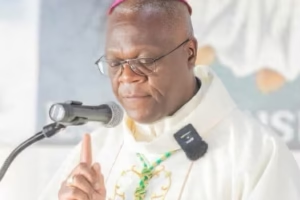
The statement signed by the Acting Rector, Very Rev. Fr. Prof. Luke E. Ijezie and Registrar, Rev. Fr. Wilson U. Akhigbe, maintained that “The Church in Africa should intensify her pastoral response to all forms of human suffering.”

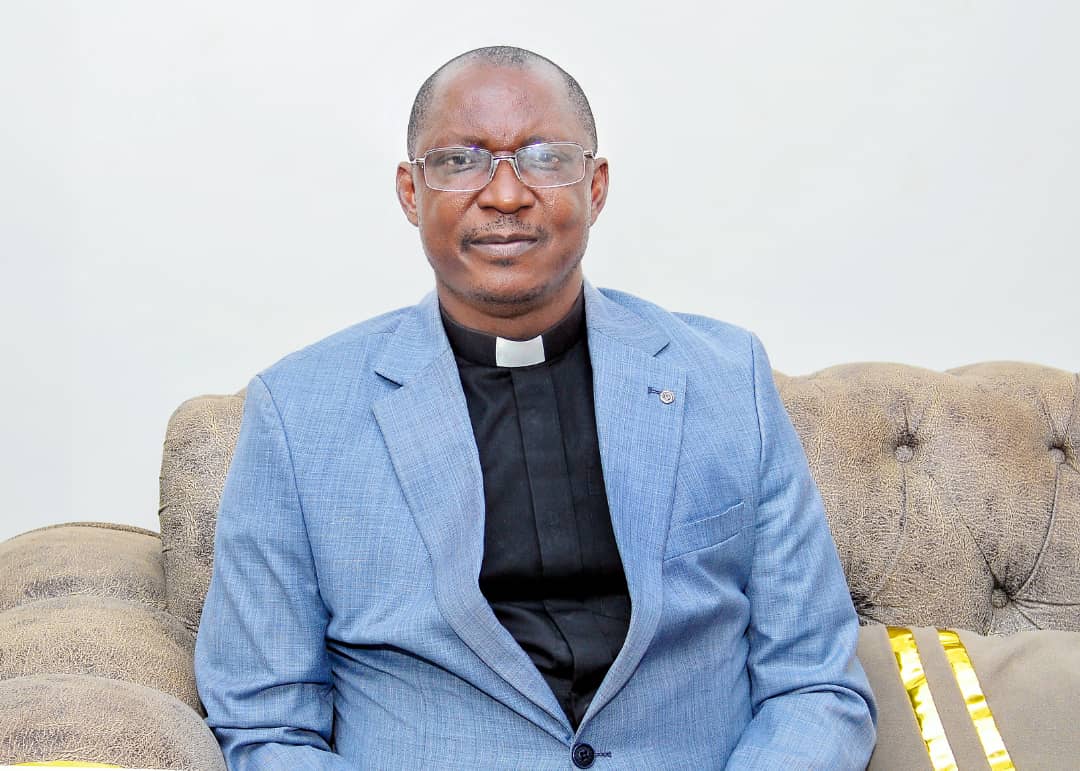
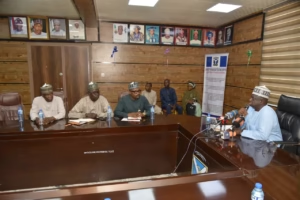
Acting Rector, Very Rev. Fr. Prof. Luke E. Ijezie, speaking during the conference. Credit: Ciwa Port Harcourt-Nigeria
It underlined that “Pastoral ministries and pastoral agents should endeavor to prioritize the poor, the sick, persons with disabilities, victims of violence, and all those living in conditions of injustice.”
“Integrating spiritual care with psychological, physical and social support.”
It urged the Church to “respond holistically to suffering by integrating spiritual care with psychological, physical and social support,” while calling for sustaining “its training of the faithful to know and ask for their rights.”
Equally, “the Conference strongly advocates that the Church collaborate more closely with psychologists, medical practitioners, social workers, counsellors and peace-building institutions in addressing human suffering.”
At the event, which was held from 23 to 27 March with the theme “Theology and Human Suffering in Contemporary Africa,” the scholars recommended that “Christian suffering must always be understood in the light of Christ’s redemptive suffering.”

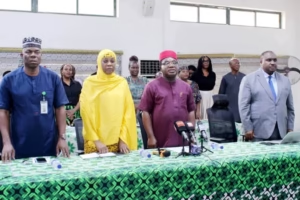
Some Ladies Knights of St. Mulumba at the event. Credit: Ciwa Port Harcourt-Nigeria
They also advised African theologians “to develop a contextual theology of suffering rooted in Scripture, Tradition, and African cultural experience.”
The experts also touched on justice and accountability, charging all to act with integrity to stamp out corruption.
“The Church must continue to promote justice, accountability, and transparency in society, especially in addressing corruption and social inequality. The Conference advocates that the Church should continue to speak prophetically against the structural causes of suffering, especially corruption, injustice, bad governance, violence, and the exploitation of the poor,” they stated.
The academics used the occasion to critically reflected on the theological, pastoral, cultural, and socio-ethical dimensions of human suffering in contemporary Africa.
Occurring “at a particularly significant moment in the life of the African continent, a time marked by persistent poverty, violent conflicts, insecurity, corruption, economic instability, forced migration, environmental degradation, psychological distress, and growing spiritual disorientation,” organisers defended the choice of the theme by maintaining that the conference reflected “not only an academic concern but a profound pastoral urgency.”
The communiqué emphasised the importance of attentive listening based on the diverse scholarly papers shared.
Through careful deliberation and dialogue, it also thoughtfully reflected on the universal and contextual nature of suffering.
“We note that suffering is a universal human experience; however, its interpretation and response vary according to cultural, religious, and historical contexts. In the African worldview, suffering is often understood within a communal and moral framework rather than purely individualistic categories,” it noted.
Listing contemporary forms of suffering in Africa, the conference “identified several major forms of suffering affecting Africa today, including poverty, homelessness, destitution, mental and bodily sicknesses, hunger and malnutrition, unemployment, displacement, forced migration, loneliness, social isolation, family breakdown, insecurity, violence, various forms of abuse, exploitation, religious persecution, marginalization, discrimination, drug addiction, loss of hope, and the suffering caused by war and communal conflicts.”

Consecrated women during one of the sessions. Credit: Ciwa Port Harcourt-Nigeria
Participants also “observed with concern the growing reality of psychological suffering in Africa, including depression, trauma, anxiety, and emotional distress. We recognise that these realities demand not only theological reflection but also concrete pastoral, legal and social responses.”
Christian suffering is rooted in faith, hope, and the redemptive mystery of Christ
Regarding biblical and theological responses, they reaffirmed that “the deepest meaning of suffering in Christian tradition is revealed in the life, passion, death, and resurrection of Jesus Christ (Heb 5:8; Phil 3:10; 1 Pet 2:21). Christian suffering, therefore, finds meaning not in despair but in faith, hope, and participation in the redemptive mystery of Christ (1 Pet 4:13).”
The Conference also affirmed that “suffering is a profound theological and moral reality that raises fundamental questions about God, human dignity, justice, hope, and the meaning of existence.”
Stressing that suffering is universal, the academics cited the African context where distinctive forms of suffering “call for a theology that is both doctrinally grounded and contextually responsive, pastorally attentive and socially transformative.”
Accordingly, the institute recognised that “theology as done in Africa already possesses rich resources for interpreting the mystery of suffering: Sacred Scripture, the redemptive suffering of Christ, the communal spirituality of African cultures, the legal and moral tradition of the Church, the principle of Inculturation and the African sense of solidarity and shared destiny.
“Emphasis must be placed on the fact that suffering is not to be interpreted solely as tragedy but also as a call to deeper faith, stronger solidarity, moral responsibility, and renewed commitment to the dignity of the human person. In this light, the Conference expresses strong conviction that theology in Africa should be contextual, pastoral, prophetic, inculturated, mission-oriented, and transformative, addressing suffering while fostering hope.”
“Building a more just, compassionate, and hope-filled society.”
The conference acknowledged the place of educational formation and social transformation in the African continent.
“Academic theological reflection must lead to concrete pastoral and social action rather than remaining purely theoretical. Theology must, therefore, remain closely connected to pastoral practice and social transformation,” they stated.

Some students during the occasion. Credit: Ciwa Port Harcourt-Nigeria
They expressed appreciation to God for “the grace for this gathering and for sustaining the Church in Africa amid the many trials confronting humanity today,” wishing that “theology in Africa should never be detached from the realities of suffering confronting the continent, and that it may remain a theology of hope, compassion, justice, and transformation.”
Committing the conference “to the intercession of our Patron Saints, Augustine and Thomas Aquinas, to the maternal intercession of the Blessed Virgin Mary, comforter of the afflicted, as we invoke the guidance of the Holy Spirit upon the Church in Africa and throughout the world,” the scholars equally prayed that “the Church in Africa, theologians, pastoral agents, and all people of goodwill could work together in building a more just, compassionate, and hope-filled society.”
The experts urged all “Catholic institutions [to] promote justice, peace, human dignity, and responsible leadership in society.”
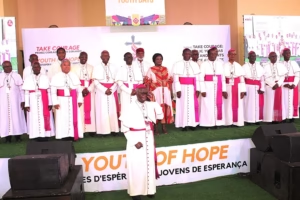
The event drew together theologians, scholars, pastoral workers, religious men and women, Knights and their Ladies, and students from across Nigeria and beyond.
Editor’s Note: All photos are courtesy of Ciwa Port Harcourt-Nigeria.