







- Under the 2022 Electoral Act, electronic transmission of results was introduced as a key reform
- INEC received ₦313.4 billion from the Federal Government to conduct the 2023 general elections
- However, the use of digital technology failed woefully, sparking outrage
- Ahead of the 2027 elections, civil society groups, election observers, and Nigerians demand stronger legal backing for the use of technology
- President Bola Tinubu recently allocated ₦1.01 trillion to INEC for the upcoming elections
- “Stop making excuses for INEC,” says Mark as Obi insists, “Allow the election to go through the normal process.”
- Ongoing protests at the Red Chamber demanding the use of technology in the next elections.
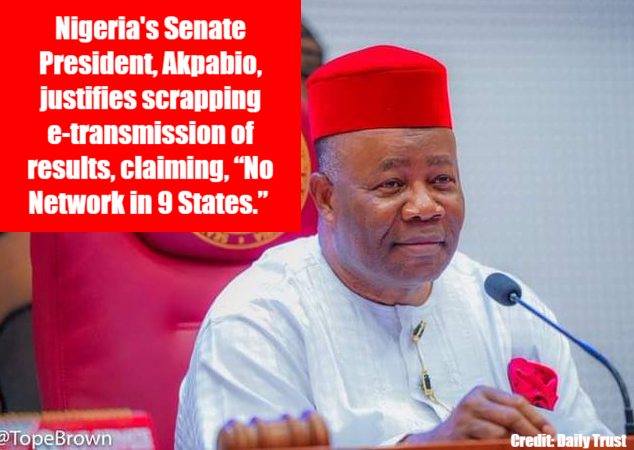
Nigeria’s Senate President, Godswill Akpabio, has come under criticism from Nigerians for publicly defending the National Assembly’s decision to remove the provision mandating electronic transmission of election results from Nigeria’s amended Electoral Act.

Senate President Godswill Akpabio. Credit: www.naijanews.com
Under the 2022 Electoral Act, electronic transmission of results was introduced as a key reform to enhance transparency and reduce manipulation.
The law empowered the Independent National Electoral Commission (INEC) to deploy the use of technology, especially the Bimodal Voter Accreditation System (BVAS) for accreditation, voting, and the transmission of results from polling units to central servers.
It would be recalled that during the 2023 general elections, the use of digital technology failed woefully, sparking outrage.
Although BVAS was used for voter accreditation, real-time transmission of results broke down in several locations, forcing INEC to rely heavily on manual uploads long after polls closed.
This is despite the fact that INEC received ₦313.4 billion from the Federal Government to conduct the 2023 general elections, one of the most expensive polls in Nigeria’s history.
While the electoral body later attributed the BVAS failure to technical glitches, commentators pointed to poor contingency planning, weak infrastructure, and inadequate transparency.
This raised eyebrows, leading to disputes, litigations, BVAS failure, public outcry and distrust of the electoral outcome.
Critics argue that the scale of funding heightened public expectations for a technologically sound and credible election, making the operational failures more difficult to justify.
As INEC prepares for the 2027 elections, civil society groups and election observers say Nigerians want stronger legal backing for technology, early testing of systems, improved infrastructure, and strict enforcement of transparency standards.
Policy documents from election monitoring organisations emphasise that credibility in 2027 depends on restoring confidence in result transmission, accountability, and the independence of the electoral body.
President Bola Tinubu recently allocated ₦1.01 trillion to INEC for the upcoming elections, signalling the government’s commitment to funding the electoral body.
However, critics argue that spending must translate into concrete technological and logistical improvements rather than excuses for backtracking on reforms.
Against this backdrop, the Senate’s recent rejection of the proposed bills that would make electronic transmission of results mandatory has sparked backlash.
Speaking in Abuja, Akpabio claimed, “Real-time transmission means that in over nine states where networks are not working because of insecurity, there will be no election results,” insisting that the legislature makes laws while INEC determines election modalities.
Akpabio made the remarks while speaking at the launch of “The Burdens of Legislators in Nigeria,” a book authored by former Senator, Effiong Bob.
His comments came amid sustained public outrage, criticism from opposition parties and the Nigerian Bar Association (NBA), and heightened political tension ahead of the 2027 general elections.
According to Akpabio, insecurity and poor network coverage make mandatory e-transmission impractical.
“Real-time transmission means that in over nine states where networks are not working because of insecurity, there will be no election results. Nationally, it means that if the national grid collapses and no network is working, no election results will be valid,” he said.
The 63-year-old legislator insisted that the policy could disenfranchise entire states, adding that lawmakers do not deploy technology because that is the role of INEC.
The 15th President of the Nigerian Senate further criticised opposition figures and commentators questioning the move, saying, “You see them talking. We even have a young man from Akwa Ibom who is the publicity secretary to one of the parties. When you see him talking, you will think he knows it all. He doesn’t know anything about lawmaking.”
The decision triggered sharp criticism nationwide as with prominent politicians, like former Senate President and National Chairman of the new opposition party, African Democratic Congress (ADC), David Mark, who openly disagreed with such a justification.
Mr. Mark faulted the reasoning, insisting that lawmakers should not shield the electoral body, adding that, the Senate should “stop making excuses for INEC, pass the law and allow the commission to decide how to implement it.”
The Benue politician contended that weakening the legal framework only fuels suspicion and erodes public trust in elections.
Civil Society Organisations (CSOs) and the 2023 presidential candidate of the Labour Party (LP), Mr. Peter Obi, on Monday, 9 February 2026, were at the National Assembly to protest against the Senate’s plan to remove electronic transmission of votes in the electoral laws in the ongoing electoral amendment.
Obi queried the Senate thus, “Why introduce confusion after the process?” insisting, “Allow the election to go through the normal process. Whatever the outcome is, we will accept it.
Prominent activist and political commentator Peter Akag also condemned the rejection, arguing that excuses about network failure undermine reform efforts and signal a lack of transparency.
Many Nigerians who echoed similar sentiments on social media, particularly on X (Twitter), also criticised Akpabio’s comments, describing such explanations as illogical and embarrassing.
Many questioned how a country where Point of Sale (POS) transactions, digital banking, and social media function daily can suddenly lack network access for elections.
Critics accuse lawmakers in the Red Chamber of deliberately weakening transparency to facilitate manipulation.
They claim this move continues to deepen public distrust in the electoral process, intensifying fears that the 2027 elections may not be free, fair and credible.