







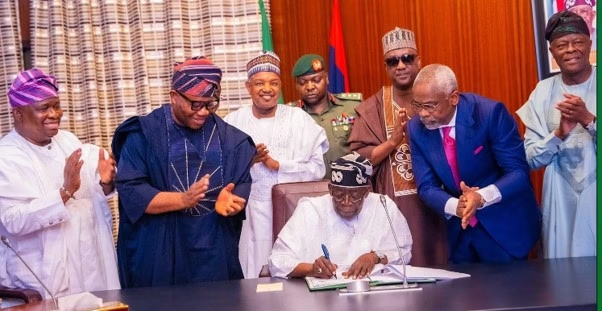
Nigeria’s 2025 budget has been presented as a roadmap for stability and growth, anchored on improved oil production, fiscal reforms, and expectations of stronger revenue performance. But underlying the headline optimism is a far more fragile fiscal structure: one heavily exposed to oil price volatility, rising debt-service obligations, and repeated warnings from the International Monetary Fund (IMF) about the sustainability of the assumptions behind government spending plans.
An analysis by Statinews stated that the 2025 Nigeria’s fiscal outlook highlights a recurring tension in economic planning: ambitious budgets built on optimistic oil benchmarks, set against an external environment that is increasingly uncertain and structurally unfavourable to oil-dependent economies.
Oil assumptions are doing too much of the fiscal heavy lifting
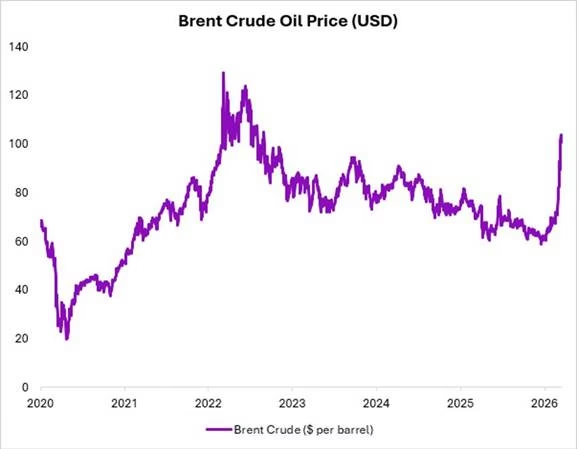
At the core of Nigeria’s fiscal framework is a familiar vulnerability: dependence on oil revenue assumptions that are highly sensitive to global price swings. The 2025 budget relies on relatively strong oil price projections and production assumptions, but market conditions have repeatedly shown how quickly these forecasts can become misaligned with reality.
The IMF has consistently cautioned that Nigeria’s fiscal position remains exposed to oil price volatility, warning that lower-than-expected crude prices could significantly widen fiscal deficits and force mid-year budget adjustments (source: International Monetary Fund Article IV Consultation).
This is not a theoretical risk. When oil prices fall below benchmark assumptions, Nigeria’s fiscal space compresses rapidly because hydrocarbons still account for a large share of export earnings and government revenue. The result is a structural mismatch between planned expenditure and actual inflows.
The implication is straightforward but uncomfortable: Nigeria’s budget credibility is increasingly dependent on a commodity it does not fully control.
Debt service is quietly becoming the dominant budget line
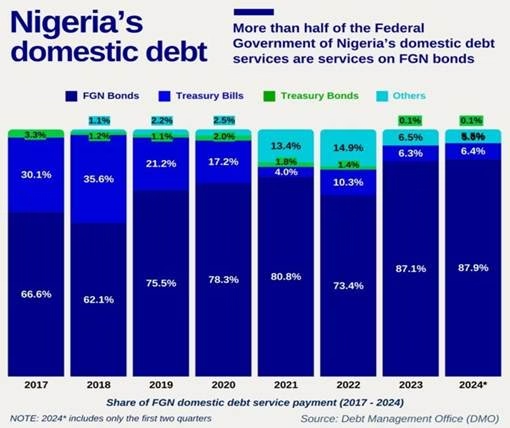
Beyond oil volatility, Nigeria’s fiscal pressure is increasingly shaped by rising debt servicing costs. Recent federal fiscal plans show that debt repayment consumes a growing share of government revenue, leaving limited space for infrastructure and social investment.
In Nigeria’s medium-term fiscal projections, debt service alone has been estimated at more than a third of total budgeted expenditure in some scenarios, highlighting how quickly borrowing costs can crowd out development spending, as reported by Reuters.
This creates a feedback loop that is difficult to break: revenue shortfalls lead to borrowing; borrowing increases debt service; higher debt service reduces fiscal flexibility; and reduced flexibility leads to more borrowing.
The IMF has repeatedly warned that if fiscal assumptions are not adjusted to reflect lower oil prices and weaker-than-expected revenue performance, Nigeria risks a widening deficit and rising debt vulnerability. In practical terms, debt is no longer just a financing tool—it is becoming a structural constraint on policy.
The IMF warning is not new—but it is becoming more urgent
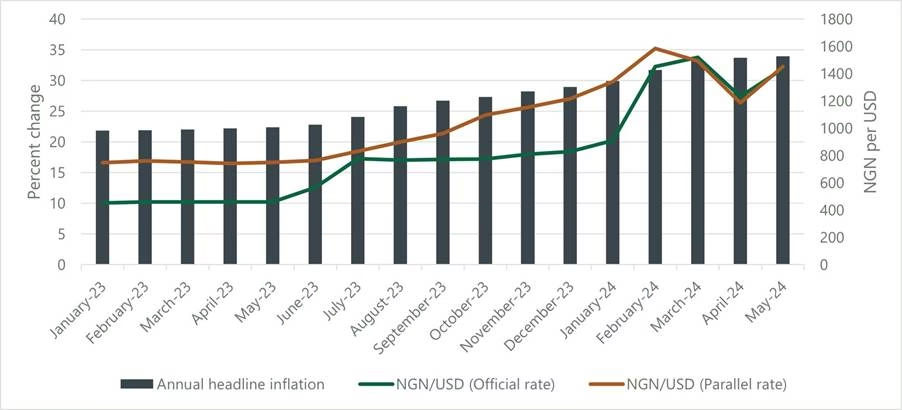
The IMF’s position on Nigeria has remained consistent over multiple review cycles: reforms are improving macroeconomic stability, but growth remains too low in per capita terms, inflation is still elevated, and poverty pressures persist despite reform momentum.
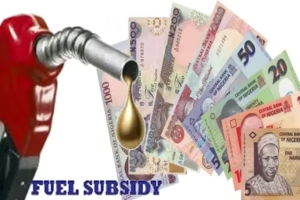
While Nigeria has implemented reforms such as fuel subsidy removal and foreign exchange adjustments, the IMF has emphasised that these gains have not yet translated into broad-based welfare improvements for the population.
This duality is critical. On one hand, investors see stronger macroeconomic discipline and improved policy credibility. On the other hand, households are still facing high inflation, rising transport costs, and persistent food insecurity. The gap between macro-stability and micro-reality is where fiscal credibility ultimately gets tested.
The deeper problem: optimistic budgets meet constrained capacity
The recurring issue in Nigeria’s fiscal planning is not simply about oil prices or debt levels in isolation. It is about the interaction between overly optimistic revenue projections and constrained institutional capacity to absorb shocks.
When budgets assume high oil prices, stable production, and strong revenue collection simultaneously, they become vulnerable to even modest deviations in global conditions. At the same time, expenditure rigidity, driven by debt service, subsidies (or their removal), and essential recurrent spending, limits the government’s ability to adjust quickly.
This is why IMF warnings about revising oil assumptions are not technical footnotes. They are structural signals about the fragility of the entire fiscal framework.
Conclusion
Nigeria’s 2025 budget reflects a government attempting to balance reform momentum with economic reality. But the underlying structure remains exposed to the same long-standing vulnerabilities: oil dependency, rising debt service, and a narrow fiscal base.
The optimism embedded in budget projections is not without foundation. Reforms are real, investor confidence has improved, and macro indicators have stabilised in certain areas. But fiscal sustainability is not just about stabilization—it is about resilience.
Until Nigeria reduces its exposure to oil price cycles and significantly expands non-oil revenue capacity, every budget will continue to sit on a tension between projected optimism and structural constraint. In that sense, the 2025 budget is not an outlier. It is a continuation of a familiar pattern: ambitious assumptions meeting hard economic limits.