







A growing number of Nigerian economic commentators are asking the public to calm down about the country’s rising debt profile. Their argument is becoming increasingly familiar: Nigeria’s debt remains manageable compared to larger economies, Eurobond investors are not panicking, the country has not defaulted like Ghana or Zambia, and international agencies are beginning to reward President Bola Ahmed Tinubu’s reforms with improved ratings.
Technically, much of that argument is correct. But for millions of Nigerians struggling with rising food prices, expensive transportation, weak wages, deepening poverty, and insecurity, the debate over whether Nigeria has officially defaulted is beginning to sound detached from everyday reality.
That contradiction was fully visible during a recent economic discussion on television anchored by broadcaster Rufai Oseni, where analyst Rotus Oddiri defended Nigeria’s debt position while urging Nigerians not to panic over new borrowing requests from the federal government.
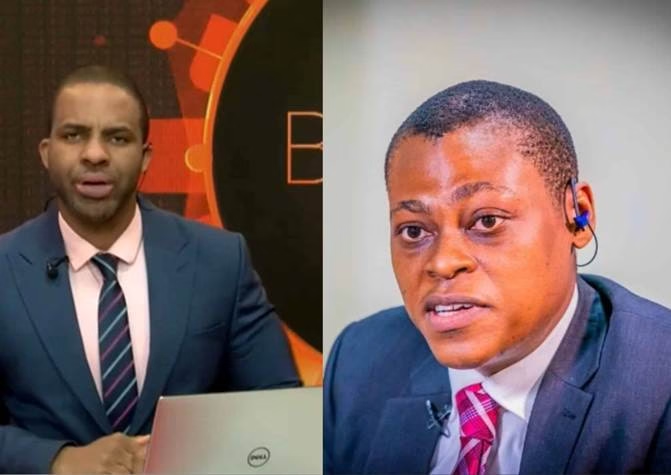
Arise TV broadcaster Rufai Oseni, and Analyst Rotus Oddiri. Credit: Victoria Chukwuani.
The Argument for Calm Over Debt Concerns
Rotus Oddiri argued that public reactions to debt have become overly emotional and often ignore global context. He pointed to rising bond yields across G7 economies, including the United States, United Kingdom, Japan, France, and Italy, explaining that even advanced economies are battling debt pressures and inflation fears.
According to him, Nigeria’s situation is being unfairly exaggerated. “Please take it easy with Nigeria’s debt. Our debt is manageable,” Oddiri said during the broadcast.
He argued that Nigeria’s external debt, currently estimated at roughly $51.9 billion after naira devaluation inflated official figures, remains significantly lower than that of countries like South Africa and Egypt. He also emphasised that Nigeria has not defaulted on its obligations, unlike countries such as Ghana, Zambia, and Ethiopia.
Oddiri further highlighted that Nigeria is not currently under an IMF bailout arrangement and praised Finance Minister Wale Edun for helping secure a recent sovereign ratings upgrade from S&P Global Ratings.
The Investor Confidence Narrative
Oddiri also defended the Tinubu administration’s exchange-rate reforms, arguing that naira stability is beginning to restore investor confidence. Referencing comments from real estate executive Toby Yiu of Veritasi Homes and business leaders interviewed in Kigali, Oddiri claimed that exchange-rate predictability now allows companies to price contracts more accurately, plan projects, and rebuild trust in the marketplace.
He repeatedly pointed to the Dangote Refinery as evidence that Nigeria’s industrial reforms are beginning to produce strategic gains. According to him, the refinery is helping reduce fuel supply uncertainty and strengthening Nigeria’s energy independence.
For investors and financial institutions, these developments matter enormously: currency predictability improves planning; refining capacity reduces import dependence; and sovereign upgrades improve market confidence. But economic stability on paper is not always the same thing as economic relief in real life.
The Reality Ordinary Nigerians Are Facing
The most revealing moment of the discussion came from Rufai Oseni’s response near the end of the segment. “It’s difficult to relax when ultimately the revenue is supposed to service the people’s needs and the people’s welfare, and there’s just no money left to do that,” Oseni replied. That statement captured the core issue far better than any debt-to-GDP ratio.
Because the real public anxiety in Nigeria is not simply about whether the government can continue borrowing. It is about whether citizens are seeing meaningful improvements in their lives despite the borrowing and the painful reforms attached to it. Since Tinubu removed fuel subsidies and floated the naira in 2023, Nigerians have experienced one of the sharpest declines in purchasing power in recent history.
Petrol prices surged dramatically. Transportation costs exploded. Electricity tariffs increased. Food inflation climbed relentlessly. The naira lost substantial value against the dollar before later stabilizing. While investors and rating agencies celebrated macroeconomic reforms, millions of Nigerians were forced into survival mode.
Even institutions that support Tinubu’s reforms acknowledge this reality. The International Monetary Fund has repeatedly praised the administration’s fiscal reforms while simultaneously warning that poverty and food insecurity have worsened during the adjustment process. The World Bank has also admitted that the reforms have imposed severe short-term pressures on households and businesses. That contradiction now defines Nigeria’s economic debate.
Supporters of the reforms see stabilization, improved fiscal discipline, stronger reserves, and rising investor confidence. Critics see a population growing poorer while being told to wait for long-term benefits that remain difficult to feel in daily life.
Why Nigerians Remain Skeptical
The problem is not that commentators like Rotus Oddiri are entirely wrong. The problem is that many of the economic indicators they focus on are indicators that matter more to investors than to citizens.
Bond yields matter to financial markets. But food prices matter to families. Credit ratings matter to lenders. But electricity costs matter to small businesses. Eurobond performance matters to foreign investors. But insecurity, unemployment, and hunger matter to ordinary Nigerians.
And this is why comparing Nigeria favorably to countries that have defaulted misses the broader point. Avoiding default is important, but it is also a very low benchmark for a country that regularly describes itself as Africa’s largest economy and regional leader. Nigeria is not expected merely to survive. It is expected to grow, industrialize, create jobs, reduce poverty, and improve living standards.
The Real Measure of Success
That is why many Nigerians remain unconvinced when they hear repeated assurances that the debt is “manageable.” To them, the economy itself no longer feels manageable. The Tinubu administration believes that difficult reforms are laying the foundation for future prosperity. That may eventually prove true. There are already signs of greater exchange-rate predictability, stronger fiscal revenues, and improved investor sentiment.
But reforms cannot ultimately be judged by what S&P says, what Eurobond traders think, or whether foreign creditors remain comfortable. They will be judged by whether Nigerians themselves can eventually afford to live better. Until then, telling citizens to relax about debt risks sounding less like economic analysis and more like elite detachment from a population already overwhelmed by the cost of survival.