







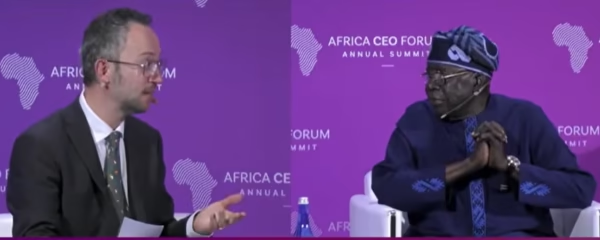
At the Africa CEO Forum, Nigeria’s President, Bola Ahmed Tinubu, defended his administration’s economic reforms, convinced that history will eventually vindicate him. Fuel subsidy removal, naira liberalisation, aggressive tax reforms, and fiscal tightening were, in his words, “necessary” decisions to save Nigeria from economic collapse.
He described subsidy removal as ending a “fake life.” He argued that Nigeria could no longer sustain wasteful spending, currency distortions, and fiscal leakages. The president insisted that painful reforms were unavoidable if the country hoped to achieve long-term stability. On paper, many economists agree with him. The problem is that for millions of Nigerians, the promised recovery still feels distant, abstract, and increasingly disconnected from daily reality.
Two years after Bola Ahmed Tinubu launched sweeping economic reforms in May 2023, international financial institutions, including the International Monetary Fund, have praised Nigeria’s macroeconomic stabilization efforts, but both institutions also acknowledge that those gains have not yet translated into broad improvements in living conditions for ordinary Nigerians.
The IMF noted in its 2024 Article IV Consultation that while subsidy removal, exchange-rate unification, and tighter monetary policy were necessary reforms, “poverty and food insecurity” had worsened amid rising inflation and weak per-capita growth. Inflation climbed above 32%, with food inflation reaching 38% in early 2024.
In its 2025 assessment, the IMF again stated that although investor confidence and macroeconomic stability had improved, “poverty and food insecurity have risen.” Similarly, the World Bank described Nigeria’s reforms as “necessary” to avert fiscal crisis and improve long-term stability, but admitted the policies had imposed “short-term pressures on households and businesses.”
The World Bank also warned that the unwinding of fuel subsidies and foreign exchange distortions significantly increased the cost of living, weakened purchasing power, and intensified hardship for vulnerable households. Meanwhile, insecurity and rising costs have deepened food shortages across the country. A Reuters report citing international development partners found that more than 31 million Nigerians were facing acute food insecurity in 2024 due to inflation, subsidy removal, and persistent violence affecting agricultural production.
World Bank estimates referenced in later reports suggest that roughly 129 million Nigerians are now living below the poverty line, with poverty rates rising faster than economic growth. The debate is no longer whether reforms were necessary. The real question is whether Nigeria implemented shock therapy without building the social protection systems needed to absorb the shock.
The IMF Supports the Reforms — But Admits Nigerians are Suffering
The IMF has repeatedly endorsed Tinubu’s core reforms, especially subsidy removal and exchange-rate unification, describing them as important structural corrections. But even the IMF acknowledges the severe social consequences. In its 2024 Article IV Consultation, the IMF noted that inflation surged above 32%, food inflation exceeded 38%, and poverty and food insecurity worsened amid the reforms.
The IMF specifically warned that: per-capita income had stagnated, growth remained too weak to outpace population growth, security challenges were hurting agriculture and food supply, and millions of Nigerians were becoming increasingly food insecure. By 2025, the IMF again admitted that while investor confidence had improved, “poverty and food insecurity have risen.” This contradiction now defines Tinubu’s presidency: macroeconomic stabilization alongside worsening household hardship.
Inflation has become the Real National Crisis
At the forum, Tinubu argued that the economy is becoming “stable” and “predictable.” But for ordinary Nigerians, the economy is measured less by fiscal deficits and more by food prices. Since subsidy removal and naira devaluation in 2023, petrol prices have more than tripled in many areas, transport costs have surged, food inflation has climbed to record levels, electricity costs have increased, and the naira has lost significant value against the dollar.
The IMF reported headline inflation reaching 32% in early 2024, while Reuters later reported inflation remaining above 23% even after statistical rebasing. For millions of households, wages have not remotely kept pace. The result is a collapse in purchasing power that has transformed middle-class anxiety into mass economic distress. The irony is striking: Tinubu says Nigeria can no longer afford subsidies, yet many Nigerians now effectively subsidise state reforms through declining living standards.
Poverty is Expanding Faster than Growth
One of the administration’s strongest arguments is that reforms will eventually produce long-term growth. Yet current growth figures remain modest relative to Nigeria’s population expansion. The IMF projects growth around 3–3.5%, barely enough to meaningfully improve per-capita living conditions. Meanwhile, poverty has accelerated, according to World Bank estimates cited in multiple reports, roughly 129 million Nigerians are now living below the poverty line, representing more than half the population.
This is perhaps the clearest contradiction in Tinubu’s reform narrative. If the economy is stabilising while poverty expands dramatically, then stabilisation alone cannot be presented as success. Economic reforms are not judged only by investor sentiment or international approval. They are judged by whether citizens can afford food, transportation, rent, healthcare, and education.
Food Insecurity and Insecurity are Feeding each Other
Tinubu told the Africa CEO Forum that insecurity is being managed through regional cooperation and pragmatic partnerships. Yet insecurity across Nigeria remains deeply tied to the economic crisis. Reuters reported in 2024 that more than 31 million Nigerians were facing acute food shortages due to rising costs and insecurity. Farmers continue to abandon farmland because of bandit attacks, kidnappings, rural violence and armed conflict in food-producing regions.
This has created a vicious cycle, including insecurity reduces agricultural production, lower production increases food prices, inflation deepens poverty, and poverty increases social instability. The administration insists reforms will unlock productivity. But productivity cannot thrive where insecurity prevents economic activity.
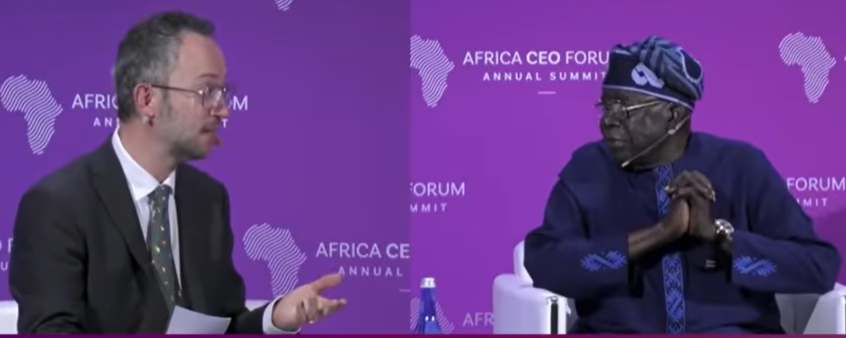
President Bola Ahmed Tinubu at the Africa CEO Forum.
The Missing Ingredient: Trust
Perhaps the greatest weakness of Tinubu’s reform programme is not economic; it is political. Many Nigerians do not necessarily reject reform. What they reject is sacrifice without visible accountability from political elites. Citizens are being asked to endure higher fuel prices, higher taxes, currency depreciation, rising electricity tariffs, and increased transportation costs.
Yet political spending, elite privileges, and perceptions of government excess remain largely untouched in public perception. That credibility gap matters. In successful reform economies, governments often build public trust by demonstrating shared sacrifice. Nigerians, however, increasingly feel the burden is unevenly distributed.
This helps explain why international institutions often praise Tinubu’s reforms while domestic frustration continues to rise. As one Reddit user summarised: “Foreigners see the big picture; Nigerians are stuck dealing with the bill.”
Reform without Cushioning becomes Shock
Tinubu may ultimately be correct that subsidy removal and fiscal restructuring were unavoidable. Even critics acknowledge that Nigeria’s old economic model was unsustainable. But timing, sequencing, and social cushioning matter. Removing subsidies in an economy already suffering from: weak electricity supply, high unemployment, low industrial productivity, insecurity, and fragile social protection systems, was always going to create severe consequences.
The government introduced cash transfers and student support programmes, and Tinubu highlighted these initiatives at the forum. But the scale of hardship appears to have outpaced the scale of relief, as stated by the IMF. The administration argues Nigerians are witnessing the painful beginning of long-term recovery. The public increasingly fears they may simply be witnessing permanent austerity.
Nigeria’s Real Test is Still Ahead
Tinubu told the audience at the Africa CEO Forum that there is “a very bright light” ahead for Nigeria. Perhaps there is. There are signs of improved fiscal discipline, stronger government revenues, and renewed investor interest. The World Bank itself acknowledged that some reforms have improved Nigeria’s fiscal position.
But economic stabilisation is only the first step. The harder challenge is converting macroeconomic reform into lower food prices, better jobs, improved security, stronger purchasing power, and visible improvements in daily life. Until Nigerians feel those changes personally, the reforms will remain politically fragile and socially contested.
And that is the uncomfortable truth at the center of Tinubu’s presidency today: the numbers may be improving on paper, but for millions of Nigerians, life itself still feels far more expensive, insecure, and uncertain than it did before the reforms began.