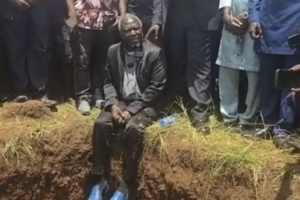

A concerned and courageous Nigerian prelate known for frequently addressing social and spiritual issues with a call for all to embrace practical Christianity, has denounced the senseless killings going on in Nigeria, urging for open and sincere documentation of these atrocities against Christians.
Most Rev. David Ajang, the Catholic Bishop of Lafia, who made this call during an exclusive interview with Advocatus Africa, stated that “the Church has recognized that we cannot fight for justice without the power of verifiable data.”
Department of Church and Society is our primary engine for documentation
Responding to whether the secretariat has a research and documentation desk which documents atrocities against Christians, the Bishop, who is a member of the administrative board of the Catholic Bishops’ Conference of Nigeria (CBCN) stated, “Indeed, the Catholic Secretariat of Nigeria (CSN) operates with a deliberate focus on research and documentation, though it functions as a collaborative ecosystem rather than a single ‘desk’ in isolation.”
He clarified that “The Department of Church and Society, which oversees the Justice, Development, and Peace Commission (JDPC), is our primary engine for documentation. Every diocese has a JDPC coordinator.
“By documenting ‘who, what, where, and when,’ we move from anecdotal complaints to forensic evidence that can be presented to the agency that may need it.” – Bishop Ajang
“When an attack occurs, like the one in Kuru, the local coordinator is responsible for gathering names, dates, and photographic evidence. This data is fed back to the National Secretariat to form the basis of our biannual communiqués and our ‘State of the Nation’ addresses.”
The philosopher cleric emphasised that “By documenting ‘who, what, where, and when,’ we move from anecdotal complaints to forensic evidence that can be presented to the agency that may need it.”

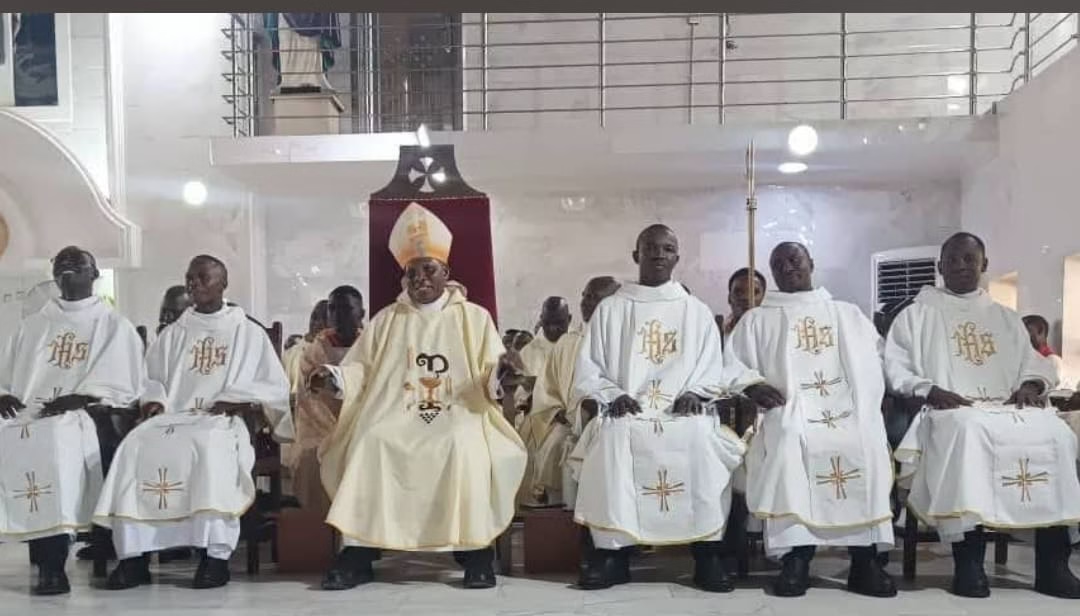
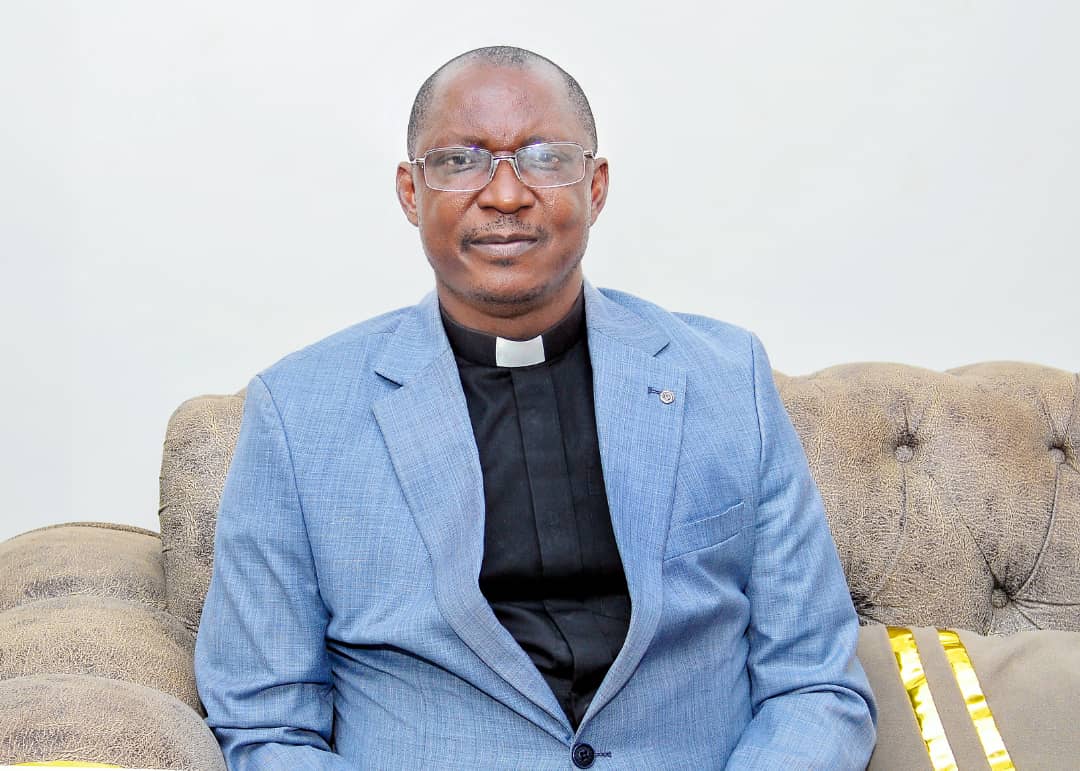
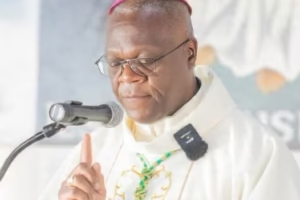
Like the Good Shepherd, Bishop Ajang faces the faithful during a December 2025 pastoral visit to St Aloysius Catholic Church, Doma. Credit: Bishop David Ajang.
Indicating collaborative efforts between the Church in Nigeria and international organisations, he stressed that “We do not work alone. The CBCN maintains a direct pipeline of information with international bodies such as Aid to the Church in Need (ACN) and the Religious Freedom Institute. For example, we recently released data showing that between 2015 and 2025, at least 212 Catholic priests were kidnapped and many murdered.
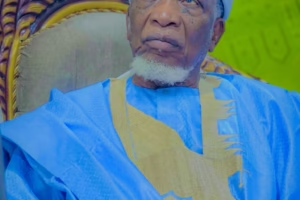
“Regarding Sheikh Gumi, we use this documentation to prove that we are not ‘burying empty coffins.’” -Bishop Ajang
“We also track the destruction of physical structures due to these conflicts – regarding Sheikh Gumi, we use this documentation to prove that we are not ‘burying empty coffins.’ Every entry in our database represents a human life, a family shattered, and a community displaced.”
The Bishop, known for his use of social media and inculcating moral values in the young, told Advocatus Africa that, “The Secretariat is constantly working to modernise this ‘Documentation Desk’ to make it more digital and real-time. We are moving toward a future where every parish priest can securely upload reports of security breaches directly to a central database.”
Conflicting figures of priests killed and kidnapped “is a reality check that the government must face.”
On the names of priests killed and kidnapped across the country released last year by the Catholic Secretariat of Nigeria (CSN), which differs significantly from government figures, Bishop Ajang disclosed that, “The disparity between the figures released by the CSN and those of the government is a matter of profound concern.”
On whether the conundrum has been resolved,the 55-year-old prelate maintained that “it is not a ‘conflict’ that needs resolving so much as it is a reality check that the government must face.”
He further queried, “By the way, in the face of the conflicting figures, who are you more likely to believe?”” adding that “The fact is that as of early 2026, the data remains a point of contention because it reflects two different worlds: the clinical, often understated world of official bureaucracy on the one hand, and the raw, lived reality of the people mostly abandoned by the government.”
“The Church, through the JDPC, has a presence in the smallest villages where the government has no ‘boots on the ground.’” – Bishop Ajang
The cleric blamed the government for the disparity in the figures, citing the way it frames these attacks.
“Some reasons why there are disparities in the number will include the fact that government reports often categorise attacks as ‘communal clashes’ or ‘banditry,’ which can dilute the specific targeting of priests,” he said.
The religious leader contended that “The Church, however, records every individual priest taken from a rectory or a highway as a specific attack on the mission of the Church” clarifying that “many incidents in rural areas are never ‘officially’ recorded by the police because the officers are either not present or the families are too afraid to report to a system they don’t trust.”
According to him, “the Church, through the JDPC, has a presence in the smallest villages where the government has no ‘boots on the ground.’
“Furthermore, there is often a political motivation for the government to underreport insecurity to maintain an image of control. For the Church, our only motivation is the Truth. We bury the bodies; we cannot underreport the graves.”
“For the Church, our only motivation is the Truth. We bury the bodies; we cannot underreport the graves.” – Bishop Ajang
On how the confusion about the data of those killed can be resolved, the former Chaplain of Government, Plateau State, suggested a way forward for both the government and the Church.
“Going forward, ‘Resolution’ in this context would mean the government acknowledging the Church’s data as a legitimate basis for action.
“Through the CBCN, we have held several closed-door meetings with the Office of the National Security Adviser (ONSA). We have presented our documentation not to ‘shame’ the state, but to offer them the intelligence to help them effectively carry out their work.”
“Until the government stops seeing the Church’s data as an ‘attack’ and starts seeing it as a resource for national healing, this disparity may persist.” – Bishop Ajang
The Bishop of Lafia emphasised that “Until the government stops seeing the Church’s data as an ‘attack’ and starts seeing it as a resource for national healing, this disparity may persist,” arguing that “We do not manufacture these names. These are our brothers. As long as they happen, we will continue to publish their names until the kidnapping of a priest is no longer a headline in Nigeria.”
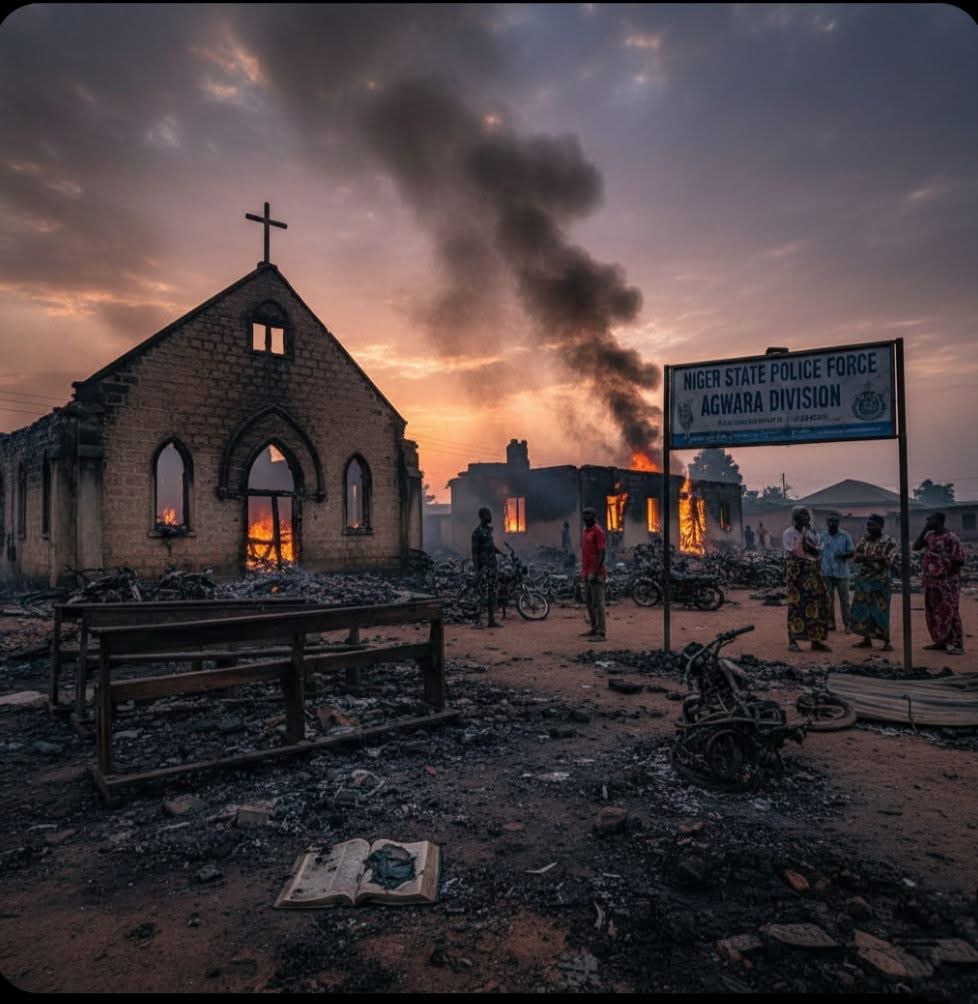
Many atrocities against Christians, like the one in Agwara, Niger State, in the early hours of Sunday, 1 February, go unnoticed, undocumented, without arrest or prosecution of perpetrators
Diocesan Directors of Communications as image markers of the Church
Asked if the Diocesan Directors of Communications are doing their work sufficiently as image markers of the Church amid this quagmire, Ajang, who is the CBCN Chairman for Social Communications Commission at the CSN, used the opportunity to say, “This is a very serious question. It will require taking a survey of all communication departments across all dioceses in order to come up with an answer.”
However, he maintained that “truth be told, the Diocesan Directors are doing their best to communicate with the world through different media platforms. The media apostolate in the church in Nigeria keeps growing and expanding, thanks to the Directors.”
He acknowledged, though, that there is room for improvement on what can be done, saying, “I believe the Diocesan Directors can do more, but they are trying their best to project the positive image of the church. Getting into the digital as well as the social media space is an option to be taken seriously by all Directors. Their presence there will contribute greatly to the positive image of the Church.”
“The media apostolate in the church in Nigeria keeps growing and expanding, thanks to the Directors.” – Bishop Ajang
Born in Zaria and ordained a priest on 3 December 1994 for the Catholic Archdiocese of Jos, Ajang was appointed the Bishop of Lafia on 31 March 2021, his birthday, and consecrated as the second Bishop of the diocese on 24 June 2021 at St. Williams Cathedral, Lafia, Nasarawa State.
Building on the work of his predecessor, the Most Rev. Matthew Ishaya Audu, who is the current Archbishop and Metropolitan of the See of Jos, Bishop Ajang has championed several pastoral, social, administrative and infrastructure reforms.
His call for the government to be sincere and open about the documentation of atrocities against Christians is coming a few days after suspected Fulani militia attacked St. Paul’s Parish, Ogie-Utonkon, Otukpo diocese, on 6 February and abducted 9 Catholic worshippers during a night vigil.
Although police authorities pledged to rescue the victims, they are still with their abductors as of the time of filing this report.