




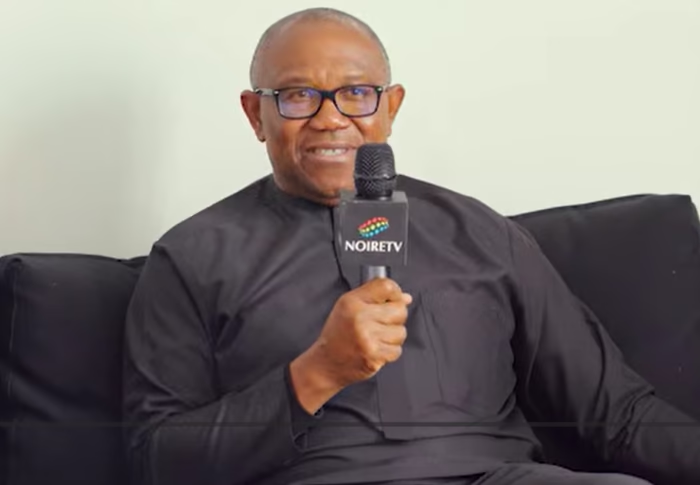
In a wide-ranging interview in Philadelphia, presidential hopeful of the Nigeria Democratic Congress (NDC), Peter Gregory Obi, has argued that Nigeria must move away from identity-driven politics and focus instead on governance, economic development, and the welfare of ordinary citizens.
Speaking on Global Politics Horizon on NO TV, the former presidential candidate of the Labour Party addressed issues ranging from tribalism and electoral reform to diaspora voting rights and youth participation in politics.
The 18-minute conversation centered on what the 64-year-old politician described as Nigeria’s misplaced political priorities.
Comparing Nigerian politics to recent elections in the United States and other Western democracies, Obi argued that political debates in advanced democracies are largely focused on economic and social issues that directly affect citizens, while Nigerian politics remains trapped in ethnic and religious divisions.
“In the western world, the issues discussed concern the people — the economy, immigration, healthcare. While in Nigeria, you have primordial issues of tribalism, religion, and ‘it’s my turn,’” Obi said.
According to him, Nigerian politics must begin prioritizing poverty reduction, food security, healthcare, education, and insecurity over identity politics. He emphasized that discussions about governance should centre on how citizens survive economically and how government policies improve daily life.
“I’m preoccupied with how the average Nigerian lives today.””
When asked whether he intended to run again for president and whether he would consider alliances with opposition parties ahead of future elections, Obi avoided making direct electoral declarations.
Instead, he criticised what he described as Nigeria’s obsession with perpetual electioneering.
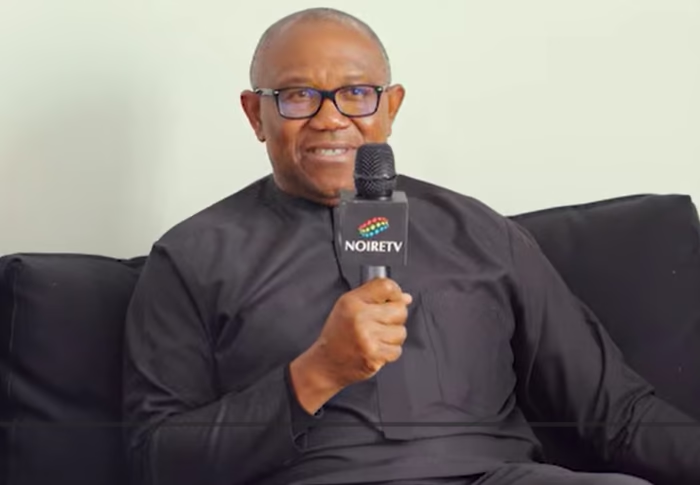
Peter Obi during an interview with NO TV. Credit: Advocatus Africa.
“I’m not preoccupied about the next election,” he said while adding, “I’m preoccupied with how the average Nigerian lives today.”
The two-term former Governor of Anambra State (2006-2014) stated that he was open to working with any political group committed to improving citizens’ welfare, but rejected coalitions formed solely for “power capture” or “state capture.”
He advocated structural political reforms that would introduce stronger checks and balances into Nigeria’s presidential system.
Referencing political developments in South Africa, Obi suggested Nigeria should consider elements of a parliamentary structure alongside the presidential model to encourage broader representation and coalition governance.
Electoral Reforms, Trust in Democracy
A major theme throughout the discussion was electoral credibility. Obi argued that restoring public trust in elections is critical to Nigeria’s democratic future.
He called for reforms that would guarantee the proper electronic transmission of election results and punish electoral malpractice.
“We’re not going to have this issue of system breakdown again,” he said, referring to controversies surrounding previous elections.
He also stressed that opposition groups and civil society must pressure institutions to ensure future elections reflect “the will of the people.”
Push for Diaspora Voting Rights
One of Obi’s strongest positions during the interview concerned voting rights for Nigerians living abroad.
He described the absence of diaspora voting as “very regrettable,” noting that many African countries already allow their citizens overseas to participate in elections.
“If diaspora Kenyans, South Africans, Canadians, everywhere, can vote, then there’s something fundamentally wrong why diaspora Nigerians cannot vote,” he argued.
Obi linked the issue directly to remittances, noting that Nigerians abroad contribute billions of dollars annually to the economy.
According to him, the diaspora’s economic importance should translate into political rights and influence.
“Their remittances are about the same thing we earn from oil,” he said and stressed that, “They should use their economic contribution to force that they also have some rights.”
He urged Nigerians abroad to engage in advocacy by lobbying elected officials in their host countries and pressuring Nigerian authorities to strengthen democratic processes.
Youth Frustration and the “Obedient Movement”
Addressing young Nigerians and supporters of the “Obidient” movement, Obi acknowledged growing public frustration, particularly among youths facing unemployment and economic hardship.
He argued that many Nigerians have lost confidence in government institutions and leadership.
“The people are disillusioned. They have lost hope in government. They have lost trust in government,” he said.
Despite these challenges, Obi encouraged supporters not to disengage from civic participation. He emphasized persistence, advocacy, and continued demands for accountability as necessary tools for political change.
“The only way we can do it is to persevere, not to give in, not to accept, but to continue,” he stated.
Diaspora Advocacy Beyond Remittances
Throughout the interview, Obi repeatedly returned to the role of the Nigerian diaspora.
He encouraged Nigerians abroad not only to send money home, but also to use their professional networks, political influence, and advocacy platforms to demand better governance.
He suggested diaspora communities could pressure lawmakers in countries such as the United States to encourage stronger democratic accountability in Nigeria.
However, he maintained that meaningful domestic change would ultimately depend on Nigerians themselves insisting on credible leadership and transparent elections.
When asked what message he would deliver to students and future leaders during his speech at the University of Pennsylvania, Obi concluded with a broader reflection on political transformation:
“Simple change is possible if only they sacrifice to bring the change. They are the change.”
Conclusion
The interview reinforces themes that have become central to Obi’s political messaging since the 2023 Nigerian presidential election: governance reform, institutional credibility, youth engagement, and economic pragmatism.
It also reflects increasing efforts by Nigerian political figures to engage diaspora communities as both economic stakeholders and political actors.
At a time when Nigeria continues to face inflation, insecurity, unemployment, and declining public trust in institutions, Obi’s remarks highlight a growing debate about whether structural political reforms and broader civic participation can reshape the country’s democratic trajectory.