


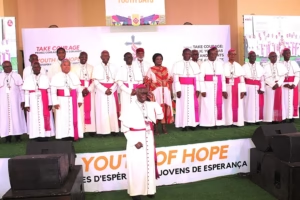
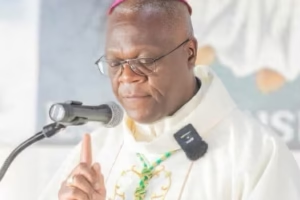



At a recent conference focused on artificial intelligence, held in Accra, Ghana, a diverse group of participants came together to address the complexities and challenges of digital engagement within the Church.
After extensive discussions and collaborative brainstorming sessions, they successfully formulated an ethical framework for artificial intelligence.
This framework is designed to guide the Church’s approach to leveraging digital tools and platforms, ensuring that their use aligns with core ethical values and principles.
The conference highlighted the importance of responsible AI deployment in fostering community engagement and spiritual growth while safeguarding the dignity and rights of individuals in the digital landscape.
In collaboration with the Vatican’s Dicastery for Promoting Integral Human Development, the workshop organised at the National Catholic Secretariat (NCS) from May 19 to 21 aimed to foster dialogue and develop strategies for integral human development.
At the conference themed “Artificial Intelligence: A Catholic Perspective,” facilitators urged participants to use technology to benefit humanity and uphold reason and conscience.
Featuring 50 participants, including heads of departments at the NCS, Diocesan Communications Directors, and leaders of the Conference of Major Superiors of Religious Ghana, the event focused on the Vatican’s call for ethical use of Artificial Intelligence (AI).
Led by Maria Amparo Alonso and Luca Baraldi from the Ethical Artificial Intelligence for Human Development initiative, the sessions focused decisively on ethics, education, and the appropriate use of AI.
The conference emphasised global digital infrastructure inequalities, stating that Africa holds less than one percent of global data centre capacity, despite Ghana’s progress in its national AI strategy.
Facilitators taught participants to assess the environmental and human costs of AI, including the effects of cobalt mining in the Democratic Republic of Congo and large-scale computing impacts.
Participants and facilitators cautioned about deepfakes, cloned voices, and fraudulent QR codes targeting Church structures, agreeing to create a verification checklist for all AI-generated content before publication.
Editor’s Note: Featured photo is courtesy of Catholic Trends.