








Fresh controversy has erupted around Nigeria’s long-running Abuja CCTV project after the Federal Government admitted it has no detailed records identifying local contractors involved in the multi-million-dollar security initiative financed through a Chinese loan.
The disclosure has reignited concerns about transparency, accountability, and the effectiveness of one of Nigeria’s most expensive public security projects.
According to documents released following legal pressure from the Socio-Economic Rights and Accountability Project, the Federal Ministry of Finance informed the organisation that while local subcontractors “may have been engaged,” there are no detailed records identifying specific Nigerian companies that received funds from the Chinese loan used to finance the project.
The revelation emerged in a letter dated May 15, 2026, signed by Permanent Secretary R. O. Omachi, as part of the government’s response to contempt proceedings initiated by SERAP over alleged non-compliance with a Federal High Court judgment delivered in May 2023.
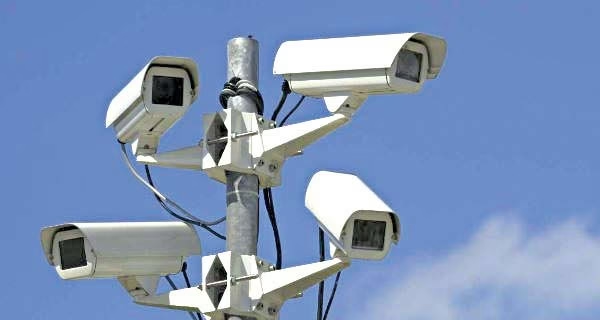
The controversial National Public Security Communication System project, commonly referred to as the Abuja CCTV project, was originally designed to strengthen surveillance and improve security across Nigeria’s capital city.
The project was financed with approximately $399.5 million from the Export-Import Bank of China, while the Nigerian government reportedly contributed an additional $70.5 million as counterpart funding, bringing the total project value to about $470 million.
Government records released to SERAP also showed that payments were made to ZTE Corporation through the Bank of China, Shenzhen Branch, between 2011 and 2013. However, major questions remain over how the funds were spent locally and whether the project was fully delivered.
According to the Ministry of Finance, inventory records indicate that 61,970 equipment units were delivered out of an expected 68,005, leaving 6,035 items reportedly unaccounted for. The equipment included GOTA phones, data cards, LED monitors, servers, cables, and communication infrastructure.
SERAP has argued that the absence of records identifying Nigerian beneficiaries raises serious concerns about public accountability, particularly because the project was funded through public borrowing that Nigerians continue repaying.
The organisation insists that citizens deserve to know which companies benefited financially and whether the project delivered value for money.
The group also questioned whether the CCTV infrastructure is currently functional, how many cameras were actually installed, and whether the investment improved public safety in Abuja amid rising insecurity across Nigeria.
The disclosure comes at a sensitive time when insecurity remains a major national concern. Abuja itself has witnessed increasing reports of kidnappings, violent attacks, and security breaches in recent years, despite the massive investment made into surveillance infrastructure.
The CCTV controversy reflects broader governance challenges involving public procurement, project monitoring, and transparency in the management of borrowed funds.
Public reaction online has also reflected growing frustration. Discussions across Nigerian social media platforms and Reddit communities show many users questioning how such a large public project could lack detailed subcontracting records more than a decade after implementation began.
SERAP has now given the Federal Government 48 hours to fully disclose the identities of all local contractors, consultants, vendors, and other beneficiaries connected to the Abuja CCTV project or face continued contempt proceedings.
Editor’s Note. Featured photo is courtesy of The Guardian.