

By Dangwam Jude Dabee
The former Anglican Archbishop of Canterbury in the United Kingdom, Bishop Justin Welby has said the suffering of the people of Plateau State is increasingly being heard around the world, stressing the need for concerted efforts to end the bloodshed and restore peace in the Middle Belt state of Nigeria.
Welby made the remarks during a visit to Plateau State, where he engaged with the Plateau State Interfaith Council, political, religious and community leaders on peacebuilding, interfaith relations and the humanitarian challenges confronting communities affected by insecurity.
Speaking on the significance of his visit, the former Archbishop said he was particularly encouraged by the courage of leaders who continue to put themselves at risk in reaching communities affected by conflict and suffering.
“Very clearly and with heartbreaking truth, this group of leaders are those who personally take risks in going to difficult and dangerous places to help those who suffer and that is the benefit for me of being here.
“It reminds me this is something that is about individual human beings who have as human beings the dignity that God has given them, and it is our duty as fellow human beings to be alongside them when they suffer.
“My message to them (people of Plateau State) is that, around the world, increasingly, thanks to the leaders in Plateau State, we hear of their suffering, and that my message is that many people long to see this end, and they are praying for them around the world. Keep praying, keep working, keep vigilant, and God will deliver,” he said.
During his courtesy visit to the Executive Governor of Plateau State, Caleb Manasseh Mutfwang, Welby also reflected on the weight of public leadership, drawing from his experience at the coronation of King Charles III.
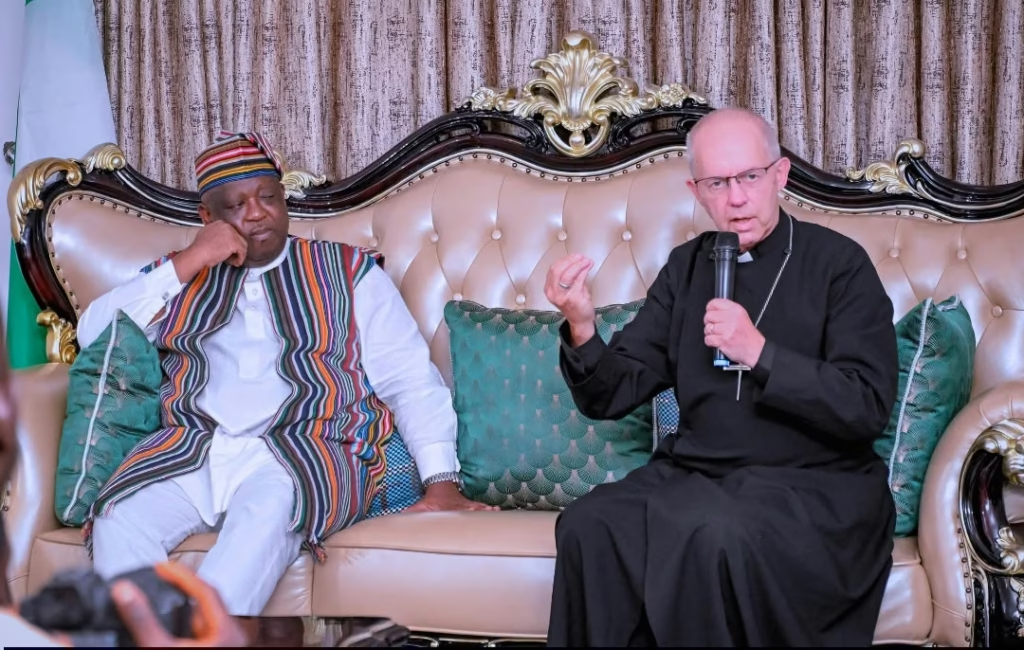
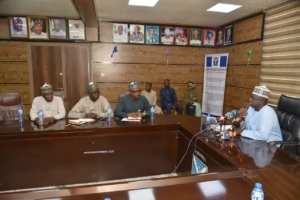
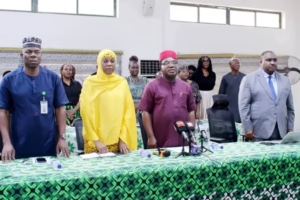
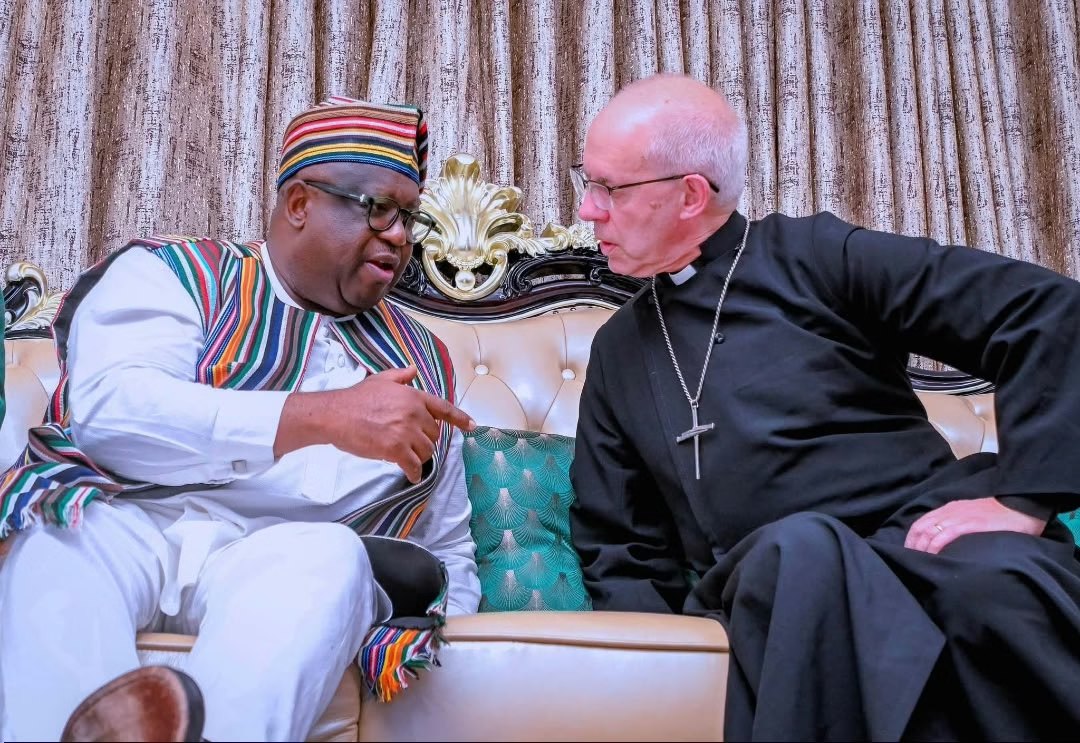
The Executive Governor of Plateau State, Caleb Manasseh Mutfwang and the former Anglican Archbishop of Canterbury in the United Kingdom, Bishop Justin Welby at Government House, Little Rayfield, Jos.
He recalled the moment he anointed the King with oil, saying the experience left a deep impression on him about the enormous responsibilities carried by those entrusted with political leadership.
“The impression I had then was of the weight of government, how enormously heavy it is to be in politics, to lead a state, to lead a local government authority, to lead a nation,” Welby stated.
He encouraged continued attention to peacebuilding, compassion and the protection of vulnerable people, drawing from his own experiences during international peace missions.
Governor Mutfwang expressed appreciation for the exchange of views on peace, interfaith relations, humanitarian support and the welfare of communities across Plateau State.
The governor described Welby, who retired as Archbishop of Canterbury on January 6, 2025, as a strong partner in the growth and development of humanity while acknowledging his longstanding affection for Nigeria.
Mutfwang recalled that Welby had maintained a long relationship with the country and had visited the region more than a dozen times since his first visit in 1978.
He also appreciated the former Archbishop’s enduring commitment to “peace, reconciliation and humanitarian causes,” stressing the important role of religious leaders in promoting unity and compassion among communities.
According to Mutfwang, “the true value of faith is demonstrated through service to humanity, particularly in caring for people in need.
“Religion, like the Bible says, is not mere talk, it is what you do for the less privileged and what you do for common humanity that shows really the value you place on God,” Governor Mutfwang stated.
Also speaking during the engagement, the founder of the Initiative for a Better and Brighter Nigeria (IBBN), Prophet Isa El-Buba, expressed concern over what he described as toxic religious preaching by some religious clerics, which has misinform young people and exposed them to hatred and violence.
El-Buba stressed the value of human life irrespective of religious or ethnic identity, arguing that the loss of one person represents a loss to the wider society.
“The world will come in on the word that it is time and the destruction on the ordinary people is enough. We know the power of love, but why should anybody you know try to mess up the preaching of what is supposed to be a blessing to the people?
“The loss of one person is the loss of a whole nation. When you lose one human being, whether the person is an enemy or the person is a Muslim or the person is a Christian is the loss of the potential in a whole nation.
“And so you come to a point where you lose 30 people, 50 people across the North and it looks normal. The north is bleeding!” he expressed concern over the situation in the region.
El-Buba noted that peaceful coexistence was critical to the growth and development of Plateau State and Nigeria as a whole.
“Our joy is to be able to shake the Chief of the Central Mosque and everyone. All of us working together to deliver the right message, whether to the Christian or to the Muslim. We will continue to build together, we will continue to save the future,” he said.
He hinted the concerted efforts towards taking Almajiri children off the streets and place them under the guidance of knowledgeable Islamic scholars who could properly train and educate them.
“We are working on taking the Almajiri off the street and get them into a place with knowledgeable Islamic scholars that will train and teach and coach these children so that they will not continue to fall into the hands of some of the people that are not literate in the Quran scriptures.
“They misinterpret it to the young people that they are fighting a just cause. So Northern Nigeria, both the Christians and the Muslims must take responsibility that among ourselves this thing cannot continue because it’s not helping our people.”
El-Buba said peace remained essential to prosperity, noting that both Christians and Muslims stood to benefit when communities were stable.
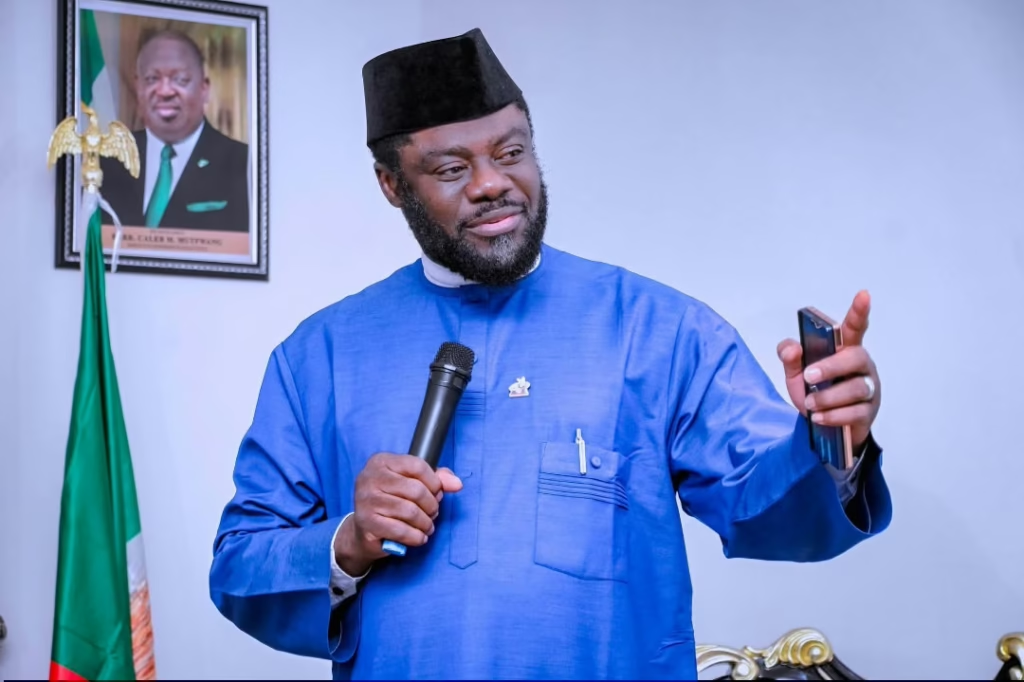
Prophet Isa El-Buba.
“Our people are living in pain, but we know that when there is peace, there is prosperity. When there is peace, everybody makes progress. The Muslim makes progress, the Christian makes progress and together we make tremendous progress.
“But when there is crisis, you go after somebody because you have the wrong notion that this person is your enemy in the true sense he is not your enemy. It’s your brother, it’s your relation, somebody somewhere is the trigger.
“So we have to go after the trigger, we have to go after the people that are causing this thing and deal with them where ever they are so that we will continue to have a peaceful night,” he reiterated.
The Chief Imam of the Jos Central Mosque and Co-Chairman of the Plateau State Interfaith Council, Imam Gazali Adam said the growing population of young people living in difficult conditions and becoming involved in violent conflicts must be addressed with seriousness.
“The problem is the youth, most of them do not go to Church or Mosques, they’re in the ghettos. They’re the ones fighting and later they’ll say Allahuakbar or Shalom. That’s why we have some natural hatred from the youth generation that are coming up, and we have to work on that.
“So the problem is not we, do they listen to us? Do we have the control? Because some of us tend to say what the congregation wants to hear, that’s another problem,” he stated.
Former President of the Church of Christ in Nations (COCIN) and Co-Chairman of the Plateau State Interfaith Council, Rev. Prof. Pandang Yamsat called for sustained dialogue between Christian and Muslim leaders as a pathway towards resolving the state’s longstanding security challenges.
“Let us continue the good work of liaising with one another. It’s not impossible, let’s not say if God’s permits, No!, that’s a bad theology when you say if God’s permits, we will have peace. No, God wants peace, it is human beings who do not want peace.
“So if we as leaders of Islam, leaders of Christianity, we have the answer to peace. Let’s go back and work on it. And we come back and sit on this table. Hear from our brothers Muslims what they believe to be the solution to peace on the Plateau. Hear from our Christian brethren what they believe is the answer to peace on the plateau. And we looked at each of it and agree.
“When we cannot agree, we will then decide what do we do with what we cannot agree. Again, that one is doable. Peace is doable. If we want peace, we will have it on the Plateau. And there’s no reason why Muslims will not want peace on the Plateau.
“There’s no reason why Christians would not want peace on the Plateau. Because our God is the God of peace. We will come back when we have our meeting to tackle this issue, it’s doable,” he firmly stated.
The Director-General of the Plateau Peace Building Agency, Dr. Julie Sanda, said the agency had continued to engaged communities across the state in efforts to de-escalate conflicts and prevent reprisals.
She said, the Interfaith Religious Council had moved beyond meetings and discussions to direct engagement with communities affected by conflict, including communities in Bassa, Bokkos, Mangu, Barkin-Ladi and Jos North.
“Immediately the Interfaith Council was set up, we sprung into action going to the communities in Bassa, in Bokkos and in Mangu and other flashpoints areas, we have engaged communities in Barkin-Ladi and also in places like Jos North and all of that.
“The latest, of course being the unfortunate crisis in other parts of Jos North just to prevent reprisals. A lot of work that the members do is actually off camera because they go into the communities to meet with the people and our Co-Chairs have led from the front.
“They have gone with us into those communities and sometimes just to comfort them, to hold their hands and say, we are with you. What is going on? So it’s not just sitting at the tables, but also in the communities. And I thought that was a very strong point. We’re going to partnership in this very area, interface, dialogue and engagement,” the DG reassured the clergyman.