This in-depth analysis provided by Catholic Snack delves deeply into the context of Pope Leo’s Apostolic Pilgrimage to Africa, offering a rich blend of theological reflections and practical insights. Unlike the often superficial coverage found in many news headlines, this exploration sheds light on the deeper significance of the pilgrimage, highlighting its implications for the Catholic Church and its mission in Africa.
He is the first American pope in history, and one of the very first things he wanted to do, even before he was elected, was go to Africa, not to Europe, not to the United States, not to the great Catholic nations of Latin America. To Africa, 11 days, four countries, 18 flights, more than 18,000 kilometers, Algeria, Cameroon, Angola, Equatorial Guinea.
Why? What is pulling the pope to this continent right now in this moment of history?
The answer is bigger than you think, and it changes the way you see the future of the Catholic Church. On the 13th of April, 2026, Pope Leo XIV departed Rome and landed in Algiers, becoming the first pope in history to set foot on Algerian soil.
Over the next 11 days, he would travel across four African nations, visiting 11 cities and towns, delivering 25 speeches and homilies, celebrating eight public masses, and meeting presidents, bishops, imams, prisoners, orphans, the elderly, and hundreds of thousands of ordinary faithful.
It is the longest trip of his pontificate so far, the most complex, the most geopolitically charged, and arguably the most personally meaningful. To understand why this trip matters, not just for Africa, but for the whole Church, and for the whole world, you need to understand seven things.
#1. The future of the Catholic Church is African
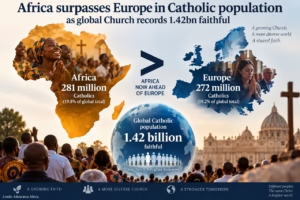
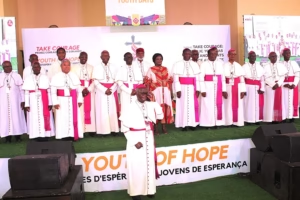
Let’s go through them one by one. The future of the Catholic Church is African. Here is a fact that will change the way you think about Catholicism. In 1910, just over a hundred years ago, there were fewer than one million Catholics on the entire African continent. Today, there are 288 million. That is not a typo. In a little over a century, the Catholic Church in Africa grew from under one million to nearly 300 million faithful. Africa now accounts for more than 20% of all Catholics in the world, and it is growing faster than anywhere else on earth.
In 2023 alone, the most recent year for which Vatican statistics are available, Africa contributed more than half of the 15.8 million new Catholics baptised globally. More than 8 million new African Catholics in a single year. Angola and Cameroon, two of the countries on this trip, consistently rank among the African nations producing the largest numbers of seminarians, a continent that for centuries received missionaries from Europe, is now exporting its own priests and nuns to parishes across the Western world.
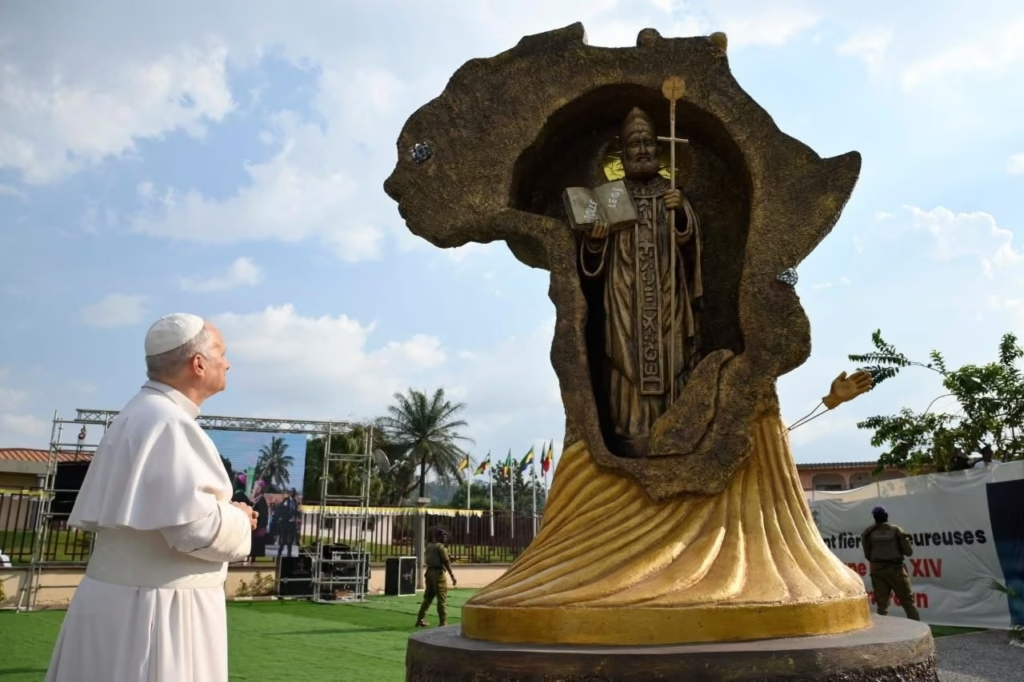
Pope Leo admired a new statue of St. Augustine at the Catholic University of Central Africa, depicting him in the shape of Africa, holding a book with the Latin words “Tolle lege,” which he heard during his conversion. Credit: EWTN News In Depth/Vatican Media.
#2. A Personal Pilgrimage
When Pope Leo XIV goes to Africa, he is not going to a mission territory. He is going to the most vibrant, most rapidly growing part of the Church he leads. He is going to meet the future, a personal pilgrimage following St. Augustine. But this trip is not only about demographics or geopolitics.
For Pope Leo XIV personally, this journey is a pilgrimage and it begins in Algeria for a deeply personal reason. On the night of his election as Pope, standing for the first time on the balcony
of St. Peter’s Basilica, Leo XIV described himself as a son of St. Augustine, St. Augustine of Hippo, the fifth-century theologian, Bishop and Doctor of the Church, whose writings have shaped Western Christianity for 16 centuries. Author of the Confessions, author of the City of God, one of the most influential thinkers in the history of human thought and a North African.
Augustine was born in 354 AD in what is today Algeria. He spent most of his life there. He was Bishop of the ancient city of Hippo, known today as Anaba for 30 years. He died there. Pope Leo XIV belongs to the Augustinian Order, a religious family founded on Augustine’s spirituality and rule. He has quoted Augustine in virtually every major speech and homily of his pontificate. And so when he landed in Algeria, he went to Anaba. He walked through the ruins of ancient Hippo. He stood in the remains of the Basilica where Augustine preached.
He prayed where Augustine prayed. He told journalists on the papal plane, as early as last May, I had said that on my first journey, I would like to visit Africa. Several people immediately suggested Algeria because of St. Augustine. It was supposed to be his very first international trip as Pope. Other journeys intervened, but he kept the appointment. This is a son returning to the land of his spiritual father.
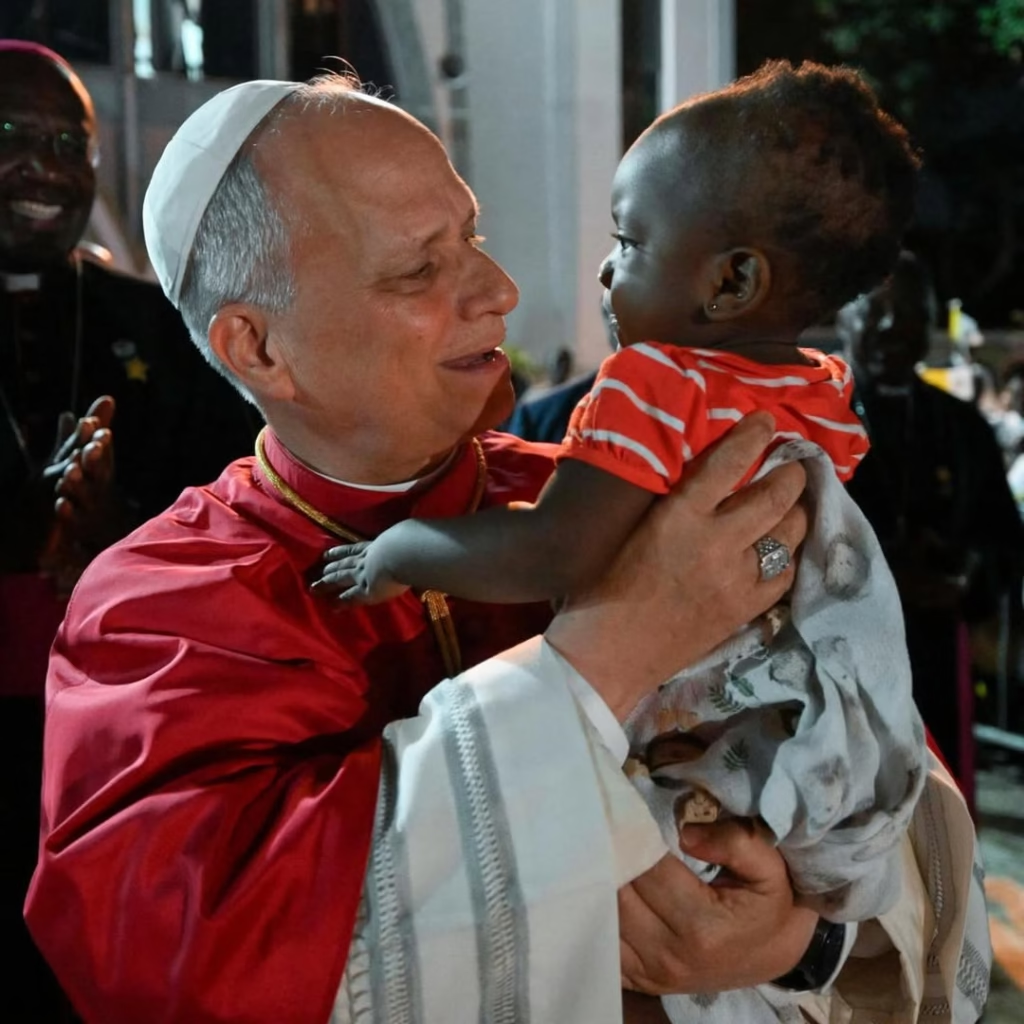
Pope Leo XIV smiles at a baby in Angola. Credit: Joseph Phan.
#3. Dialogue between Christianity and Islam
Algeria is a Muslim-majority country of approximately 48 million people. The number of Catholics? Approximately 9,000. A fraction of 1% of the population. Most are foreign students, diplomatic personnel, and religious sisters. So why does the Pope go to a country with 9,000 Catholics? Because the Church’s mission has never been only to count its own numbers. In Algeria, Pope Leo XIV visited the great mosque of Algiers, home to the world’s highest minaret, completed only in recent years. It was his second visit to a mosque as Pope.
The first was the blue mosque in Istanbul during his trip to Turkey in November 2025. These are not symbolic gestures. They are deliberate theological choices. Rooted in the conviction that in a world tearing itself apart along religious and cultural lines, Christianity and Islam must learn to be neighbours, not enemies. The Archbishop of Algiers described the visit as an attempt to build bridges between the Christian and Muslim worlds.
Algeria knows what religious violence looks like. In the 1990s, the country was torn apart by a brutal civil war, the Black Decade, in which some 250,000 people were killed as the army fought an Islamist insurgency. Among the victims were 19 Catholics, priests, nuns and seven trappist monks from the Tibhirin Monastery, kidnapped and killed in 1996. Two of those nuns belonged to Leo’s own Augustinian religious family. Leo honoured those martyrs. He prayed for them, and he spoke clearly and without hesitation about the need for peace, coexistence and mutual respect. “God desires peace for every nation,” he told the crowd in Algiers, “a peace that is not merely an absence of conflict, but an expression of justice and dignity.”
#4. Peace in a continent scarred by conflict
The third country on this trip is Cameroon. And Cameroon is a nation at war with itself. Since 2017, the English-speaking regions of Cameroon have been locked in a violent conflict with the French-speaking central government. Anglophone separatists launched a rebellion demanding an independent state. The fighting has killed more than 6,000 people and displaced over 600,000 others. An entire population uprooted in a country most of the world barely notices.
Pope Leo XIV flew to Bamenda, the largest Anglophone city in Cameroon, and presided over a peace meeting. Around the table, a traditional Mankon chief, a Presbyterian moderator, an Imam, and a Catholic nun. Think about that image, a pope surrounded by representatives of different faiths and communities in a city at the heart of an active conflict, calling for dialogue instead of violence, for reconciliation instead of revenge.
The expected crowd for the mass in Dwala, Cameroon’s largest city, 600,000 people. In Angola, there is a different kind of wound. The legacy of a 27-year civil war, fueled by Cold War rivalry between the United States and the Soviet Union, that ended only in 2002. A country rich in oil and diamonds, where more than 30% of the population still lives on less than $2.15 a day. Leo flew into Saramo, the heart of Angola’s controversial diamond mining industry, and celebrated mass.
A pope surrounded by diamond country, speaking about justice, exploitation, and the dignity of those whose labour extracts wealth that rarely reaches them. And in Equatorial Guinea, a country ruled by the same president since 1979, in what many describe as an authoritarian regime built on oil revenues, Leo addressed the nation’s leaders directly. With a pope standing next to you, it becomes harder to ignore the voice calling for human rights and justice.
#5. The exploitation of natural resources
Africa is among the wealthiest continents on Earth, in natural terms. Oil, natural gas, gold, diamonds, cobalt, iron ore; critical minerals essential for the technologies of the 21st century. Angola is Africa’s fourth-largest oil producer and the world’s third-largest diamond producer. Cameroon sits atop significant reserves of oil, natural gas, cobalt, boxite, gold, and diamonds. In its eastern gold mining regions, UN experts have documented severe environmental damage and human rights abuses, including, according to UNICEF, hundreds of children who have abandoned school to dig for gold at makeshift mines, risking their lives for a dollar’s worth of ore.
Equatorial Guinea’s president and his family are accused of capturing the country’s oil wealth for personal enrichment, while the population remains largely poor. The Catholic Church has been sounding the alarm about this reality for decades, but a papal visit amplifies that alarm to a global stage. When Pope Leo XIV lands in Soremo to celebrate mass in the heart of Angola’s diamond country, he is making a statement that cannot be ignored. “The Earth’s resources belong to all of humanity, not to the few, not to foreign corporations, not to corrupt elites.” This is the same man who, in Monaco, told “the world’s wealthiest citizens that every talent placed in our hands has a universal destination, not to be held back, but to be shared.” In Africa, he is saying the same thing, to a very different audience, in a very different context, but with the same gospel.

The Holy Father, during a powerful rosary with thousands of pilgrims at the Muxima Marian shrine in Angola. Credit: OSV News.
#6. Migration, the human cost of a broken world.
More than 600 deaths in the Mediterranean in just the first two months of 2026 alone, the highest figure since 2014. These are men, women, and children leaving Africa, many of them from the exact countries Leo is visiting, crossing deserts and seas in search of safety or a better life. The migration crisis is not an abstraction for the Church. It is the daily reality of thousands of parishes across North Africa and the Mediterranean coast. It is the ministry of the religious sisters in Algeria who serve people of all faiths, giving food, shelter, legal advice, and human dignity to those the world has discarded.
Pope Leo XIV has been one of the most vocal critics of the Trump administration’s migration policies, calling its treatment of migrants inhumane. He has also called for Europe to move beyond emergency management to a genuine strategic vision that protects dignity and addresses the root causes of displacement. Coming to Africa, to the countries where so many migrants begin their journey, is not a political statement. It is a pastoral one. It is the Church standing with the people at the beginning of their suffering, not only at the shore where they arrive. It is a pope saying, “We see you, where you are from, what drove you here, and what you deserve.”
#7. A pope unafraid to speak when the world needs to hear it
Before Pope Leo XIV even boarded the plane for Algiers, something extraordinary happened. President Donald Trump attacked him publicly. Trump called Leo weak on crime and terrible for foreign policy. He accused him of toying with a country that wants a nuclear weapon, a reference to Leo’s calls for peace in the war between the United States, Israel, and Iran that had begun in late February, 2026.
Most leaders would have softened their message, chosen a lower profile, avoided the confrontation. Leo XIV did not. On the papal plane speaking to journalists, he said simply, he had a moral duty to speak out against war. He had no intention to debate with Trump. He was not a politician. And then he landed in Algiers and said this to the crowd, today this is more urgent than ever in the face of continuous violations of international law and neo-colonial tendencies. He did not name Trump. He did not need to.

Pope Leo received the President of the Republic of Equatorial Guinea, H.E. Mr. Teodoro Obiang Nguema Mbasogo, at the Vatican in June 2025. Credit: Vatican Media.
Conclusion
A pope going to Africa, to the most forgotten continent in the eyes of Western media, to countries scarred by colonialism and exploitation and conflict, is itself a statement. It says, “the Church does not measure importance by wealth or military power. It measures importance by need, by suffering, by the cry of the poor.” In a world where the powerful speak loudest, Leo XIV went to the places where the voiceless live.
And he spoke, 11 days, 18,000 kilometers, four countries, 25 speeches, eight masses, and one clear, consistent message. Africa is not the periphery of the Catholic Church. Africa is its beating heart. The Church that began in Jerusalem spread through Rome, shaped Europe for a millennium, and crossed the Atlantic with missionaries, is now renewing itself on a continent that the world has too long treated as a source of resources to be extracted rather than a community of people to be respected.
Pope Leo XIV knows this. He has known it since his years as head of the Augustinian order when he traveled to Africa repeatedly. He wanted Africa to be his first destination as Pope. And even when the most powerful man in the world attacked him the morning he was leaving, he got on the plane.
He went, because that is what the gospel asks. Not comfort, not safety, not approval. Presence with those who are forgotten, with those who suffer, with those who are building something extraordinary, even when the world isn’t watching. The Catholic Church in Africa is growing. It is young, it is vibrant, it is the future, and its Pope showed up.
Editor’s Note: Featured Photo is courtesy of Corazón de Paúl. Meanwhile, for the rest of Leo XIV’s extraordinary pontificate, which of these seven reasons surprised you the most? Tell us in the comments section. We want to know. May the Church in Africa inspire all of us. God bless you!