


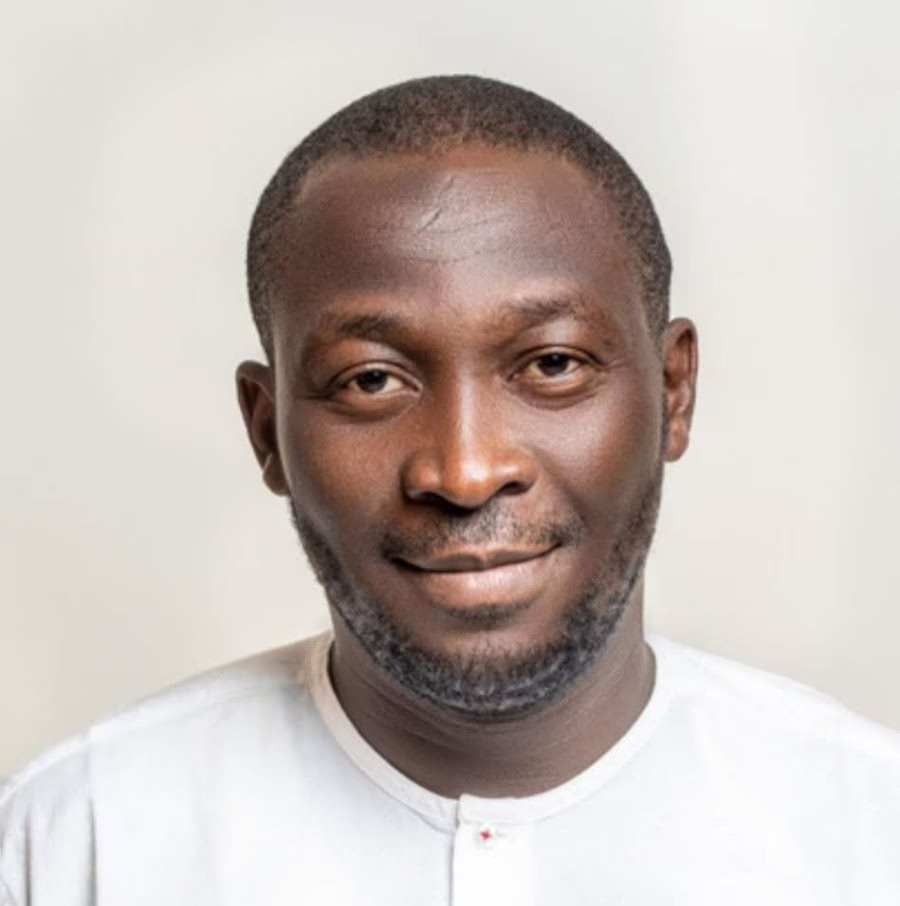
Veteran conflict reporter, Ahmad Salkida, has reacted to the intractable conflict across Northern Nigeria with a call for authorities to pay attention to contexts to avoid costly mistakes.
In a social media post titled, “The Burden of Proximity,” the prominent Nigerian investigative journalist observed that, “Across northern Nigeria, context in security operations is not optional. It determines whether officials act on intelligence or make costly errors. Without context, routine behaviour gets misread and innocent people become targets.”
“Across northern Nigeria, conflict often resides within communal relationships.”
The founder and CEO of HumAngle Media, a platform dedicated to reporting on conflict, security, and development across Africa, argued that in the region, “conflict often resides within communal relationships. Family is wide. Friends are lifelong. Neighbours are constant. And you cannot control the choices of your child, let alone a distant childhood friend or former classmate. Everyone eventually chose their path over time.”
Salkida founded HumAngle in 2020 as a newsroom that focuses on amplifying the voices of victims and survivors rather than just official government narratives.
The journalist who has over 25 years of experience in reporting conflict in Nigeria warned about the consequences of allowing insecuirty to happen without adressing it.
“If this trend continues, sending cash to a sick childhood friend or shool mate or an indigent acquaintance could require security clearance. You apply, you wait, and the approval arrives after the burial. That is the risk of overreach.
“Every day support, quiet, urgent, human, gets trapped in systems that do not understand it. Communal care, when it is not excessive, still works. It moves faster than institutions. It saves lives before paperwork begins. Strangle it, and you remove one of the most reliable lifelines millions depend on,” Salkida said.
He noted that “In this part of the world, black tax is entrenched, people consistently ask for help and you are expected to respond. School fees, hospital bills, weddings, funerals, you send money, you host. You take or make calls to maintain ‘zumunci.’ These are routine acts. Yet in a conflict environment like ours, routine becomes risk.”
The acclaimed journalist also pointedly cautioned against ignoring context and detaining courageous citizens who speak against infractions of security.
“A call is flagged. A transfer is traced. A familiar name becomes a suspect link. If our system lacks local context, we will reduce all contact to complicity. When the line collapses, innocent civilians are pulled in. Many are being detained today for association, not action,” he warned.
Widely regarded as a leading expert on the Boko Haram insurgency and conflicts in the Lake Chad region, Salkida underlined that “Rural communities face deeper exposure. Years under insurgent rule or ungoverned spaces force interaction. Armed groups taxed and judged disputes. Civilians complied because there is rarely an alternative. That history now reads as allegiance.”
From Conflict Reporting to Self-Exile and 2026 Yale Peace Fellowship
Salkida’s recent investigations include reporting on the security implications of Kainji Lake and the ongoing human.
Known for governance and resilience, in late 2025, the conflict reporter openly shared his mind about the financial and emotional toll of running an independent media organisation, describing how HumAngle survived a significant loss of income to continue its mission into 2026.
Due to threats from both the insurgents and security agencies, he has lived in self-exile in the United Arab Emirates at various points of his journalistic career.
His work has frequently placed him in conflict with Nigerian authorities. In 2016, he was declared wanted by the Nigerian Army for alleged ties to Boko Haram (stemming from his reporting), though he was later cleared after interrogation.
Salkida began reporting on the Boko Haram sect in 2006, often having rare professional access to its leadership, including its late founder, Mohammed Yusuf.
He was selected as a 2026 Yale Peace Fellow, an award that recognises his commitment to impactful journalism and peace-building efforts.