








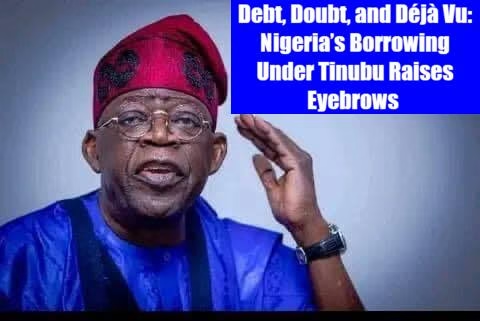
In this Op-ed, Dr. Ijuptil K. Joseph critically examines Nigeria’s borrowing spree, arguing that “until transparency, discipline, and trust improve, every new loan approval may feel less like progress and more like déjà vu.”
The approval of President Bola Ahmed Tinubu’s $6 billion external loan, which comprises $5 billion from Abu Dhabi Bank for budget financing and $1 billion from London Citi Bank for the rehabilitation of the Lagos and Tin Can port complexes, by the House of Representatives, has once again placed Nigeria’s borrowing culture under intense scrutiny. Framed as a move to finance infrastructure and stabilise fiscal liquidity, the decision has sparked mixed reactions across political and public spaces.
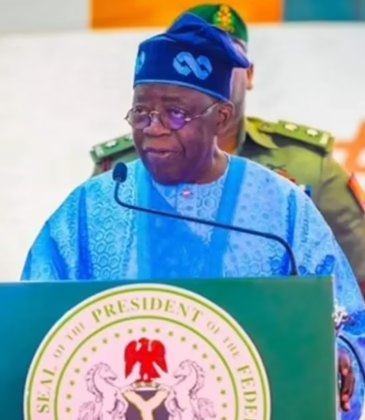
President Bola Ahmed Tinubu. Credit: Tribune Online.
While some lawmakers argue it is necessary for economic growth, others warn it reflects a deeper reliance on debt rather than reform. The development also echoes earlier concerns about governance, accountability, and financial opacity raised in previous national debates. For many Nigerians, this is not just another loan; it is a continuation of a troubling pattern. Recall that Advocatus Africa reported that Nigeria’s public debt has exceeded ₦153 trillion, with external debt amounting to about $47–48 billion.
Borrowing Without Limits? Conflicting Voices in Power
One of the most controversial reactions came from Senator Jimoh Ibrahim, who reportedly described a separate $2.2 billion loan as “lunch money” and encouraged the government to borrow even more. “Tinubu’s fresh $2.2billion loan is ‘lunch money, too insignificant; we should encourage the government to borrow more,” Senator Ibrahim stated. Such remarks highlight a growing divide between political elites and public sentiment on Nigeria’s rising debt profile.
While economists such as Mr. Adi, who stated that a “loan is a means for poverty alleviation,” ordinary Nigerians disagree with such an assertion. However, many Nigerians strongly disagree, pointing to the country’s worsening economic indicators. I can argue that borrowing does not automatically reduce poverty, especially when debt servicing already consumes a large portion of national revenue. Reports of additional borrowing plans, including ₦569.6bn loan for IDPs and a fresh $5bn loan request, further intensify these concerns. This raises a critical question: at what point does borrowing shift from necessity to dependency?
Trust Deficit: Old Questions, New Loans and a Growing Debt Web
Public confidence remains shaky, especially in light of unresolved financial controversies like the ₦210 trillion in unaccounted funds linked to state institutions, as reported by Advocatus Africa. Approving new loans without conclusively addressing past financial gaps only deepens suspicion. Many Nigerians worry that new funds may follow the same opaque trajectory as previous allocations. This concern mirrors earlier criticisms of government agreements where financial decisions appeared disconnected from accountability. Without transparency, borrowing becomes less about development and more about risk.
The government maintains that the $6 billion loan will fund infrastructure, refinance expensive debts, and support budget implementation. However, Nigeria’s total public debt is already projected to rise significantly, with servicing costs consuming a large share of revenue. I can argue that continuous borrowing, whether $5 billion, $2.2 billion, or even smaller tranches, adds to a mounting financial burden.
The Bigger Question: Who Pays the Price?
Ultimately, the debate goes beyond figures and approvals. For me, it is about long-term consequences.
If borrowing continues without strong oversight, future generations may inherit both the debt and its limitations. The contrast between political confidence in borrowing and public concern over accountability reveals a widening disconnect.
As seen in past agreements linking financial decisions to external interests, the implications often extend beyond economics. In conclusion, until transparency, discipline, and trust improve, every new loan approval may feel less like progress and more like déjà vu.