


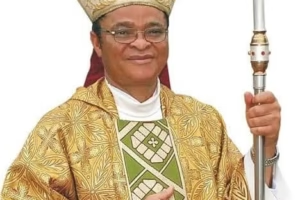

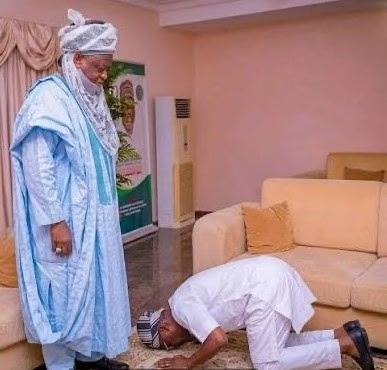
The Sultan of Sokoto, Sa’ad Abubakar III, has dismissed as fake a viral and controversial photo of Benue State Governor, Hyacinth Alia, bowing down to him.
The embattled image is being widely circulated on Facebook and WhatsApp platforms, with sentiments triggering religious and cultural biases.
Swift response to the controversial image
However, in a swift response, head of the Sultan’s media team, Prince Bashir Adefaka, cautioned that “We wish to categorically state that the image in question is fake, likely AI-generated, and deliberately crafted to misinform the public.”
According to him, “It is also a mischievous and dangerous attempt to associate the revered leadership of Muslims in Nigeria, particularly the Sultan of Sokoto, with issues unrelated to his office or person.”
In the rebuttal titled, “Re: False and misleading claims circulating on social media,” Adefaka stated that the attention of the Sultanate has been drawn to “a misleading post circulating across WhatsApp groups and other social media platforms, titled ‘leaked photo of Governor Hyacinth Alia worshipping the Sultan of Sokoto.”
The Sultan’s Media Team warned that “The content attempts to introduce a divisive religious and ethnic narrative into the ongoing security challenges in Benue State.
“The accompanying commentary falsely alleges religious bias and attempts to inflame tensions by linking the Sultan to the crisis in Benue State. Such claims are not only baseless but also constitute a serious threat to national unity and security.”
The paramount ruler and leader of the Muslim Ummah in Nigeria highlighted the danger of misinformation while stressing the need for peaceful coexistence.
“These actions reflect a pattern of disinformation designed to incite division and undermine peaceful coexistence among Nigerians,” the statement noted.
Citing the Sultan’s role as a custodian of “the image and public communication of the Sultan of Sokoto, who also serves as President-General of the Nigerian Supreme Council for Islamic Affairs (NSCIA), Chairman of the National Traditional Rulers Council of Nigeria, Co-Chairman of the Nigerian Inter-Religious Council and Co-President of the World Religions for Peace, New York,” the statement underscored: “We condemn these acts in the strongest terms.”
The media team urged Nigerians to disregard the post and refrain from sharing unverified content or any information that is manipulative and divisive in nature.
The Sultan and the Priest: The question of religious and ethnic identities
Meanwhile, based on historical records, the Tiv people, especially residents of Katsina-Ala area of Benue State, were among the ethnic groups in Nigeria’s Middle Belt, like Plateau and Southern Kaduna people, who successfully resisted the 19th-century jihad led by Usman dan Fodio.
Between Sokoto and Benue, there is a case of historical resistance during the expansion of the Sokoto Caliphate in the early 1800s by jihadist forces into surrounding regions.
According to experts, the Tiv people, known for their decentralised political structure and fierce independence, did not fall under the control of the Fulani jihadists.
This resistance is significant because it meant that the area now known as Benue State, particularly the Tiv nation, retained its local traditional and, later, Christian identity, rather than becoming part of the Islamic emirate system established in parts of northern Nigeria.
Put in a modern context, it is little wonder that the controversial viral photo of a “Catholic priest” and Governor of Benue State, a region which resisted jihad in time and space, bowing to a Muslim-Fulani supreme leader would raise eyebrows due to the fault lines of religious and ethnic identities.