






As Nigeria’s fiscal pressures continue to intensify, new concerns are emerging over the country’s growing debt obligations and shrinking room for development spending. A recent assessment by the Budget Office of the Federation warned that rising debt servicing costs and cash-flow bottlenecks are slowing project implementation and weakening the government’s ability to fund critical sectors. While officials continue defending ongoing reforms as necessary for long-term stability, analysts argue that Nigeria’s economic reality increasingly reflects a country struggling to balance reform ambitions with mounting fiscal strain.
Rising Borrowing Without Visible Structural Transformation

According to a fiscal assessment published by the Budget Office and reported by Sahara Reporters, Nigeria’s debt service-to-revenue ratio remains dangerously elevated, leaving limited fiscal space for development spending. The figures are striking. Between January and September 2025, Nigeria reportedly spent about ₦12.63 trillion servicing debt obligations, while only ₦3.1 trillion was released for capital projects and infrastructure development. Domestic debt servicing accounted for roughly ₦6.22 trillion, while foreign debt obligations stood at about ₦6.29 trillion during the same period.
Government officials often defend the country’s borrowing levels by pointing to Nigeria’s relatively moderate debt-to-GDP ratio compared to those of economies such as South Africa and Egypt. However, critics argue that the more important issue is not how much Nigeria borrows, but whether those loans are producing measurable economic transformation. This concern is becoming increasingly central to public debate as many Nigerians continue questioning why rising borrowing has not translated into stable electricity supply, improved infrastructure, stronger industrial output, or visible reductions in poverty.
Infrastructure Delays Reflect a Bigger Governance Problem

Beyond debt itself, the Budget Office report also highlighted deeper governance and implementation problems slowing economic progress. According to the assessment, “cash management bottlenecks —including bottom-up cash planning delays — continue to slow project execution and raise project cost risks.” The report warned that delayed fund releases across ministries and agencies are undermining infrastructure delivery and increasing long-term project costs.
This issue has reinforced criticism from civic organisations and policy analysts who argue that Nigeria’s challenge is not simply insufficient revenue generation, but weak coordination and poor expenditure management. Organisations such as BudgIT Nigeria have repeatedly stressed that Nigerians are not necessarily opposed to borrowing itself. Instead, many citizens remain concerned about transparency, accountability, and whether public funds are being directed toward productive projects capable of driving long-term economic growth.
The concern is amplified by reports that only about 13 percent of Nigeria’s 2025 capital budget had been released by September despite extensive borrowing and repeated government promises of infrastructure expansion, as reported by Sahara Reporters. I argue that borrowing without efficient implementation creates a dangerous cycle where debt rises faster than development outcomes. In that environment, even well-intentioned reforms risk losing public credibility because citizens struggle to see tangible improvements in daily life.
This governance problem also explains why many analysts believe Nigeria’s economic debate can no longer focus only on macroeconomic indicators such as exchange-rate stability or sovereign credit ratings while infrastructure delivery remains inconsistent.
Economic Reforms Cannot Succeed on Debt Servicing Alone
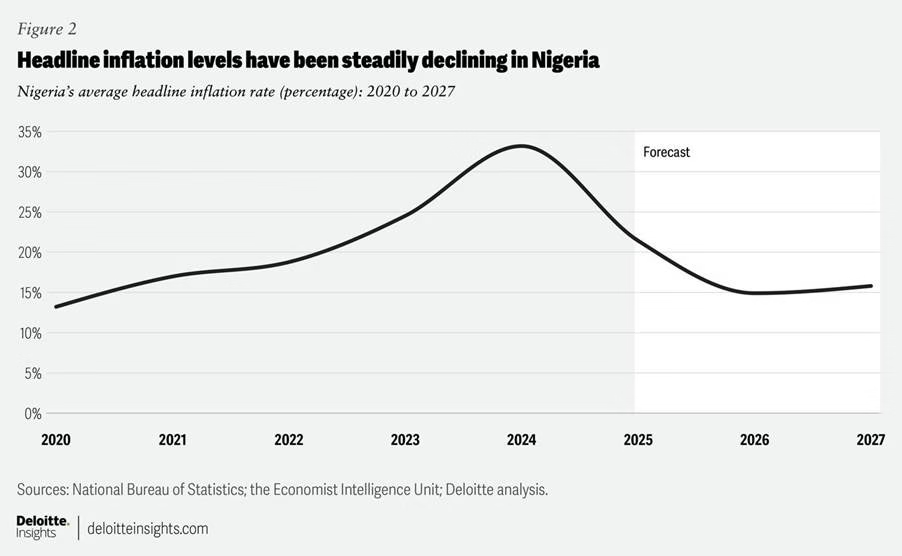
The Tinubu administration continues presenting its reforms, including subsidy removal, exchange-rate liberalisation, and fiscal restructuring — as painful but necessary corrections designed to stabilise the economy after years of structural distortions. International institutions such as the International Monetary Fund (IMF) and the World Bank have praised parts of the reforms for improving fiscal transparency and investor confidence. Recent sovereign rating upgrades by S&P Global Ratings have also been cited by government supporters as evidence that economic stabilisation is gradually taking hold.
However, many economists argue that stabilisation alone cannot define economic success if debt obligations continue consuming most public revenue while poverty and hardship remain widespread. Reuters recently reported that Nigeria still faces heavy fiscal deficits and major debt-servicing pressures despite improvements in some macroeconomic indicators. This reflects a broader contradiction within the current reform narrative. While officials highlight exchange-rate stability, investor confidence, and moderating inflation, ordinary Nigerians continue experiencing high living costs, weak purchasing power, expensive transportation, and persistent insecurity.
For many observers, this is the core issue behind Nigeria’s growing debt debate. Economic reforms ultimately succeed not because international institutions approve them, but because citizens eventually experience meaningful improvements in living standards, employment opportunities, infrastructure quality, and social welfare. Until those gains become visible to ordinary Nigerians, concerns that debt servicing is gradually overtaking national development priorities are unlikely to disappear.
Editor’s Note: Featured photo is courtesy of withinnigeria.com.