







President Bola Ahmed Tinubu has marked the third anniversary of his administration, with the claim that the removal of fuel subsidy was a necessary decision that saved Nigeria from bankruptcy, placing the economy on a path of recovery. Speaking during a meeting with state governors at the Presidential Villa, Tinubu stated that the reforms prevented fiscal collapse, strengthened government finances, and created the conditions for future growth.
There is little doubt that the fuel subsidy regime was expensive, inefficient, and vulnerable to abuse. Yet the central question remains whether removing it has translated into measurable improvements in the lives of ordinary Nigerians. Three years after the reforms began, the evidence suggests a more complicated reality than the government’s success narrative implies.
Fiscal Gains Have Not Solved Nigeria’s Financial Vulnerabilities
The strongest argument in support of subsidy removal is that it improved government revenues. State governments now receive larger allocations through the Federation Account Allocation Committee (FAAC), allowing many states to clear salary arrears and fund projects that were previously difficult to finance. However, increased revenues have not translated into stronger fiscal stability.
However, the Federal Government continues to face severe debt pressures. According to the Budget Office of the Federation, Nigeria’s debt-service-to-revenue ratio remains elevated, while fiscal space remains constrained. The office warned in its fiscal assessment that debt obligations continue to consume a significant share of government revenue, limiting resources available for infrastructure, healthcare, education, and economic development. By September 2025, Nigeria had spent approximately N12.63 trillion on debt servicing compared to only N3.10 trillion on capital expenditure, according to budget implementation reports from the Office of the Accountant-General and the Budget Office.
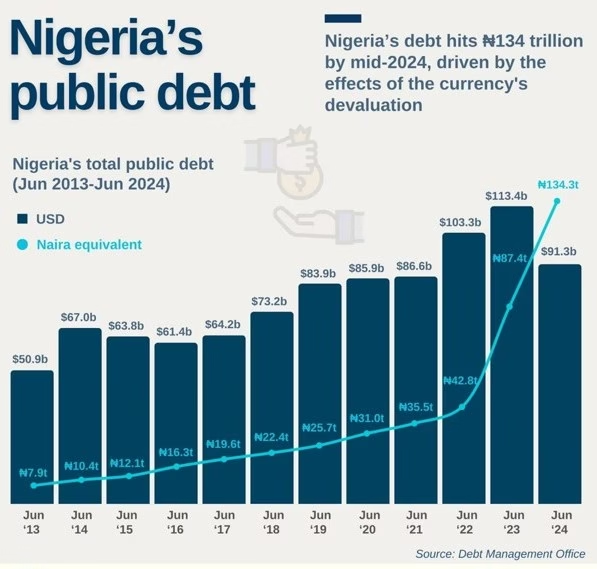
This fiscal reality raises questions about the administration’s repeated claim that the economy has recovered. A government that spends several times more servicing debt than building infrastructure cannot easily claim to have escaped economic danger. The pressure has merely shifted from subsidy payments to debt obligations.
Recent comments by economic analyst Wale Gbadamosi and Budget Nigeria’s Country Director, Victor Muruako, reinforce this concern. Both argued that the issue is not simply how much Nigeria borrows but whether borrowed funds generate productive assets capable of driving future growth. Three years into the reforms, many Nigerians still struggle to identify transformative projects that justify the country’s expanding debt burden.
Economic Stability Has Not Delivered Broad Prosperity
President Tinubu frequently points to exchange-rate reforms, improved investor confidence, and recent credit-rating upgrades from S&P Global Ratings as evidence that the economy is moving in the right direction. International institutions largely agree that many of the reforms were necessary. The International Monetary Fund (IMF) and World Bank have repeatedly praised subsidy removal and exchange-rate liberalisation as important corrections to longstanding distortions. Yet those same institutions continue to warn about worsening poverty and social hardship.
The World Bank recently reported that Nigeria’s poverty rate has climbed to 63 percent despite easing inflation. While inflation has moderated from the extreme levels recorded after subsidy removal and naira devaluation, the cost-of-living crisis remains severe for millions of households. Food prices remain substantially higher than they were before May 2023. Transportation costs continue to absorb a growing share of household income. Small businesses face high energy costs and weak consumer demand.
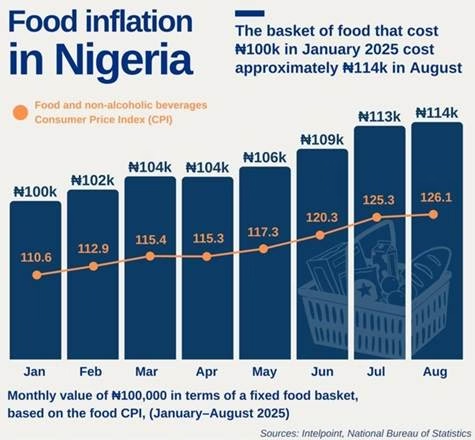
This explains why government optimism often clashes with public sentiment. Credit-rating agencies evaluate economic reforms through indicators such as reserves, exchange-rate stability, and fiscal management. Citizens evaluate economic performance through their ability to buy food, pay rent, afford transportation, and find employment. For many Nigerians, those indicators have not improved significantly.
Necessary Reforms Should Not Be Confused With Economic Transformation
The debate surrounding subsidy removal is often framed as a choice between supporting reforms or opposing them. In reality, the issue is more nuanced. Many economists agree that fuel subsidies were unsustainable. The system drained public finances, encouraged smuggling, and disproportionately benefited wealthier consumers. Removing it may indeed have been unavoidable. But unavoidable reforms are not automatically evidence of successful governance.
The administration increasingly presents the removal of fuel subsidy as proof that Nigeria has been rescued from economic collapse. Such messaging risks oversimplifying a far more complex situation. Economic transformation requires more than balancing government accounts. It requires stronger productivity, higher incomes, reliable electricity, improved security, expanded manufacturing, better infrastructure, and declining poverty. Three years after the reforms began, Nigeria still faces serious challenges in all of these areas.
Even the government’s own fiscal documents acknowledge continuing vulnerabilities, including weak oil revenues, project implementation delays, rising debt obligations, and cash-management bottlenecks. That does not mean the reforms have failed. It means their long-term success remains unproven. For now, the claim that subsidy removal has unquestionably moved Nigeria onto a path of economic recovery remains more of a political argument than a settled economic fact. The reforms may have prevented one set of fiscal problems, but millions of Nigerians are still waiting to see evidence that the sacrifices demanded since 2023 have produced tangible improvements in their daily lives.
Editor’s Note: Featured photo is courtesy of Arise TV.