



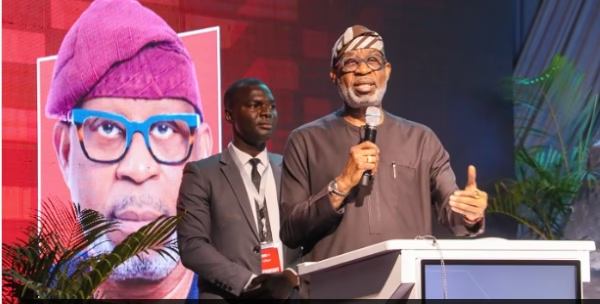
As Nigeria continues to navigate the economic consequences of sweeping reforms introduced since 2023, the Minister of Solid Minerals Development, Dr. Dele Alake, Ministry of Solid Minerals Development (NRS-MSMD), Joint Stakeholder Sensitisation for the North Central zone. Government allies continue to defend the administration’s reforms as necessary measures to restore economic stability and rebuild investor confidence, but rising inflation, declining purchasing power, and persistent hardship have overshadowed any visible benefits of the policies.
The Politics Behind the “Saved Nigeria” Claim
Recent comments by Solid Minerals Minister Dele Alake that President Bola Ahmed Tinubu “saved Nigeria from total economic collapse” reflect a growing political narrative from the administration and its allies. The argument is straightforward: Nigeria inherited a deeply troubled economy in May 2023; subsidy removal and exchange-rate reforms were painful but necessary, and without them, the country would have collapsed financially. Similar claims have also been made by Information Minister Mohammed Idris and Anambra governor Chukwuma Soludo, who described Nigeria as being close to economic breakdown before the reforms.
But while the reforms may have prevented deeper fiscal pressure, the idea that Nigeria was rescued from “total collapse” is difficult to establish objectively. The phrase itself is politically useful because it frames the administration as courageous saviours confronting inherited chaos. It also creates a convenient contrast: any criticism of current hardship can then be dismissed as resistance to necessary reforms. Yet economies do not suddenly become healthy simply because governments adopt painful policies.
Nigeria today still faces rising living costs, fragile consumer spending, high debt-servicing obligations, persistent insecurity, and deepening poverty. Even international institutions supporting the reforms continue to warn about the country’s social crisis. Reuters recently reported that despite macroeconomic improvements, Nigeria still projects major fiscal deficits and heavy debt servicing burdens under the Tinubu administration. That reality complicates the idea of a dramatic “economic rescue.”
International Praise Does Not Mean Ordinary Nigerians Are Better Off
One reason the government continues promoting the “saved Nigeria” narrative is that international financial institutions and rating agencies have responded positively to parts of the reforms. Nigeria recently secured credit rating upgrades from S&P Global Ratings while addressing its long-standing distortions. But those same institutions also acknowledge the severe pain caused by the reforms.
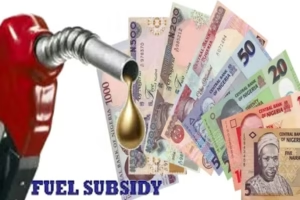
The naira devaluation sharply increased import costs. Fuel subsidy removal triggered inflation across transportation, food, electricity, and household spending. Businesses faced rising operational costs while wages failed to keep pace with inflation. For me, the reforms have not felt like a rescue. They have felt like survival. This disconnect explains why government officials often sound more optimistic than ordinary citizens. International investors evaluate reforms through macroeconomic indicators such as reserves, exchange-rate stability, debt management, and investor confidence. Citizens judge economies through food prices, transportation costs, employment opportunities, electricity supply, and personal security.
That gap is now central to Nigeria’s economic debate. Even discussions online reflect this divide. On Reddit’s Nigeria community, many contributors acknowledge that some reforms were economically necessary while arguing that the shock was poorly managed and insufficiently cushioned. One recurring criticism is that reforms were introduced before adequate social protection systems, stable infrastructure, or industrial support mechanisms were in place. That criticism is difficult to dismiss entirely.
Economic Necessity And Political Branding Are Not the Same Thing
There is little doubt that Nigeria’s old subsidy system was fiscally unsustainable and vulnerable to corruption. Even critics of the Tinubu administration acknowledge that difficult reforms were eventually unavoidable. However, unavoidable reforms are not automatically proof of successful leadership. The current government increasingly presents every painful adjustment as evidence of courage and vision while portraying criticism as ignorance or sabotage. That approach turns a complicated economic transition into political branding. The danger is that political messaging may begin replacing honest economic assessment.
Nigeria still faces enormous structural problems. Poverty remains widespread. Insecurity continues to affect farming communities and economic productivity. Debt servicing still consumes a large portion of government revenue. Power shortages continue to hurt businesses and manufacturing growth. If the economy had truly been “saved,” citizens would likely already be experiencing broad improvements in living standards. Instead, what Nigeria currently has is a partially stabilised macroeconomic environment alongside widespread social hardship.
That is not the same thing as economic transformation. The reforms may eventually produce stronger long-term outcomes. They may improve fiscal discipline, attract investment, and strengthen economic foundations over time. But those possibilities remain future expectations, not present realities. For now, claims that Tinubu “saved Nigeria from total economic collapse” appear less like neutral economic analysis and more like political messaging designed to shape public perception ahead of future political contests.